Rain falls differently in Aberdeenshire.
If you have ever stood near the River Dee in early September, you know the sound. It is not the frantic, drumming rain of London, which clatters against black cabs and glass skyscrapers with a sense of urban urgency. Highland rain is a fine, cold mist that settles into wool coats, turns granite walls the color of wet slate, and muffles the footsteps of anyone foolish enough to walk the heather without proper boots.
For seventy years, Queen Elizabeth II moved through a world built entirely of noise. Brass bands. Camera shutters. The low, anxious hum of prime ministers waiting outside an audience room. The roar of crowds pressed against iron railings from Sydney to Ottawa.
Then, every summer, the noise stopped.
When we talk about Queen Elizabeth II’s final days at Balmoral Castle, we usually reach for the cold geometry of biography. We list dates. We cite acreage. We mention that she died on September 8, 2022, at the age of ninety-six, inside a Scottish baronial fortress bought by Prince Albert in 1852. Those facts are true, and they are entirely insufficient. They explain the setting, not the gravity. To understand why the longest-reigning British monarch chose to spend her final, fragile weeks inside a 53,000-acre estate in the Scottish Highlands, you have to understand what happens when a human being spends nearly a century carrying the symbolic weight of an empire—and finally sets it down.
The Architecture of a Sanctuary
Picture a woman who has never once in her adult life entered a room without everyone inside it standing up.
Think about the psychological cost of that reality. Imagine a hypothetical civil servant—let us call him Arthur—who spent forty years working in Whitehall. On the day Arthur retires, he hands back his security pass, walks out onto Horse Guards Parade, and instantly becomes invisible. Nobody asks him to sign legislation. Nobody analyzes the angle of his hat for hidden political messages. He is free to be frail.
Elizabeth II never had an exit door. Even at ninety-six, visibly diminished by mobility issues and the quiet toll of grieving Prince Philip, she remained the living embodiment of the British state. Buckingham Palace, for all its gilded splendor, is an office building with a balcony. Windsor Castle, perched beside the flight path of Heathrow Airport, is a monument under constant surveillance.
Balmoral was different.
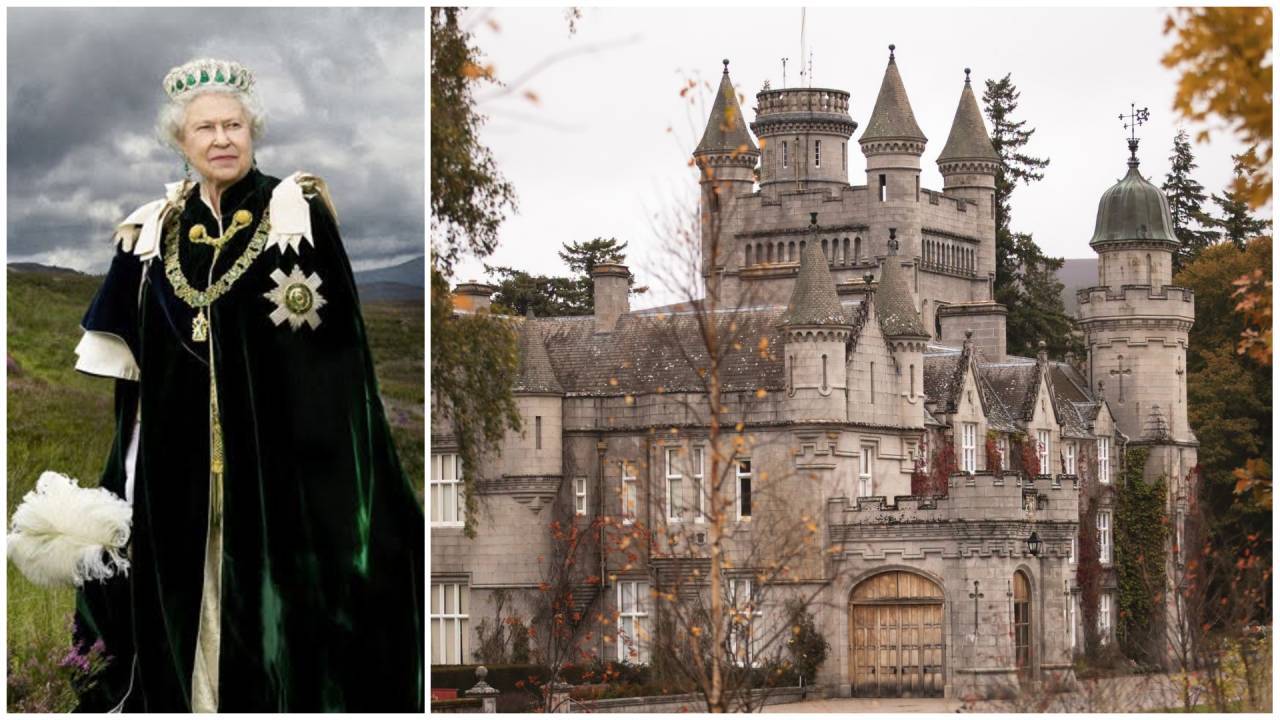
Purchased by Prince Albert for £32,000 in 1852 after Queen Victoria fell in love with the rugged Cairngorms, the estate spans roughly 53,000 acres—an expanse larger than the entire city of Manchester. Yet the castle itself is surprisingly intimate, built from local Invergelder granite in the Scottish Baronial style, bristling with turrets, crow-stepped gables, and conical roofs that look pulled from a nineteenth-century storybook.
Inside, there are no velvet ropes. There are no tour guides reciting dates. Generations of royal observers—and anyone who has ever walked the public paths bordering the estate—know the jarring contrast between the public myth of the Crown and the fiercely domestic reality of Balmoral. Chintz sofas worn soft by decades of corgis. Tartan carpets. Electric bar heaters tucked into draughty corners because even a monarch refuses to waste money heating unused rooms.
Here, the Crown was not an institution. It was a family cottage scaled up to fit fifty-three thousand acres of peat bog, Caledonian pine forest, and grouse moor.
The Weight of the Red Boxes
By July 2022, when the Queen arrived in Scotland for her annual summer break, the physical arithmetic of age had become impossible to hide.
She had missed several events during her Platinum Jubilee celebrations in June. When she appeared on the Buckingham Palace balcony in emerald green, leaning heavily on a walking stick, the crowd cheered with a fierce, protective tenderness. Everyone saw what nobody wanted to say out loud. The anchor was dragging.
Yet even in her Scottish sanctuary, the machinery of duty refused to idle.
Every day, excluding Christmas Day and Easter Sunday, the famous leather-bound "red boxes" arrived from London. Inside were parliamentary briefings, diplomatic telegrams, letters from Commonwealth prime ministers, and bills awaiting Royal Assent. Think of the red boxes like an IV drip of responsibility—a constant, steady flow of global crisis and constitutional obligation delivered straight to her desk, whether she was in London or tucked beside the River Dee.
Why didn't she simply step aside? People ask that question constantly, usually viewing monarchy through the lens of modern corporate succession. In business, a CEO retires when their energy fades. In a hereditary constitutional monarchy, abdication is not a retirement plan; it is an earthquake. Elizabeth II had watched her uncle, King Edward VIII, walk away from the throne in 1936, an act that shattered her father’s quiet life and dragged him onto a throne he never wanted. To her, the oath she swore on her twenty-first birthday—that her whole life, whether it be long or short, would be devoted to service—was not a speechwriter’s flourish. It was an unbreakable contract.
So she stayed at Balmoral, trading the ceremonial pomp of London for a quieter rhythm, doing the paperwork of a nation in a room overlooking the hills she loved most.
September 6 and the Last Audience
History rarely announces its final chapters with trumpets. More often, it arrives on a rainy Tuesday afternoon in a drawing room with floral curtains.
Normally, when a British Prime Minister resigns and a new one takes office, the constitutional choreography happens in London. The outgoing leader travels to Buckingham Palace to tender their resignation; the incoming leader arrives minutes later to be invited to form a government—a ritual formally known as "kissing hands."
In September 2022, the Queen could not make the five-hundred-mile journey south. Doctors had advised against travel. For the first time in her seventy-year reign, the mountain had to come to the Highlands.
On September 6, Boris Johnson flew to Aberdeen and drove through the rain to Balmoral to resign. Less than an hour later, Liz Truss arrived to become the fifteenth Prime Minister of Elizabeth II’s reign—a span stretching all the way back to Winston Churchill in 1952.
Look closely at the photographs taken in the Balmoral drawing room that afternoon.
They are haunting not because of what they conceal, but because of what they refuse to hide. The Queen is standing beside a stone fireplace, wearing a grey tartan skirt, a cardigan, and her signature three-strand pearl necklace. Her hands are visibly bruised—a common mark of frailty and medical care in the very elderly. She is leaning on a wooden walking stick. Her frame has shrunk inside her clothes.
And yet, look at her face.
There is a bright, unmistakable smile. Her eyes are sharp, engaged, and entirely present. That single frame captures the quiet heroism of her final days. She was visibly exhausted, operating on the very margins of her physical reserves, yet she stood upright to fulfill the constitutional duty she had performed fourteen times before. She did not delegate it to Prince Charles. She did not conduct it over a video screen. She stood on her own two feet, in her own home, and kept the constitutional engine running until forty-eight hours before her heart stopped.
Beyond the Castle Gates
What did those final days actually feel like when the cameras left and the heavy oak doors closed?
We do not have a transcript of her private hours, and anyone claiming to know every whispered conversation behind those granite walls is selling fiction. What we do have are the testimonies of family members, staff, and the documented routines of the estate—pieces that form a clear, quiet picture of a woman stripping away every non-essential layer of existence.
In her younger years, Balmoral meant long rides on Fell ponies across the heather, picnics at Glassalt Shiel—a remote lodge on the shores of Loch Muick built by Queen Victoria—and barbecues where Prince Philip grilled sausages while the Queen washed the dishes in yellow rubber gloves. Guests like former Prime Minister Tony Blair famously remarked on the surreal experience of watching the sovereign clear plates after dinner.
By the late summer of 2022, the long rides and hillside picnics were memories. The world had narrowed to the immediate perimeter of the castle.
Still, the sensory anchors of the Highlands remained. The smell of woodsmoke drifting from the chimneys. The sound of the River Dee rushing over smooth stones at the bottom of the lawn. The presence of her surviving corgis and dorgis—Muick, Sandy, Candy, and Lissy—padding across the carpets, entirely indifferent to constitutional history. Dogs do not care about titles. To them, she was simply the woman who kept treats in her pocket and sat quietly by the fire.
For someone whose every word had been scrutinized by global media since she was a toddler, that kind of unselfconscious companionship is priceless.
The Quiet Gathering
On the morning of September 8, 2022, the atmosphere across Britain shifted almost imperceptibly before any official announcement was made.
At 12:32 PM, Buckingham Palace released a short, carefully worded statement: "Following further evaluation this morning, The Queen’s doctors are concerned for Her Majesty’s health and have recommended she remain under medical supervision. The Queen remains comfortable and at Balmoral."
Anyone who understands the understated vocabulary of royal communications knew immediately what those words meant. The Palace never uses the word "concerned" lightly.
Within hours, the quiet roads leading toward Royal Deeside became arteries of urgent grief. King Charles—then still Prince of Wales—and Princess Anne were already in Scotland and reached her bedside quickly. A Royal Air Force flight carrying Prince William, Prince Andrew, Prince Edward, and Sophie, Countess of Wessex landed at Aberdeen Airport under heavy grey skies, their black Range Rovers speeding west along the A93 toward the castle gates. Prince Harry made his own journey north, arriving later that evening.
Outside the iron gates of Balmoral, a small crowd began to gather in the steady drizzle. They were not the roaring throngs of London. They were locals from Ballater and Braemar, hillwalkers in waterproof jackets, farmers who had spent their lives working the neighbouring glens. They laid bouquets of heather and supermarket lilies against the wet grass beside the gatehouse and stood in silence.
Inside, behind thick granite walls and drawn curtains, the twentieth century was quietly slipping away.
Why Balmoral Matters Now
There is a temptation, when looking back at Queen Elizabeth II’s final days, to treat Balmoral merely as a picturesque backdrop—a postcard setting for the end of an era. That misses the deeper human truth.
We live in an age obsessed with visibility, noise, and public performance. Most of us struggle to disconnect from our phones for a single weekend, terrified of becoming irrelevant the moment we step out of the spotlight. Elizabeth II was the most famous woman on Earth, and she understood something we have largely forgotten: a human soul cannot survive without a place where the performance ends.
Balmoral was not an escape from her duty. It was the fuel that made seventy years of duty possible.
Without those fifty-three thousand acres of wind, heather, and silence—without a space where she could be "Lilibet" instead of "Your Majesty"—the weight of the Crown would have crushed her decades earlier. She earned her peace in the only place on Earth that belonged to her family rather than the state, surrounded by the hills she had walked since she was a child.
At 6:30 PM on September 8, 2022, the Royal Standard flying above Buckingham Palace was lowered to half-mast. Millions of people stared at their television screens in disbelief, struggling to imagine a world without the only monarch most of them had ever known.
Four days later, a plain oak coffin draped in the Royal Standard of Scotland was carried out of Balmoral Castle by six gamekeepers from the estate—men who knew the hills, the weather, and the quiet woman who had walked among them every summer. As the hearse pulled away down the long gravel drive, passing between ancient pines and wet heather toward Edinburgh, the mist rolled down from Lochnagar and swallowed the granite turrets whole.