The final act ended at 8:32 p.m. on a Thursday night in a Utah hospital room. There were no cameras, no judges, and no rolling television crews. A 38-year-old inmate named Nicholas Rossi took a breath, looked at the ceiling, and decided he was finally done fighting. He chose to discontinue his medical treatment. The state bureaucracy recorded the time, noted the complications of his existing illnesses, and filed the paperwork.
To the world, it was the quiet expiration of a convicted rapist who spent years spinning a web of falsehoods across continents. But to anyone who watched his life unfold, it was the closing of one of the most bizarre psychological thrillers in modern legal history. For an alternative view, see: this related article.
Six years earlier, the world was told this man was already dead.
On February 29, 2020, an online obituary announced that Nicholas Alahverdian—one of Rossi’s many identities—had succumbed to late-stage non-Hodgkin lymphoma. The notice described a tragic end to a young life. It was a clean exit. A permanent escape from the investigators closing in on financial fraud charges in Ohio and a failure to register as a sex offender in Rhode Island. For a while, the system accepted the closure. Death is usually the one border authority that cannot be tricked. Related reporting on this trend has been shared by USA Today.
But the real problem lay elsewhere. DNA has a terrifyingly long memory.
The Cold Record
In 2018, Utah authorities launched an aggressive initiative to clear a massive backlog of decades-old, untested rape kits. Inside one of those dusty cardboard boxes sat the genetic signature of an unsolved 2008 attack in Orem, Utah. A young woman had gone to an apartment to collect money stolen from her. Instead, she was assaulted. When the DNA profile was uploaded to national databases, it didn't return the name of a dead man. It pointed directly to Nicholas Rossi.
By the time the warrants were signed and Interpol notices went live, the man they were looking for had vanished into the damp air of the United Kingdom. He changed his names like winter coats. He became Nicholas Brown. He became Arthur Brown. He collected a dozen lives, stepping into them completely, shedding his past like dead skin.
Consider what happens when a person decides to erase themselves entirely. You cannot merely change your name; you must rewrite your posture, your accent, the very cadence of your breath.
In late 2021, a man check-in at the Queen Elizabeth University Hospital in Glasgow, Scotland. He was desperately ill, gasping for air under the crushing weight of severe COVID-19. He told the medical staff his name was Arthur Knight. He spoke with a soft, lilting accent. He claimed to be an eccentric, harmless Irish orphan who had somehow found himself in Scotland.
For weeks, nurses tended to the fragile man in the respiratory ward. They adjusted his oxygen. They spoke softly to him. But Interpol notices carry pictures, and pictures carry details that cannot be masked by an accent.
Underneath the hospital gown, inked onto the skin of his shoulder, was the crest of Brown University. Rossi had never attended the school, but he had tattooed the emblem onto his flesh years prior. The Glasgow medical staff looked at the tattoo. They looked at the international alert. The illusion broke.
The Wheelchair and the Oxygen Mask
What followed was a masterclass in behavioral defiance. Arrested in his hospital bed, Rossi refused to drop the curtain. For nearly two years, as Scottish prosecutors fought to extradite him back to the red dirt of Utah, the man in the center of the storm insisted he was a victim of a monstrous bureaucratic mix-up.
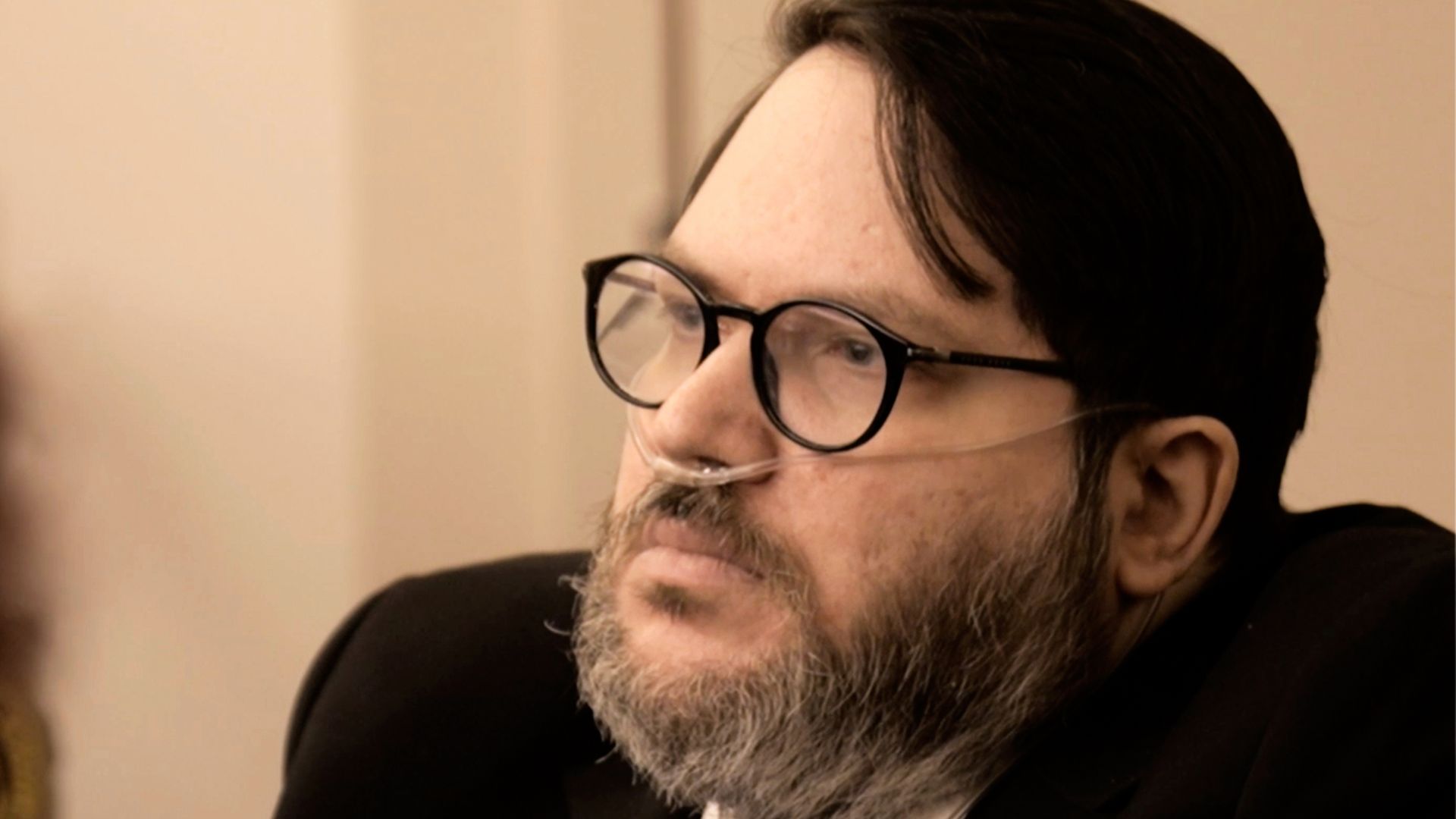
He arrived at the Edinburgh Sheriff Court in a wheelchair, his face buried behind an oxygen mask, his voice a wheezing whisper. He told reporters he was Arthur Knight. He claimed British intelligence and American prosecutors were conspiring against him. When prosecutors pointed out that his fingerprints and DNA matched the fugitive Nicholas Rossi perfectly, he had an explanation ready: while he was in a coma in the Glasgow hospital, mysterious actors had entered his room, stealthily tattooed his shoulder, and altered his biometric data to frame him.
The performance was total. It was desperate. During one hearing, he insisted his illness was so profound that he lacked the physical strength to raise his arms above his head. The judge, dryly unimpressed, noted that the defendant had done exactly that the previous afternoon while gesturing wildly in open court.
In November 2022, a Scottish judge looked past the oxygen tank and ruled that the man in the chair was, without a doubt, Nicholas Rossi. By January 2024, the legal appeals were exhausted. He was put on a plane and flown across the Atlantic, returning to the jurisdiction he had spent a lifetime running from.
The Accounting
The return to Utah brought the narrative back to its original, painful reality. The grand international theater of "Arthur Knight" disappeared, replaced by the testimonies of the women he had harmed.
During his trials in August and September 2025, the court did not hear about secret agents or fabricated identities. They heard from a survivor who, in 2008, was recovering from a traumatic brain injury when she answered a Craigslist ad posted by Rossi. Within weeks, he had charmed his way into her life, pressured her into paying for his lifestyle, forced her into debt for their engagement rings, and ultimately attacked her in his bedroom.
Rossi sat through the trials in his wheelchair, looking smaller than he had in Europe, declining to take the stand to defend himself. The jury took only hours to find him guilty. The sentences came down heavily: two consecutive terms of five years to life.
He was sent to the Utah State Prison, the walls thick and the windows narrow. The vast horizons of his international flights were reduced to concrete walkways. He maintained his innocence to the very end, but the legal reality was absolute. The system had caught up.
There is a specific kind of exhaustion that comes from maintaining an elaborate lie for decades. It consumes the body. It drains the nervous system. When his health began to fail significantly within the prison walls, Rossi was transferred back to a hospital bed—a setting achingly similar to the one in Glasgow where his secret was first unraveled.
This time, there was no escape plan. There were no new aliases left to register. On that final Thursday evening, surrounded by the sterile hum of medical monitors, Nicholas Rossi looked at the life he had constructed out of thin air, saw the heavy iron door of the prison waiting for his recovery, and chose the silence.


