The Ink That Didn’t Save Him
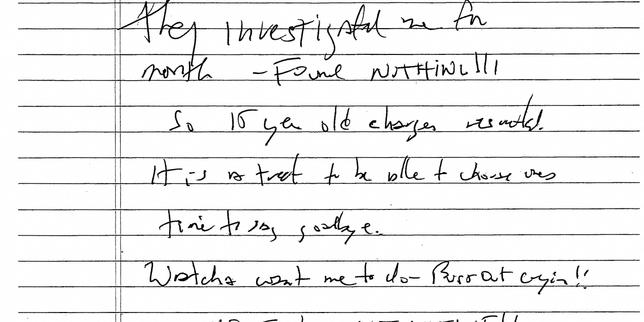
The paper is yellowing now, a cheap scrap of institutional stationery that carries the weight of a thousand secrets. It was found in a place where hope usually goes to die: the Metropolitan Correctional Center in Lower Manhattan. For years, the world has chased the ghost of Jeffrey Epstein, seeking some shred of truth in the vacuum left by his sudden departure from the living. Now, a handwritten note has surfaced, purported to be the final words of a man who held the keys to the most dangerous social circles on the planet.
It isn't a manifesto. It isn't a confession. It is a desperate, scrawled plea from a man who spent his life buying silence, only to find himself swallowed by it.
To understand the note, you have to understand the air in that cell. It was thick with the smell of floor wax and old sweat. Epstein was a man who lived in the sensory overload of private jets and Caribbean breezes. In his final hours, his world had shrunk to a concrete box. The document, recently revealed through ongoing legal inquiries and investigative digging, suggests a mind fraying at the edges. He writes of the conditions. He writes of the "pigs" who ran the floor. He claims he was being treated like an animal.
But there is a glaring hole in the center of his prose. He mentions nothing of the victims. Not a word.
The Architecture of a Shadow
We often look at figures like Epstein as monsters under the bed, but the reality is more unsettling. He was a mirror. He reflected the darkest desires of the powerful and, in doing so, became indispensable. The "suicide note" isn't just a legal artifact; it is a window into the psyche of a broker who realized his currency was finally worthless.
When a man like this dies, the story usually ends. In this case, the story shifted from the crimes themselves to the vacuum of accountability. The note mentions a fear of being "extorted" or "targeted" by other inmates. It paints a picture of a man who believed he was the protagonist of a grand tragedy, rather than the architect of a systemic nightmare.
Consider a hypothetical investigator—let's call him Miller. Miller has spent thirty years looking at crime scenes. He knows that when a high-profile prisoner dies, the paperwork is usually the first thing to go missing or the last thing to be believed. To Miller, this letter isn't proof of suicide. It’s evidence of a state of mind. It shows a man who, even at the precipice of death, was still trying to control the narrative.
The handwriting is erratic. The margins are tight. It feels like someone screaming into a pillow.
The Broken Chain of Custody
The controversy surrounding this letter isn't just about what it says, but why we are only seeing it now. For months, the official story was a closed book: a tragedy of negligence, a failure of cameras, a lapse in guard rotations. Yet, every time a new piece of paper emerges from the depths of the Department of Justice files, that book flies open again.
Why did it take years for a "suicide note" to become public discourse?
The legal system is a machine designed to grind slowly. In the case of the Epstein estate, that machine has been clogged by the sheer volume of interested parties. There are the victims, still seeking a day in court that will never truly come. There are the associates, many of whom are likely relieved that the man in Cell 501 took his secrets to the grave. And then there are the conspiracy theorists, who view every smudge of ink on this note as a coded message from a deep-state cabal.
The truth is often more mundane and more depressing than a conspiracy. It is usually a story of incompetence. The guards were tired. The cameras were old. The system was broken. The note describes a man who felt the walls closing in, but it doesn't answer the question of how a man on suicide watch was allowed to have the tools to end his life.
A Ghost in the High Society
There is a specific kind of chill that comes from reading the words of someone who knew where all the bodies were buried. Epstein’s note doesn't name names. It doesn't list the politicians, the royals, or the tech moguls who frequented his private island. Instead, it focuses on his own discomfort.
This is the ultimate irony of the "Epstein Letter." The world wanted a roadmap to the elite's darkest corners. What they got instead was a complaint about the prison food and the lack of respect shown to a former billionaire. It is a testament to the ego. Even when facing the void, the focus remained on the self.
The note's existence was buried in a mountain of evidence produced during the trial of Ghislaine Maxwell. It was a footnote in a larger saga of grooming and exploitation. But as it circulates through newsrooms and social media feeds today, it serves as a haunting reminder that we are no closer to the full truth than we were the morning the news broke.
Imagine the silence of that hallway. It’s three in the morning. The light is fluorescent and flickering. The only sound is the scratching of a pen on paper. This wasn't a hero's end. It wasn't even a villain's grand finale. It was a lonely man realizing that all the money in the world couldn't buy him another hour of freedom.
The Weight of What Is Unsaid
The most important part of any story is the subtext. When you read the lines of this alleged suicide note, you have to read the spaces between the words. You have to hear the echoes of the girls who were flown across oceans. You have to feel the weight of the years they lost.
The letter is a distraction. It's a shiny object thrown into the middle of a room to keep people from looking at the door that’s still locked. While we debate the authenticity of the handwriting or the intent behind his words, the systems that allowed him to operate for decades remain largely intact. The circles he ran in have simply tightened. The parties have moved to more private venues.
We want the note to be a key. We want it to unlock the mystery and give us the closure that a trial would have provided. But paper is fragile. Ink fades. A letter is just a shadow of a person.
The legal teams continue to argue over the details. The "presumed" nature of the letter keeps it in a state of purgatory—it is real enough to report on, but vague enough to deny. This ambiguity is the hallmark of the entire Epstein case. Nothing is ever quite certain. No one is ever quite finished.
The Cold Reality of the Record
Beyond the emotional turmoil, there are the cold, hard statistics of the penal system. High-profile suicides in federal custody are statistically rare, yet they carry an outsized impact on public trust. When the most watched man in the country dies under the watch of the most powerful government on earth, the ripples are felt for generations.
This note is now part of that permanent record. It will be filed in a folder, digitized in a database, and cited in textbooks on criminal justice and psychology. It will be analyzed by graphologists looking for signs of coercion. It will be scrutinized by historians trying to understand the collapse of an era of decadence.
But for the families of those he harmed, the letter is nothing more than garbage. It doesn't offer an apology. It doesn't offer restitution. It is the final act of a man who spent his life making sure he was the only one who knew the full story.
The ink is dry. The cell is empty. The paper remains, a haunting scrap of evidence that tells us everything about the man’s misery and nothing about his crimes.
The lights in the Metropolitan Correctional Center don't ever truly go out. They just dim, casting long, distorted shadows across the floor where a man once sat, realizing that his world had finally run out of room. He folded the paper. He set it down. He left us with a handful of sentences that explain nothing, leaving the rest of us to wander through the wreckage of the secrets he left behind.