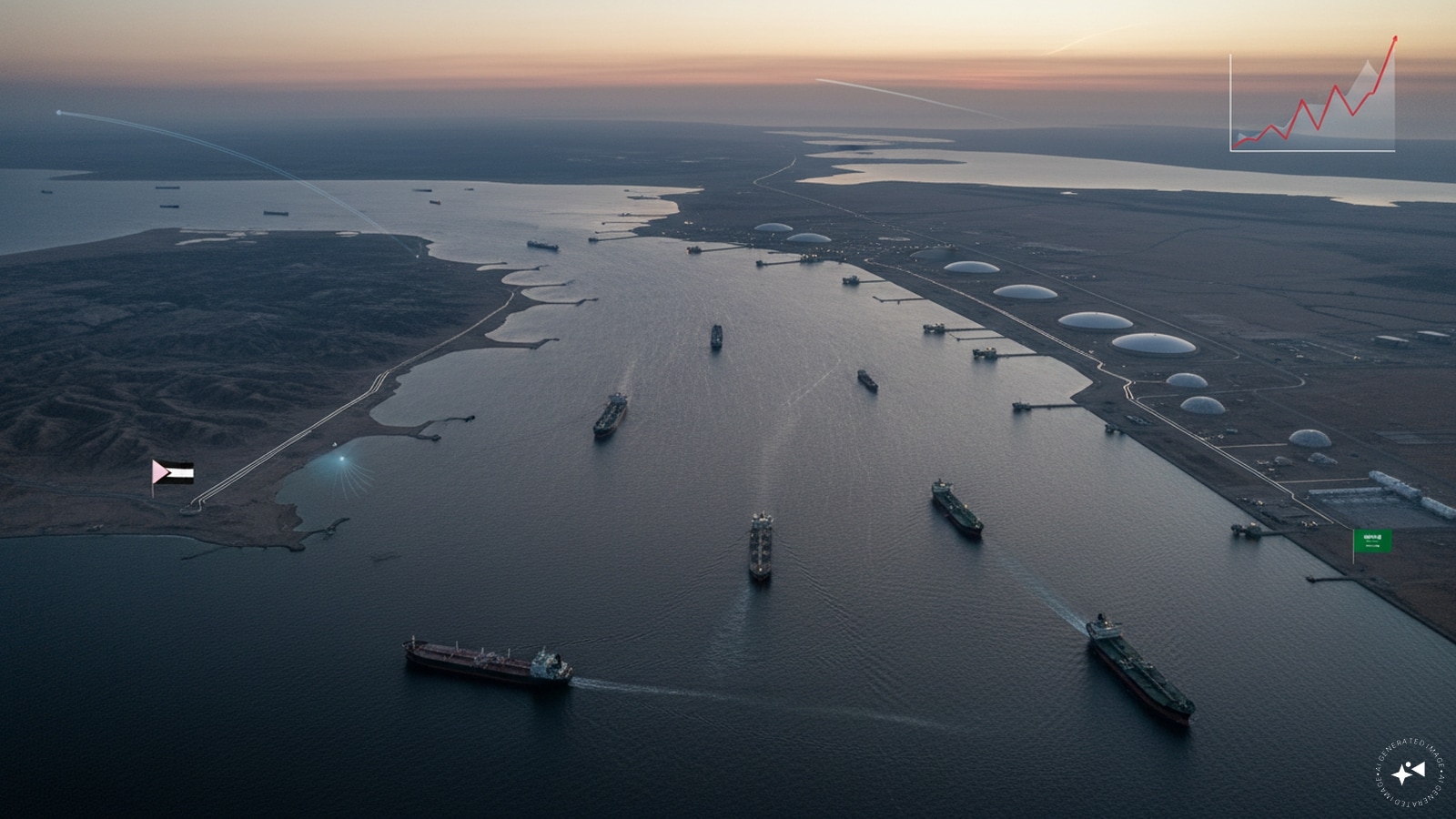
The smoke rising over Saudi infrastructure installations is not merely a localized tactical maneuver. It represents a systemic failure of regional containment strategies and diplomatic channels designed to secure the world's most critical energy corridor. When Houthi forces execute long-range drone and missile strikes against Saudi targets while negotiations over the Strait of Hormuz completely stall, the immediate casualty is not just concrete and steel. It is the fragile architecture of global energy flow.
Decades of military posture assumed that maritime chokepoints could be defended purely through naval dominance and conventional deterrence. That assumption has dissolved. Modern asymmetric warfare has turned high-value economic targets into vulnerable nodes. Every successful strike against petroleum processing plants or coastal storage facilities sends shockwaves through international markets, reminding traders and strategists alike that the physical security of oil transit is fundamentally intertwined with land-based insurgent capabilities. Expanding on this theme, you can find more in: Why Treating Homelessness Like a Weather Emergency is Complete Nonsense.
Diplomatic tracks have historically relied on compartmentalization. Negotiators attempted to separate maritime freedom-of-navigation talks in the Strait of Hormuz from the broader civil conflict within Yemen and the cross-border drone campaigns targeting the Kingdom. This compartmentalization was always an illusion. Insurgent factions operating advanced ballistic and unmanned systems view regional waterways and domestic political leverage as a single continuous theater. When political settlements stall, kinetic pressure increases. The Houthi leadership
Fire Over the Bab el Mandeb The Real Cost of the Houthi Oil Strategy
news, business Analysts at The Washington Post have shared their thoughts on this trend.
The smoke rising over Saudi processing plants is not just the byproduct of local friction. It is the visible manifestation of a structural transformation in modern asymmetric warfare. When regional proxy forces target critical energy infrastructure while diplomatic tracks freeze over the Strait of Hormuz, the global economic architecture shudders. For years, Western security analysts dismissed maritime harassment in the southern Red Sea as localized noise. That luxury of ignorance has expired. The convergence of drone technology, ballistic missile proliferation, and stalled diplomatic frameworks has created a permanent vulnerability at one of the world's primary economic chokepoints.
To understand the current impasse, one must look past the immediate headlines of intercepted projectiles and examine the mechanics of the standoff. The Bab el Mandeb strait handles millions of barrels of oil and refined products daily, moving between the Indian Ocean and the Mediterranean via the Suez Canal. When traffic through this corridor faces persistent kinetic threats, shipping conglomerates do not simply absorb the risk. They reroute around the entire African continent. That detour adds thousands of nautical miles, weeks of transit time, and millions of dollars in fuel and insurance costs per voyage.
The Houthis understand this arithmetic better than their adversaries. Deprived of heavy industrial capacity and facing a crippled domestic economy, they have mastered the economics of disruption. A drone costing a few thousand dollars to assemble forces a defensive response involving missiles costing millions. More importantly, it forces commercial operators to recalculate risk globally. Every strike on a Saudi facility or a passing tanker acts as a multiplier, driving up maritime insurance premiums and forcing energy markets to price in a permanent risk premium.
Diplomacy has failed to blunt this strategy because the underlying incentives do not align with a neat negotiated settlement. Riyadh wants a secure southern border and a graceful exit from a multi-year quagmire that has drained national capital and exposed the limits of modern air defense networks. Tehran, maintaining its strategic depth through the Axis of Resistance, views the southern maritime approaches as a useful pressure valve. Whenever nuclear talks stall or regional tensions spike in the Levant, the temperature rises along the Yemeni littoral. The proxy network functions as a rheostat, turned up or down depending on capital city calculus.
The structural flaw in international containment efforts lies in the mismatch between conventional naval posture and distributed asymmetric threats. Aircraft carriers and guided-missile destroyers are magnificent instruments of statecraft, but they are expensive and ill-suited to policing swarms of low-altitude loitering munitions. Protecting every commercial vessel transiting the Red Sea is a mathematical impossibility for coalition forces. The defense must be successful every single time; the attacker only needs one lucky vector to paralyze a terminal or ignite a supertanker.
Compounding this operational headache is the transformation of the regional energy market. Saudi Arabia has spent decades positioning itself as the ultimate swing producer, capable of ramping up or throttling back output to stabilize global prices. But when processing hubs like Abqaiq or coastal storage facilities face recurring aerial threats, the psychological buffer of spare capacity evaporates. Traders no longer look at total barrels in the ground; they look at vulnerability along the export veins.
Consider the secondary economic shockwaves hitting nations thousands of miles away from the theater of operations. Asian manufacturing hubs relying on Middle Eastern crude and European markets waiting for refined products absorb the delayed costs of every rerouted hull. Inflationary pressures do not always announce themselves with dramatic central bank announcements. Sometimes they begin with a cheap delta-wing aircraft launched from a dry riverbed in Yemen, heading toward a valve station on the Red Sea coast.
The diplomatic track regarding the Strait of Hormuz remains similarly paralyzed because neither side trusts the other's staying power. Oman and other regional mediators have cycled through draft agreements for months, trying to bridge the gap between humanitarian concessions and permanent security guarantees. Yet every round of talks founders on the rocks of enforcement. How do you guarantee a cessation of cross-border drone strikes when the command structure is decentralized and ideological commitment supersedes economic pragmatism? You do not. You manage the symptoms while the core disease metastasizes.
The illusion of containment is perhaps the most dangerous element of the current crisis. Policymakers in Washington and European capitals prefer to categorize these incidents as isolated security friction rather than a fundamental rewiring of maritime trade security. This categorization allows for business-as-usual rhetoric while supply chains quietly fracture. Insurance underwriters do not care about geopolitical spin; they care about loss ratios. As long as those ratios spike, the cost of moving goods across the globe will remain artificially inflated.
We are witnessing the permanent end of the post-Cold War consensus on freedom of navigation. For decades, globalization operated on the quiet assumption that open sea lanes were a natural law of economics, protected by an unquestioned superpower hegemony. That assumption is now an artifact. Regional actors with modest conventional arsenals have demonstrated that they can hold global commerce hostage for fractions of a percent of the cost incurred by the defenders.
As talks drag on and the diplomatic calendar rolls forward without a breakthrough, the tactical reality on the ground hardens. The next phase of this conflict will not be decided by formal treaties signed in air-conditioned European hotels. It will be forged in the telemetry data of incoming missiles, the shifting ledgers of maritime insurance syndicates, and the quiet calculations of ship captains deciding whether the Red Sea is worth the risk.