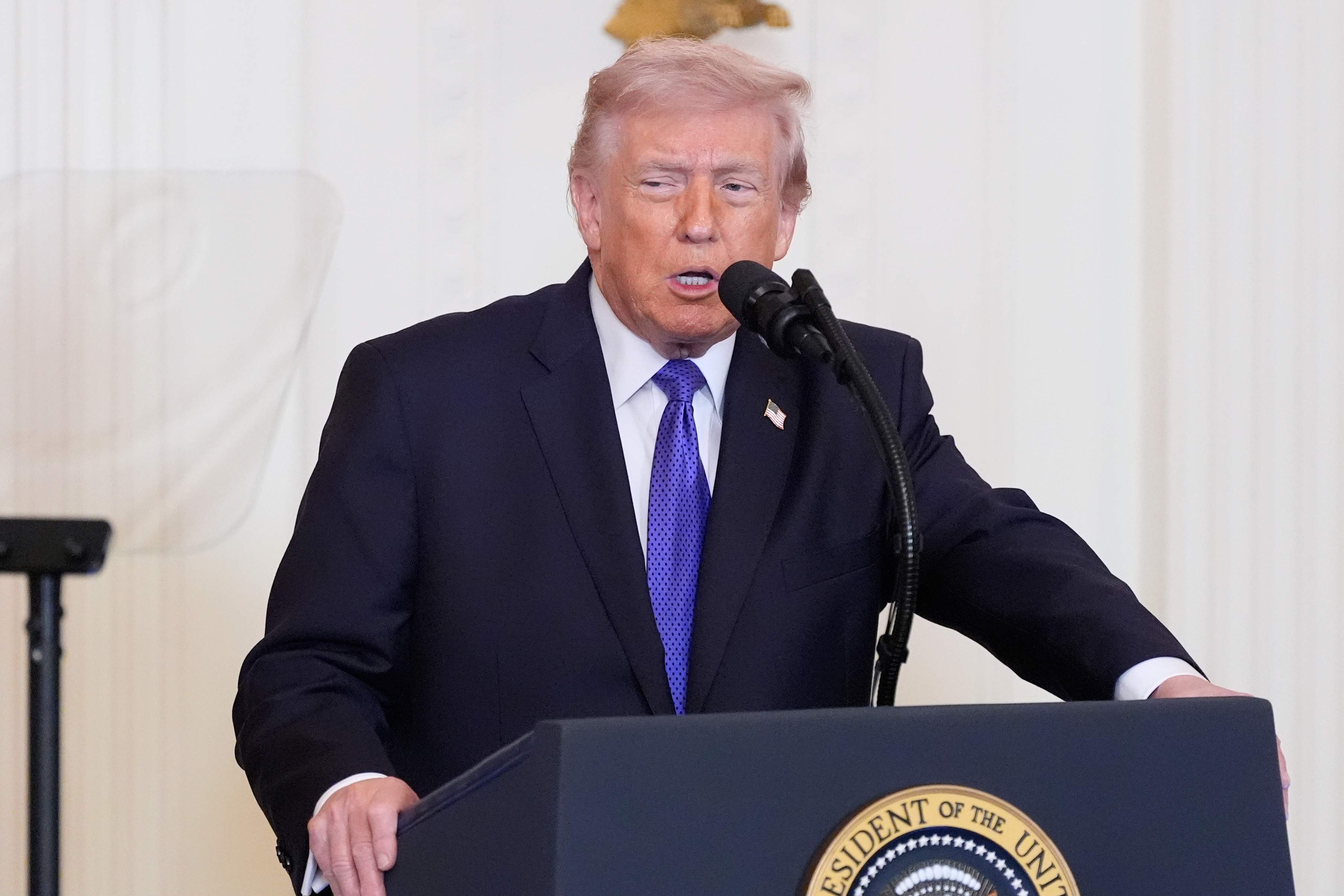
Donald Trump’s recent assertion that a conflict with Iran could be settled in a window of four to five weeks represents a dangerous fundamental misunderstanding of modern asymmetric warfare. While the administration projects a timeline based on overwhelming kinetic superiority, the theater of operations in the Middle East rarely respects the calendar of a Western election cycle or the logistical spreadsheets of the Pentagon. A conflict with Tehran is not a sprint. It is a plunge into a deep, jagged canyon where the initial strike is the only predictable moment of the entire endeavor.
The math behind the "five-week" theory relies on the total destruction of Iran’s command and control centers, its nuclear infrastructure, and its conventional naval assets in the Persian Gulf. In a vacuum, the United States possesses the air power to achieve these specific tactical goals within 30 days. However, this perspective ignores the reality of Iranian "Forward Defense" strategy. Iran has spent four decades preparing for exactly this scenario, building a decentralized mosaic of proxies and hidden missile silos designed to function long after the central government in Tehran is silenced.
The Myth of Surgical Precision
Planners often talk about "taking out" targets as if they were removing pieces from a chessboard. In reality, every strike on an Iranian facility triggers a pre-programmed response from the "Axis of Resistance." This network, stretching from the borders of Israel to the Bab el-Mandeb strait, does not require a direct dial to Tehran to begin its work.
If the U.S. initiates a massive campaign, the five-week clock begins. But by week two, the global economy would likely face a massive shock as the Strait of Hormuz becomes a graveyard for tankers. Iran doesn't need to defeat the U.S. Navy; they only need to make the cost of insurance for a commercial vessel so high that global trade halts. This is the "How" of Iranian strategy—using geography as a weapon of mass disruption.
Cyber Warfare and the Invisible Front
While the physical war might involve F-35s and Tomahawk missiles, the most enduring part of the conflict will take place on digital infrastructure. This is where the "far longer" caveat in Trump’s statement becomes the dominant reality. Iran’s cyber capabilities have matured significantly since the Stuxnet era. They have transitioned from basic denial-of-service attacks to sophisticated intrusions into industrial control systems.
A kinetic strike on Natanz or Fordow will almost certainly be met with a digital retaliation against the American power grid or financial sectors. This isn't a theory. We have seen the dry runs in the form of attacks on small-town water utilities and regional banks. When the physical bombing stops, the digital siege continues for years. This persistent state of low-boil conflict is why "winning" in the traditional sense is an obsolete concept in this theater.
The Proxy Trap and the Ghost of Baghdad
The biggest oversight in the short-war narrative is the role of the Islamic Revolutionary Guard Corps (IRGC) Quds Force. Their specialty is unconventional warfare. They don't fight tank battles; they manage insurgencies.
- Hezbollah: Possesses over 150,000 rockets and missiles aimed at the Levant.
- The Houthis: Capable of shutting down the Red Sea with low-cost "suicide" drones.
- Iraqi Militias: Positioned to strike U.S. bases with short-range mortars and EFP (Explosively Formed Penetrators).
If the U.S. destroys the Iranian Air Force in week one, these groups do not simply surrender. They escalate. The conflict shifts from a state-versus-state war to a regional wildfire that requires thousands of American boots on the ground to contain. We have seen this film before. The "Mission Accomplished" moment in Iraq was followed by eight years of grinding attrition.
Economic Suicide via the Energy Market
The world consumes roughly 100 million barrels of oil per day. About 20% of that flows through the Strait of Hormuz. Any conflict that lasts more than a few days—let alone five weeks—risks a permanent spike in energy costs that would trigger a global recession.
The administration’s hope is that Saudi Arabia and the UAE can ramp up production to offset the loss of Iranian oil and the disruption of Gulf shipping. This is a gamble. Iranian "Karrar" drones and "Fateh" missiles are specifically designed to target the desalination plants and oil refineries of the Gulf monarchies. If the Abqaiq-Khurais attack of 2019 taught us anything, it’s that even sophisticated Western air defenses can be saturated by cheap, coordinated drone swarms.
The Intelligence Gap
To execute a four-week victory, you need perfect intelligence. You need to know where every mobile launcher is hidden, where every centrifuge is spinning, and where every senior commander is sleeping. The reality is that our intelligence on the ground in Iran is far from perfect.
We are operating on assumptions. When those assumptions meet the friction of war, timelines expand. A "surgical" strike that misses its mark or causes significant collateral damage turns a limited military objective into a nationalistic rallying cry for the Iranian public, even those who currently despise the clerical regime.
Logistics of a Long War
War is a hungry beast. It eats munitions, fuel, and political capital. To sustain a high-intensity conflict beyond the initial wave of cruise missiles, the U.S. would need to activate a massive logistical tail.
$$C_{war} = \sum (L_{ops} + E_{muni} + P_{recon})$$
The cost of operations $L_{ops}$ increases exponentially as the conflict spreads to multiple fronts. The inventory of precision-guided munitions $E_{muni}$ is not infinite. In a five-week window, we might exhaust our stocks of specific long-range penetrators, forcing us to use less precise methods that increase the risk of a protracted quagmire.
The Diplomatic Dead End
Finally, there is the issue of the "Day After." If the U.S. successfully degrades Iran's military in five weeks, what is the governance plan? History shows that vacuum-filling is a messy, violent process. Without a viable diplomatic track or a credible alternative to the current power structure, a "victory" merely creates a more chaotic, more radicalized version of the problem we started with.
The rhetoric of a quick war is a political tool, used to project strength and deter aggression. But in the corridors of the Pentagon, where the "What If" scenarios are played out on digital maps, no one believes in a five-week solution. They know that once the first missile is fired, the timeline belongs to the chaos of the battlefield, not the rhetoric of the podium.
The real question isn't whether the U.S. can hit Iran hard for five weeks. It's whether the U.S. is prepared for the fifty weeks—or fifty months—of consequences that follow.
Stop looking at the calendar and start looking at the map. Would you like me to analyze the specific missile defense vulnerabilities of the Gulf states?