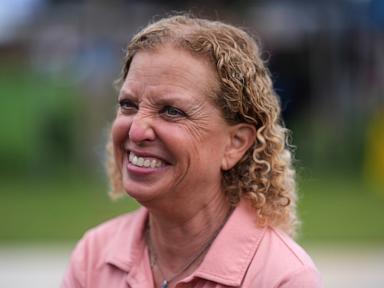
When Republican mapmakers in Florida tore apart the congressional boundaries of Broward County to maximize conservative gains, they initiated a chain reaction. Longtime Democratic Representative Debbie Wasserman Schultz found herself staring down a politically hostile new map that threatened her decades-long tenure. Rather than retreating into a newly configured, predominantly white district that leaned heavily toward Donald Trump, she crossed traditional boundaries. She dropped straight into Florida's 20th Congressional District, a historically Black-plurality seat that has sent Black Democrats to Washington since 1992.
That single strategic maneuver triggered a fierce, uncomfortable collision between institutional seniority and racial representation. It forces an open examination of what political representation actually means when gerrymandering dismantles minority-access seats. The ensuing primary fight is not just a localized turf war in South Florida. It is a preview of the structural fractures facing the Democratic Party nationwide as the federal courts and state legislatures reshape the map of American power.
The Mechanics of Displacement
Gerrymandering is rarely subtle, but the post-census map alterations in Florida executed by Governor Ron DeSantis and the GOP legislature functioned with surgical precision. By packing and cracking traditional Democratic voting blocks, the process squeezed the total number of safe, predictable seats and pitted incumbent against incumbent or forced scramble tactics.
Wasserman Schultz, a former national party chair with deep institutional clout and a seat on the powerful Appropriations Committee, faced an existential choice. Her original base was split and pushed into territory where a white Republican advantage loomed. Staying meant fighting an uphill battle in a conservative-leaning zone. Moving southward into District 20 meant challenging a field of prominent Black candidates for a seat that has served as a cornerstone of Black political empowerment in Broward County for over three decades.
The friction was immediate. Critics argued that an established white politician stepping into a majority-minority seat subverts the hard-fought gains of minority communities. State and national figures voiced sharp reservations. The Congressional Black Caucus raised alarms about the erosion of Black representation in the wake of federal rollbacks to the Voting Rights Act. House Democratic leadership offered cold distance rather than an endorsement, illustrating the delicate tightrope national party leaders must walk when internal factionalism threatens their core constituencies.
Seniority Versus Shared Experience
At the heart of the debate lies a fundamental philosophical split over the nature of a representative democracy.
On one side stand local leaders and community advocates who argue that lived experience is non-negotiable. Broward NAACP President Marsha Ellison articulated a view held by many in the district, noting that representation must stem from an intrinsic, shared understanding of systemic hurdles and community history. To these critics, legislative tenure cannot substitute for cultural and historical alignment, especially in a district encompassing a massive Caribbean-American population, including a vibrant Haitian community.
On the other side stands the argument of raw institutional power. Wasserman Schultz defends her candidacy by pointing to her three decades of public service representing overlapping swaths of Broward County, her deep familiarity with local infrastructure, and her high-ranking position within federal budget negotiations. Her camp argues that in a polarized political climate where conservative state houses actively target minority voting power, the region cannot afford a legislative novice. They frame seniority not as a perk of incumbency, but as a protective shield and a delivery mechanism for federal resources that directly benefit working-class neighborhoods.
This tension exposes a harsh reality of modern electoral politics. Ideological survival often forces politicians to prioritize institutional survival over coalition sensitivities. When external actors redraw the rules of engagement, internal solidarity fractures.
The Broader Fallout
The primary in Florida's 20th District serves as a clinical study of what happens when systemic map manipulation collides with demographic realities. It lays bare the vulnerability of minority-access districts in states where judicial protections have weakened. As federal oversight of redistricting recedes, marginalized voters find themselves caught in a double bind. They must fight off partisan gerrymandering from the right while navigating the defensive maneuvers of entrenched white incumbents from within their own party on the left.
For voters on the ground in Broward County, the choice is wrenching. It pits loyalty to historic milestones of representation against pragmatism in an era of razor-thin congressional margins. The outcome will reverberate far beyond South Florida, signaling whether institutional muscle can successfully override traditional identity boundaries in an evolving political landscape.
There are no clean villains or simple heroes in this dynamic. There is only a brutal contest for leverage inside a broken system, where every player is forced to decide how much historical precedent they are willing to sacrifice just to keep a seat at the table.
See the discussion on the local implications of this high-stakes congressional race in Facing South Florida coverage of District 20 controversy.
http://googleusercontent.com/youtube_content/1