The salt on the kitchen window does not care about geopolitics. It cakes thick and gray, born of a slate-gray North Atlantic that churns relentlessly against cliffs of black basalt. Here, four thousand miles from the cafes of Paris and mere leagues from the jagged coast of Newfoundland, life is measured by the wind's temper and the endurance of cod nets.
For the people of Saint-Pierre-et-Miquelon, the world usually arrives in muffled whispers. A container ship from Halifax. A weather report crackling through static. But recently, a different kind of noise broke over the archipelago—the sharp, transactional echoes of superpower ambition. Donald Trump, eyeing the map with the casual possessiveness of a real estate mogul scanning an unbuilt parcel, let loose rhetorical suggestions that borders, even distant island ones, might be up for negotiation.
To a boardroom in Manhattan, a speck of land on a maritime map is an asset, a negotiation chip, a strategic footnote. To the roughly six thousand souls who live where the fog swallows the morning, it is home.
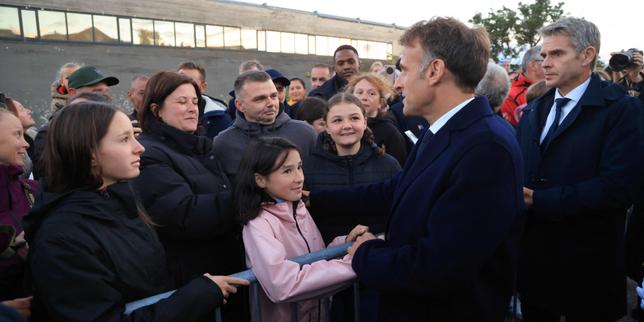
And so, Emmanuel Macron arrived.
Not merely as a head of state ticking a box on a diplomatic itinerary, but as an anchor dropped in a churning sea. Stepping onto the tarmac against a backdrop of low-hanging clouds, the French president did not offer bureaucratic hedging or polite diplomatic phrasing. He struck the stones of the harbor wall with verbal steel. Saint-Pierre-et-Miquelon is French. Undeniably, fiercely, unconditionally French.
Consider what happens when a map becomes a battleground of intent.
Imagine Jean-Luc, standing on the deck of his trawler, fingers gnarled and stained with the honest grime of a life spent pulling wealth from freezing depths. Jean-Luc does not wake up thinking about trade deficits or presidential posturing. He wakes up at four in the morning to the creak of timber and the smell of diesel. When he hears that a former American president—a man whose world of gleaming towers and television studios feels as distant as the moon—is casually eyeing his ancestral sanctuary like an unclaimed lot, a cold knot forms in his stomach. It is a strange violation. It is the realization that to the powerful, your identity is just a variable in an equation you never asked to solve.
History is heavy on these rocks. This archipelago is the last surviving fragment of New France, the lonely remnant of a vast empire that once stretched from the mouth of the St. Lawrence down to the Gulf of Mexico. Every other acre was traded, lost, or signed away in treaties centuries ago. Saint-Pierre and Miquelon remained, clinging to the edge of the continental shelf like a barnacle on a ship’s hull. The people here speak French with a cadence shaped by generations of Basque and Breton sailors who crossed an ocean because they preferred the hardship of the sea to the tyranny of the old world.
When a leader like Trump speaks in terms of expansionism, he views territory through the lens of nineteenth-century cartography. Land is something to be acquired, traded, or dominated. But in the twenty-first century, sovereignty is not merely a colored polygon on a classroom globe. It is a human covenant. It is the baker kneading sourdough at dawn, the schoolteacher explaining the French constitution to children whose playground overlooks the freezing spray, the local doctor who knows every family history for three generations back.
Macron understood the stakes of the silence if he chose to remain quiet. Silence, in diplomacy, is often mistaken for consent. By marching onto the wind-scoured docks and repeating what should have been obvious, he performed an act of psychological reassurance. He told Jean-Luc, and everyone else whose ancestors bled and sweated into this cold soil, that they are not floating orphans of the Atlantic.
Yet, the friction points to a deeper, more unsettling truth about our era. We are sliding backward into an age where old rules feel brittle. When borders are treated as negotiable suggestions by powerful men looking for leverage, small communities feel the tremor first. They do not have armies or massive treasuries. They have only the legitimacy of law, the weight of history, and the stubbornness of their own presence.
Listen to the wind howl through the alleyways of Saint-Pierre on a Tuesday night. The streetlamps cast long, amber shimmers on wet pavement. Inside the local boulangerie, the warmth of ovens battles the coastal chill. The patrons discuss the visit with a mixture of pragmatic skepticism and quiet pride. They have seen presidents come and go. They have survived embargoes, fishing bans, economic shifts, and the indifferent fury of nor'easters. They know that politicians make speeches, but the tide keeps coming in.
Still, words matter. In a world where global superpowers increasingly view international law as an inconvenience, a clear line drawn in the salt air is a vital shield.
Macron’s declaration was not just a message directed across the border to Washington. It was an existential embrace. It told the world that no matter how small an exclave may be, no matter how isolated by geography or vulnerable to the whims of larger nations, the core compact of a republic cannot be carved away like a slice of pie.
The danger of expansionist rhetoric is not that an army will suddenly land on these rocky shores tomorrow. The danger is insidious. It normalizes the erasure of smaller identities. It breeds a slow-burning anxiety in places that already feel the fragility of their isolation. When a superpower casually flirts with the idea of redrawing the map of the hemisphere, it sends a chill through every community that lacks the muscle to defend its own boundaries single-handedly.
This is why the reaction had to be swift and absolute.
As evening settles over the harbor, the lights of the boats bob in the black water. The silhouette of the war memorial stands resolute against the fading light, bearing the names of sons who gave their lives for a country thousands of miles away—a country they loved not because it was convenient, but because it was who they were.
The empires of the past have risen and shattered against these rocks. Monarchies fell, republics transformed, and the Atlantic swallowed its share of dreamers and conquerors alike. Through it all, the tricolor has snapped in the salt wind above Saint-Pierre and Miquelon.
The maps may shift in the minds of men who measure greatness in square miles and transactional victories. But out here, where the horizon is an endless slate of grey and white, reality is anchored in something deeper than a real estate pitch. It is anchored in the defiant pulse of a community that refuses to be rendered invisible.
The fog rolls back in, thick and heavy, wrapping the island in a protective shroud. For tonight, the noise from the south fades into the sound of the surf. The rocks are wet. The air is cold. And the island remains, exactly where it has always been.