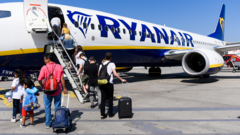
The internet is currently throwing a collective tantrum over budget airlines charging parents extra to sit next to their children. Regulatory bodies are launching high-profile investigations, consumer rights groups are screaming foul play, and the public is nodding along in outraged agreement.
The standard narrative is simple: greedy airlines are holding children hostage to extort cash from terrified parents.
It is a beautiful, emotionally charged story. It is also completely wrong.
The outrage machine is fundamentally misinterpreting how aviation economics, behavioral psychology, and safety regulations actually work. The target of this misplaced anger is Ryanair, an airline that has turned turning a profit into a science. But forcing ultra-low-cost carriers to give away allocated seating for free will not solve a single problem. It will just make flying more expensive for everyone, including the families the regulators claim they want to protect.
The Myth of the Entitled Passenger
Let us strip away the emotion and look at the underlying mechanics of an airline seat.
When you buy a ticket on an ultra-low-cost carrier, you are not buying an experience. You are buying transportation from Point A to Point B. That is it. Everything else—a carry-on bag, a cup of water, a sandwich, and yes, the specific coordinate of your seat—is an optional add-on.
This unbundled pricing model is the single reason why millions of people who could never afford to fly twenty years ago can now crisscross continents for the price of a pair of shoes.
The lazy consensus states that sitting next to your child is a basic human right that should be included in the base fare. But air travel is a game of weight, space, and logistical efficiency. If an airline cannot monetize specific seats, they have to recover that lost revenue elsewhere.
Imagine a scenario where a regulatory body passes a law stating that any adult traveling with a minor must be assigned an adjacent seat for free. What happens next? The airline does not just absorb that cost out of the goodness of its heart. It distributes that financial deficit across the base fare of every single ticket.
The single traveler, the business commuter, and the backpacker are now subsidizing the family vacation. More ironically, the low-income family that meticulously plans their budget is now paying a higher base fare just to ensure an affluent family, which simply forgot to pre-book, gets to sit together for free.
The Mathematical Impossibility of Free Randomized Harmony
People love to argue that the algorithms used by low-cost airlines are intentionally malicious, designed to separate groups to force them into paying the seat-selection fee.
Let us look at the mathematics of a standard Boeing 737-800, the workhorse of the Ryanair fleet. It has 189 seats, arranged in a tight three-by-three configuration.
When hundreds of passengers check in over a rolling 24-hour window, the algorithm has to balance the aircraft's weight and trim while maximizing the number of available seats left for purchase. If a massive chunk of passengers refuse to pay for seat selection and simply click "random allocation," the remaining space becomes a fragmented jigsaw puzzle.
It is mathematically impossible to guarantee that every unallocated group sits together without completely overriding the system. If the airline gives preference to unallocated families, they have to bump passengers who actually paid money to select their specific seats.
I have watched logistics operations crumble under the weight of artificial constraints. When you force a digital optimization engine to prioritize non-paying customers over paying ones, the entire commercial model breaks. You create a system where compliance replaces efficiency, and when efficiency drops, prices skyrocket.
The Safety Hypocrisy
The loudest argument for forced family seating is safety. Critics claim that during an emergency evacuation, children will be separated from their parents, causing chaos in the cabin.
This sounds logical until you read the actual guidance from aviation authorities.
The UK Civil Aviation Authority and the European Union Aviation Safety Agency have clear guidelines on the allocation of seats. They state that children should be seated in the same row as their accompanying adults, or at least separated by no more than one seat row.
Airlines already comply with this for very young children through algorithmic locks or gate-agent interventions. But here is the nuance the outrage mob ignores: if safety is truly the primary driver of this complaint, why are parents refusing to pay the nominal five-euro fee to guarantee that safety?
If a parent truly believes that being separated from their ten-year-old by three rows puts that child in mortal peril, yet they refuse to skip a single airport coffee to pay for a seat assignment, they are valuing cash over their own definition of safety. You cannot claim an issue is an absolute emergency while treating the solution as an optional luxury.
The Behavioral Hazard of Rewarding Bad Planning
If regulators mandate free adjacent seating for families, they create a massive moral hazard.
Right now, organized travelers log on, check in early, pay their small fees, and secure their seats. They keep the system orderly.
If you make family seating free at the point of consumption, you reward bad behavior. Parents will intentionally buy the absolute cheapest unallocated tickets, knowing that the airline is legally obligated to reshuffle the cabin to accommodate them.
The gate agents and cabin crew—who are already under immense pressure to hit 25-minute turnaround times—will become unpaid babysitters and negotiators. They will have to spend precious boarding minutes begging paying passengers to move to worse seats so that a family that failed to plan can sit together.
This introduces friction. Friction introduces delays. Delays cost money. In aviation, a plane only makes money when it is in the air. A five-minute delay at the gate reverberates through an airline's entire network, causing missed slots and cancellations later in the day.
The Hypocrisy of the Consumer Rights Crusade
Consumer champions love an easy target. Attacking Michael O'Leary or any other airline executive is guaranteed to get clicks. It positions the advocate as a defender of the vulnerable.
But where does this logic stop?
Should hotels be forced to provide connecting rooms for free if a family books two separate cheap rooms? Should train companies halt departures until every group finds a cluster of four seats together? Should theaters reshuffle their audience because a ticket buyer bought three random single seats in the balcony?
No. Because in every other industry, we accept the basic premise that you get what you pay for.
If you want premium positioning, you pay a premium. If you want the bare minimum price, you accept the bare minimum service. Forcing an airline to subsidize a specific demographic’s lack of preparation is not consumer advocacy; it is market distortion.
The Actual Solution Nobody Wants to Hear
If you want to ensure your family sits together, the solution is incredibly simple, entirely within your control, and costs less than a fast-food meal.
Pay the fee.
Stop expecting the regulatory framework of international aviation to bend to your refusal to open your wallet. The unbundled model is the fairest system we have. It charges people exactly for what they use. If you use more space, more attention, or more specific coordinates on the aircraft, you pay for it.
If regulators get their way and ban these seating fees for families, the era of the ultra-cheap flight is over. The base fare will rise for everyone. The very people celebrating this regulatory overreach will be the first ones complaining when their weekend flight to Europe suddenly costs double.
You cannot have thirty-dollar flights and first-class entitlement. Pick one.