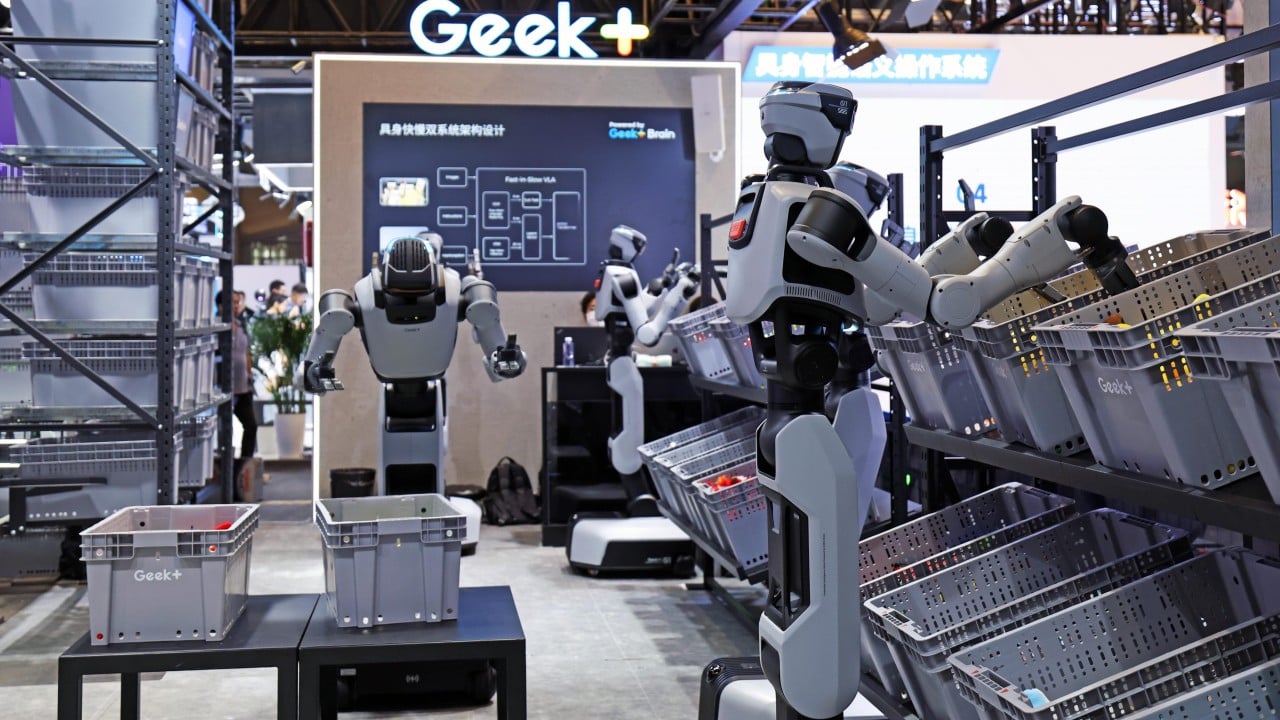
Washington just fired another broadside in the ongoing tech cold war, slamming the door on imported humanoid and quadruped machines through sweeping federal restrictions. The lazy consensus making the rounds across financial media suggests this trade barrier will hobble Chinese automation start-ups, starving them of American capital and giving domestic manufacturers a fighting chance to catch up.
That analysis is completely backwards.
The policy wonks celebrating these import curbs are fighting yesterday's geopolitical war. They assume hardware manufacturing works the way steel mills or cargo ships worked thirty years ago. By treating advanced mechatronics as simple widgets that can be blocked at the border, policymakers are handing foreign competitors an unexpected gift: total freedom from Western compliance burdens, forcing them to refine their supply chains, dominate the Global South, and render US industrial automation utterly non-competitive before the decade is out.
The Hardware Trap Nobody Wants to Talk About
Look past the political headlines and examine the unit economics. Companies like Unitree and other dominant hardware players were already scaling production at volumes that western firms can only envy. When a regulatory body blocks a market, it does not destroy demand; it merely redirects cash flow.
I have watched enterprise buyers blow millions on custom domestic hardware strategies that rely on protected supply chains, only to find themselves tethered to fragile, overpriced prototypes. Protectionism creates a cozy incubator for lazy incumbents. While domestic outfits celebrate a government-mandated moat, their overseas rivals are stress-testing their platforms across massive markets from Southeast Asia to Latin America and the Middle East.
Imagine a scenario where an engineering firm in Shenzhen loses access to buyers in Ohio, but immediately redirects those exact production lines to satisfy a massive, uninhibited rollout across industrial automation plants in fifty other countries. The manufacturing volume stays high. The unit costs drop through continuous iteration. The real-world training data flows uninterrupted.
Software Eats the Border
The entire premise of the ban rests on an outdated fallacy: that controlling the physical shell controls the intelligence.
Modern robotics is not about the motors, the titanium alloy limbs, or the carbon-fiber joints. Those are commoditized hardware components. The value rests entirely in the neural architecture, the spatial reasoning models, and the edge-computing inference loops running on those platforms.
By blocking physical imports, regulators assume they are stopping foreign eyes and ears from entering critical infrastructure. But data does not need a passport. Open-source architectures, weight-sharing repositories, and cross-border software development pipelines bypass customs checkpoints entirely. If a foreign lab trains a bipedal locomotion model on millions of hours of operational footage, that brain can be downloaded, adapted, and deployed onto any compliant domestic hardware chassis anywhere in the world within hours.
You can impound a shipping container at the Port of Los Angeles. You cannot quarantine an idea.
The Domestic Illusion
Proponents of the ban argue that shutting out external competition will force a renaissance in local manufacturing. This is magical thinking. Building an advanced robotics ecosystem requires a dense, interdependent matrix of specialized component suppliers, rare earth processing capability, precision actuator engineering, and cheap local power.
The United States has spent decades hollowing out its light industrial base. You cannot legislate a localized supply chain into existence with a stroke of a pen when the foundational metallurgy and micro-actuator manufacturing ecosystems have long since migrated overseas. When you ban foreign-built automation hardware without having a mature, scalable domestic alternative ready to deploy at matching price points, you simply starve your own factories of the tools they need to stay solvent.
American logistics and manufacturing companies will find themselves paying triple the price for domestic prototypes that perform at half the reliability level of their banned foreign counterparts. That is not national security. That is an enterprise tax on innovation.
The Global South Wins While the West Isolates
While Washington builds high walls, the rest of the world is open for business. The developing economies driving the next wave of global manufacturing growth do not share these Western security anxieties. They want cheap, reliable, autonomous labor to offset demographic crunches.
By cutting off Western markets, Chinese start-ups are being forced to hyper-optimize for the vast, unserved markets of the developing world. They are building ruggedized, low-cost bipedal and quadruped units designed to operate in extreme environments without relying on western cloud infrastructure or software licenses.
When these platforms achieve near-zero marginal cost and absolute operational reliability across millions of deployments globally, they will be impossible to ignore. At that point, protectionist walls will crumble under the sheer weight of economic gravity. The choice will no longer be between secure domestic hardware and insecure foreign hardware. It will be between competing globally with state-of-the-art tools or failing locally with obsolete equipment.
Stop pretending trade barriers can legislate away structural disadvantages. The future belongs to those who build faster, iterate cheaper, and deploy wider.
Why US-China robot ban will backfire
This brief visual breakdown highlights how export controls and import blocks fail to address the core economic and structural realities of modern hardware supply chains.
http://googleusercontent.com/youtube_content/1