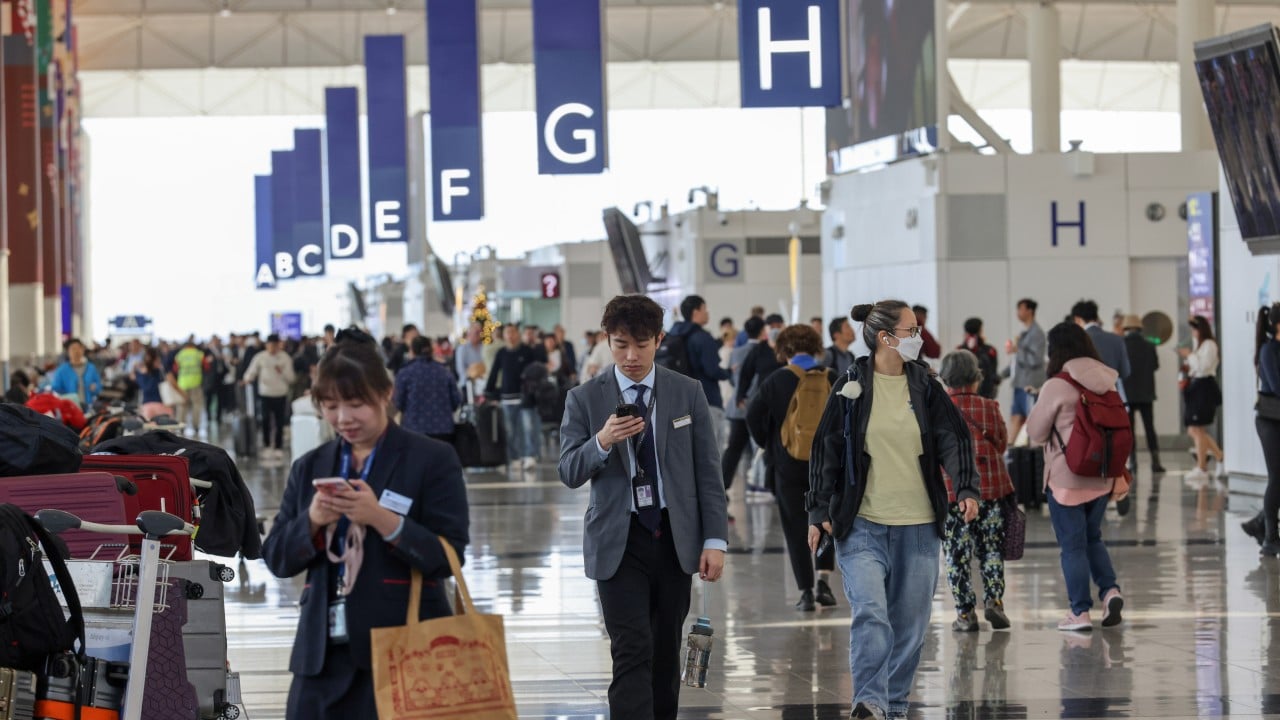
The luggage carousel in Beijing was spinning like a roulette wheel, and I was losing.
My knuckles were white around the handle of my carry-on. Sweat pooled at the base of my neck, soaking through a crisp white shirt that had been ironed four hours earlier in a quiet apartment in Kowloon. Beside me stood a seventy-year-old woman in a floral cardigan, gripping a laminated boarding pass with trembling fingers, staring at the rubber flaps of the baggage chute as if waiting for a verdict.
We had both landed from Hong Kong twenty minutes ago. We both had connecting domestic flights deeper into mainland China—mine to Xi'an, hers to a small city in Sichuan where her first grandchild had been born the night before. And because of a bureaucratic fault line that had existed for decades, our bags were trapped in customs purgatory, forcing us to exit the secure zone, reclaim our suitcases, sprint across a cavernous terminal, check in all over again, and fight through a second round of security screening.
Watch the clock. Forty minutes until gate closure. Thirty-five. Thirty.
If you have ever transited through mainland China from Hong Kong, you know that specific brand of panic. It is a cold, metallic taste in the back of your throat. On paper, Hong Kong and the mainland are part of the same country. In practice, moving between them by air has long felt like crossing an invisible, jagged border where two entirely different aviation ecosystems refuse to shake hands.
Until now.
Quietly, without the usual fireworks of mega-infrastructure announcements, Hong Kong has begun dismantling that wall. Aviation authorities and select carriers have rolled out a single check-in scheme—known in industry terms as Through Check-In—for select flights connecting Hong Kong International Airport with mainland Chinese cities.
To a casual observer reading a dry press release, it sounds like a minor operational tweak. A clerical adjustment. A footnote for frequent flyers.
They are wrong. This is the quiet erasure of one of Asia's most exhausting travel bottlenecks, and understanding why it took so long reveals everything about the friction—and the future—of how millions of people actually move across the Pearl River Delta and beyond.
The Invisible Wall at Gate 42
To understand why a luggage tag can ruin a human life—or at least a family reunion—you have to look at how aviation treats sovereignty and customs.
When you fly from New York to Chicago and connect to Denver, your suitcase disappears into a subterranean conveyor network in Queens and magically reappears on a belt in Colorado. You never think about it. You walk off the first plane, grab an overpriced coffee, and stroll onto the second.
Hong Kong, operating under the "One Country, Two Systems" framework, maintains its own customs territory, its own immigration controls, and its own aviation regulatory body. For decades, that meant a flight from Hong Kong to Shanghai or Beijing was treated, from a baggage and security standpoint, almost identically to an international arrival from London or Tokyo.
Consider a hypothetical traveler—let us call him David—an architectural engineer based in Central, Hong Kong, who needs to inspect a manufacturing plant in Wuhan. Under the old system, David’s morning began at 5:00 AM. He took the Airport Express to Chek Lap Kok, checked his bag containing specialized laser-measuring equipment, and boarded a two-hour flight north.
The moment his wheels touched the tarmac in Wuhan, his real ordeal began. David couldn't follow the purple "Domestic Transfers" signs. He had to join the international arrivals queue, clear immigration, walk down to the baggage hall, wait twenty-five minutes for his Pelican case to drop onto the belt, haul it through customs inspection, take an elevator up three floors to the departures hall, stand in a twenty-minute check-in line to hand the exact same bag back to the exact same airline, and strip off his belt and shoes for security a second time.
Multiply David’s lost ninety minutes by tens of thousands of passengers every single day.
Think about the mothers traveling alone with toddlers and collapsible strollers. Think about the elderly parents who cannot read digital departure boards, terrified of missing a connection because they don't know which terminal floor houses the domestic check-in counters. Think about the sheer economic drag of missed meetings, rebooked tickets, and hotel rooms paid for out of pocket because a twenty-minute headwind over Guangdong meant a passenger missed their baggage cut-off by four minutes.
I missed that cut-off in Beijing three years ago. The woman in the floral cardigan next to me missed hers too. I still remember the sound she made when the check-in agent gently shook her head and pointed to the closed flight status on the monitor—not a loud cry, just a small, deflated exhale, as if someone had let the air out of her chest. She had to sleep on a metal bench near Gate 14 until the next morning's flight.
How the Mechanics Actually Work
So what changed? Why can you suddenly hand over your suitcase at Hong Kong International Airport and forget it exists until you reach your final mainland destination?
The breakthrough is not physical; it is digital and diplomatic.
Think of the old system like two neighboring banks that used different currencies and refused to install an exchange counter. Even if you held an account at both, you had to withdraw your cash in bills, walk across the street in the rain, and deposit it by hand. The new single check-in scheme builds an underground pneumatic tube between the vaults.
Under the updated arrangement, participating airlines—spearheaded by flag carriers and major regional operators working alongside the Airport Authority Hong Kong and mainland customs—have integrated their passenger manifest and baggage reconciliation systems. When you check in at Hong Kong, the system generates two boarding passes and prints a single routing tag that embeds customs clearance data directly into the barcode.
Let us be clear about the boundaries here, because confusion at the airport is the enemy of calm. This is not yet a universal blanket covering every single puddle-jumper flight into every regional airstrip in China. Right now, the scheme applies to select routes and partner airlines—specifically targeting high-volume trunk routes and key provincial hubs where automated baggage screening and remote customs inspection infrastructure have been synchronized.
Here is what happens behind the curtain while you sit in the cabin drinking tea:
- Origin Screening: Your checked luggage undergoes high-resolution CT security scanning in Hong Kong that meets both Hong Kong Civil Aviation Department standards and mainland Civil Aviation Administration protocols.
- Data Handshake: While your plane is at 35,000 feet, encrypted manifest data and X-ray images of your suitcase are transmitted ahead to the mainland transit hub.
- Remote Clearance: Customs officers at the arrival airport review the digital scans before your wheels even touch the runway. Unless an anomaly triggers a physical inspection flag, your bag is cleared remotely.
- Airside Transfer: Ground handlers pull your bag directly from the belly of the Hong Kong flight and load it onto the domestic connector.
You still pass through immigration—because Hong Kong and the mainland maintain separate border controls—but you do it through dedicated, streamlined airside transfer channels without ever touching a suitcase or exiting the sterile zone.
The Doubt Every Frequent Flyer Carries
I will admit something that official press releases never will: the first time I used a through-check-in connection on a regional Asian route, I didn't trust it.
Years of travel trauma train you to become a control freak. When you have watched a ground crew leave a suitcase sitting in the rain on a tarmac in Guangzhou, handing over your belongings at Point A and trusting an invisible algorithm to deliver them to Point C feels like a leap of faith off a cliff.
You stand at the boarding gate of your second flight, watching the baggage carts roll up to the cargo hold, squinting through the terminal glass trying to spot the bright neon ribbon tied to your handle. Your brain whispers: What if the data handshake failed? What if mainland customs pulled it for inspection and nobody told me? What if I land in Chengdu with nothing but a phone charger and a paperback?
Those doubts are rational. Aviation logistics are messy, and any transition involving cross-border regulatory alignment carries growing pains. If you are flying on two separate, unlinked tickets—say, booking a budget carrier into Shanghai and a separate domestic airline onward—the single check-in scheme will not save you. The airlines must have an interline agreement, and the entire journey must sit under a single booking reference.
Furthermore, if mainland customs flags your bag for a manual check—perhaps you packed an unusual battery pack, certain food items, or high-value electronics that look ambiguous on a scan—you may still be paged at the transfer desk to witness the opening of your luggage. The rules haven't vanished; the friction has simply been removed for the ninety-eight percent of travelers carrying ordinary clothes and souvenirs.
Why This Matters Beyond the Baggage Belt
Step back from the terminal for a moment and look at the map.
For the past several years, Hong Kong has been fighting an existential battle to reclaim its crown as Asia’s premier super-connector. During the pandemic years, while Hong Kong maintained strict border controls, rival hubs like Singapore’s Changi, Seoul’s Incheon, and Doha’s Hamad aggressively captured long-haul transit traffic. Travelers flying from Europe or North America into secondary Chinese cities realized it was often easier to route through Tokyo or Frankfurt than to deal with the logistical hurdles of transiting via Hong Kong.
At the same time, mainland Chinese carriers massively expanded their own direct international networks out of Beijing, Shanghai, and Guangzhou, bypassing Hong Kong altogether.
Hong Kong’s airport is a marvel of engineering—three runways, gleaming architecture, hyper-efficient trains—but concrete and glass mean nothing if the passenger experience breaks down the moment a plane crosses the Shenzhen River. Connectivity is not measured by how many routes appear on an airline's route map; it is measured by how effortlessly a human body can move from one dot to the next.
By establishing single check-in for select mainland flights, Hong Kong is finally weaponizing its greatest natural advantage: proximity.
Think about a business traveler flying from London to Changsha, or a family flying from Vancouver to Kunming. Previously, flying via Hong Kong meant enduring that dreaded mid-journey disruption—waking up groggy after a thirteen-hour polar flight only to wrestle heavy suitcases through a domestic re-check in China. Now, that traveler checks their bags at Heathrow or YVR, steps off the plane in Hong Kong for a bowl of wonton noodles, boards a short connector, and walks out of the airport in central China with their luggage waiting for them.
The psychological shift is enormous. It transforms Hong Kong from a destination where your journey stops and restarts into a true bridge.
The Quiet Revolution of Unnoticed Moments
If you are planning a trip across the border in the coming months, do not assume your route is automatically covered. Check your itinerary before you pack. Confirm that your flights are booked on a single ticket with participating carriers, and ask the check-in agent at Hong Kong International Airport a simple, direct question before your bag disappears down the belt: "Is this tagged all the way through to my final destination?"
Look at the printed white strip they wrap around your handle. Check the three-letter airport code at the very top. If it shows your final mainland city rather than your transit hub, breathe out. Unclench your jaw. Put your passport back in your jacket pocket.
Great progress rarely announces itself with a parade. Usually, it looks like nothing happening at all. It looks like a businessman walking calmly toward a departure gate with his hands in his pockets. It looks like a toddler sleeping undisturbed in a stroller while a plane taxis toward the runway.
Somewhere in a mainland terminal this week, a seventy-year-old grandmother in a floral cardigan will step off a flight from Hong Kong, follow a short corridor to her connecting gate, and board her final plane with twenty minutes to spare. She won't know anything about remote CT image transmission, interline baggage protocols, or cross-border aviation diplomacy. She will just be there in time to hold her grandchild.