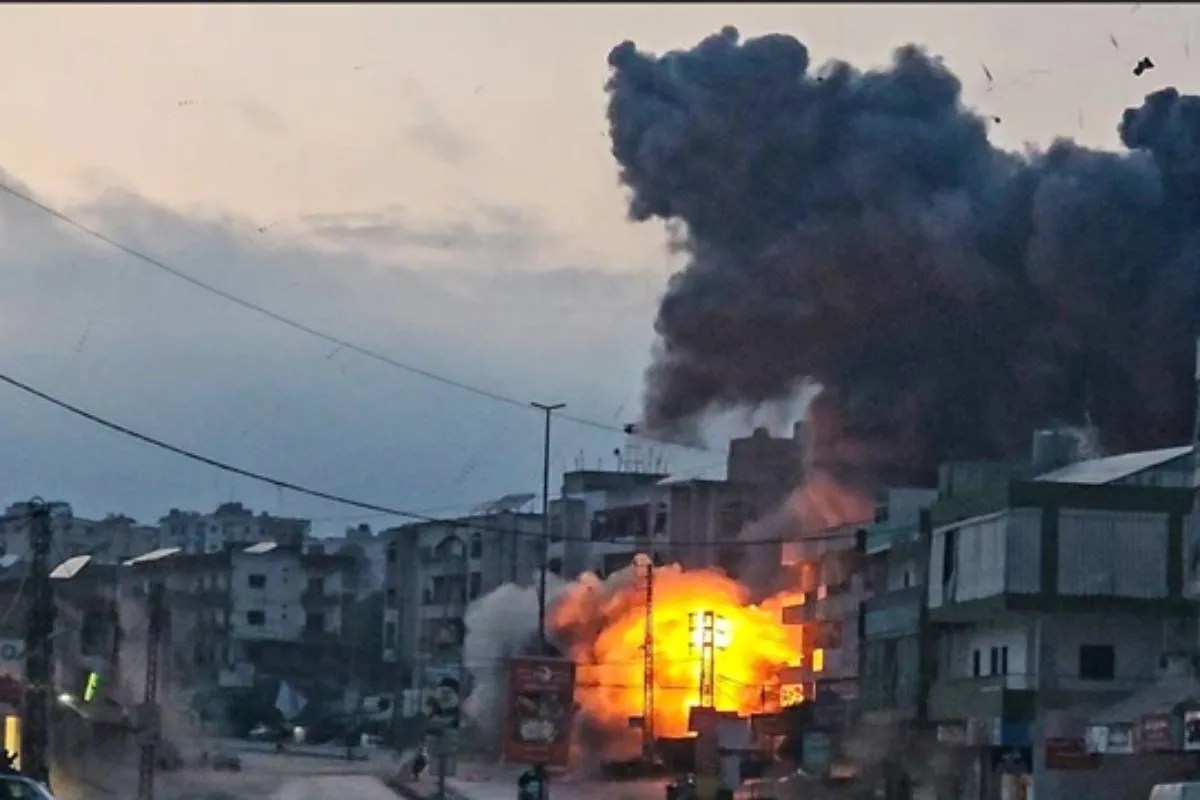
The ink was barely dry on the diplomatic papers before the first explosions echoed across the Litani River. Within hours of the supposed cessation of hostilities, the familiar silhouette of Israeli drones returned to the skies over Southern Lebanon, followed shortly by targeted strikes that shattered the briefest moment of quiet the region had known in months. While international mediators in Washington and Paris scrambled to claim a victory for diplomacy, the reality on the ground told a grimmer story. This was not a peace; it was a tactical pause being tested to its absolute limit.
The fundamental disconnect lies in the interpretation of "defensive action." For the Israeli Defense Forces (IDF), the presence of any moving vehicle or individual in specific restricted zones constitutes an immediate threat. For the residents of South Lebanon attempting to return to their homes, these same movements are the first steps of a desperate repatriation. When these two perspectives collide, the ceasefire evaporates. This isn't a series of accidental violations. It is a deliberate, calculated exertion of military will designed to set the terms of a new status quo before the diplomatic framework can even take root.
The Mechanics of a Calculated Escalation
Ceasefires in the Levant rarely fail because of a single misunderstanding. They fail because the underlying triggers for conflict remain active and pressurized. In this instance, Israel has maintained a policy of "active enforcement," a term that effectively allows for kinetic strikes against what it deems "emerging threats."
The logic is straightforward from a military standpoint. If the IDF observes Hezbollah operatives attempting to retrieve cached equipment or move back into fortified positions, they strike. However, the definition of an "operative" is often fluid in a war zone where combatants blend into the civilian population. Reports from Nabatieh and the surrounding villages indicate that several strikes hit targets where civilian returnees were present. This creates a cycle of provocation. Hezbollah, feeling the pressure to defend its remaining infrastructure and its image as a protector, faces an internal mandate to respond.
We are seeing a high-stakes game of chicken played with heavy artillery. Israel is testing the boundaries of the international community's patience, betting that the United States and France will not collapse the entire deal over a handful of "localized" breaches. By striking early and often, the IDF establishes a precedent: the ceasefire is conditional on their terms, not the written text of the agreement.
The Ghost of Resolution 1701
To understand why this ceasefire is crumbling, you have to look at the historical wreckage of UN Resolution 1701. Passed in 2006, it was supposed to ensure that the area between the Blue Line and the Litani River was free of any armed personnel, assets, and weapons other than those of the Lebanese government and UNIFIL. It never happened.
The current agreement is essentially 1701 with more teeth, or so the diplomats claim. But teeth are useless if the jaw is wired shut. The Lebanese Armed Forces (LAF) are expected to be the primary enforcement mechanism, yet the LAF is an institution crippled by Lebanon's wider economic collapse. Asking a soldier who hasn't been paid a living wage in years to disarm a battle-hardened militia is a fantasy.
The recent strikes serve as a blunt reminder from Tel Aviv that they have zero faith in the LAF or UNIFIL to maintain the buffer zone. By hitting targets within hours of the ceasefire start time, Israel is communicating that it will remain the primary arbiter of security in South Lebanon, regardless of what the Lebanese state or international monitors say. This undermines the very sovereignty the deal was supposed to restore.
The Intelligence Gap and the Danger of Assumptions
Modern warfare relies on a constant stream of signals intelligence and overhead surveillance. The IDF operates with a "target bank" that is constantly updated. When a ceasefire begins, the transition from active targeting to observation is supposed to be absolute.
However, intelligence is rarely perfect. A truck carrying humanitarian supplies can look remarkably like a logistics vehicle for a militia when viewed through a grainy thermal feed at three in the morning. When the command structure is primed for aggression, the default response to ambiguity is a kinetic strike. This "shoot first, verify later" posture is the primary engine of ceasefire erosion. It removes the benefit of the doubt and forces the opposing side into a defensive crouch, making further conflict inevitable.
The Political Calculus of the Border
The domestic pressures on both sides cannot be ignored. For the Israeli government, any perceived weakness is a political death sentence. Thousands of displaced citizens from Northern Israel are demanding a total removal of the threat across the border before they return home. A "quiet" ceasefire that allows Hezbollah to reorganize is seen as a failure. Therefore, the strikes are as much for a domestic audience in Haifa as they are for a military target in Tyre.
On the flip side, Lebanon is a house of cards. The government in Beirut is desperate for the billions in reconstruction aid that a lasting peace would bring. Yet, they cannot appear to be a puppet of Western interests or an enabler of Israeli military overreach. Every time an Israeli missile hits a Lebanese village during a "ceasefire," the political capital of the moderates in Beirut dissolves.
- Displaced populations: Over 100,000 people on both sides are waiting for a sign that it is safe to go home.
- Economic ruin: Lebanon’s economy cannot sustain another decade of border skirmishes.
- Military ego: Neither the IDF nor Hezbollah wants to be seen as the one who backed down first.
The Failure of International Monitoring
Where are the monitors? The current deal relies on a five-nation committee, led by the United States, to oversee complaints and violations. But a committee moves at the speed of bureaucracy, while a Hellfire missile moves at the speed of sound.
By the time a violation is reported, documented, and debated in a secure room in Beirut or Washington, the tactical reality on the ground has already changed. The aggressor has already achieved their objective, and the victim has already planned their retaliation. This lag time is the graveyard of peace agreements.
The lack of a rapid-response, neutral force with the authority to actually stop a skirmish means that the "ceasefire" is merely a suggestion. It is a gentleman’s agreement in a land that hasn't seen a gentleman in decades. Without real-time enforcement, we are simply watching a slow-motion return to total war.
The Litani River as a Psychological Barrier
The geography of this conflict is as much psychological as it is physical. The Litani River has become a symbol of a line that cannot be crossed. For Israel, anything south of that line is a legitimate target if it moves with intent. For Hezbollah, the area south of the Litani is their heartland, their defensive depth, and their recruitment base.
The strikes following the ceasefire have specifically targeted access points and corridors leading to the river. This is a clear attempt to "seal" the south. But you cannot seal a region where people live, work, and die. You can only terrorize them into temporary submission. This strategy has been tried in 1978, 1982, 1996, and 2006. It has never produced a lasting peace. It has only produced a more sophisticated and angry adversary.
The Strategy of Attrition
We must stop viewing these post-ceasefire strikes as "violations" and start seeing them as a continuation of the war by other means. This is a strategy of attrition. The goal is to make the cost of remaining in South Lebanon so high for Hezbollah—and the civilians who support them—that the "buffer zone" creates itself through depopulation and destruction.
The danger of this approach is that it assumes the other side will eventually break. History suggests the opposite. Every strike that occurs under the banner of a ceasefire serves as a radicalization tool. It proves to the local population that diplomatic guarantees are worthless and that only armed resistance provides a modicum of security.
The ceasefire is currently a hollow shell. It exists in the speeches of diplomats and on the front pages of international newspapers, but it is absent from the valleys of South Lebanon. If the international community wants this deal to survive, they need to stop issuing "expressions of concern" and start imposing actual consequences for those who pull the trigger. Until the cost of breaking the ceasefire is higher than the perceived military gain of a single strike, the sirens will continue to wail.
The reality is that a ceasefire is not the end of a conflict; it is the most dangerous phase of one. It is the moment when the fog of war is replaced by the clarity of betrayal. Every explosion that occurs after the "deadline" is a brick in the wall that will eventually block any path to a genuine, multi-generational peace. We are not watching the beginning of the end. We are watching the preparation for the next, more violent chapter.
Move the monitors out of the hotels and onto the hillsides. Stop the flow of munitions that fuel the "enforcement" strikes. Demand an immediate and total halt to overflights. Without these concrete steps, the ceasefire is just a countdown to the next invasion.