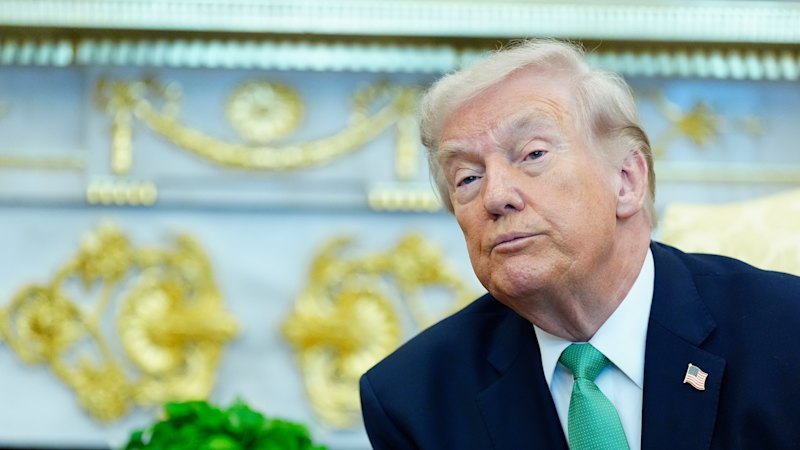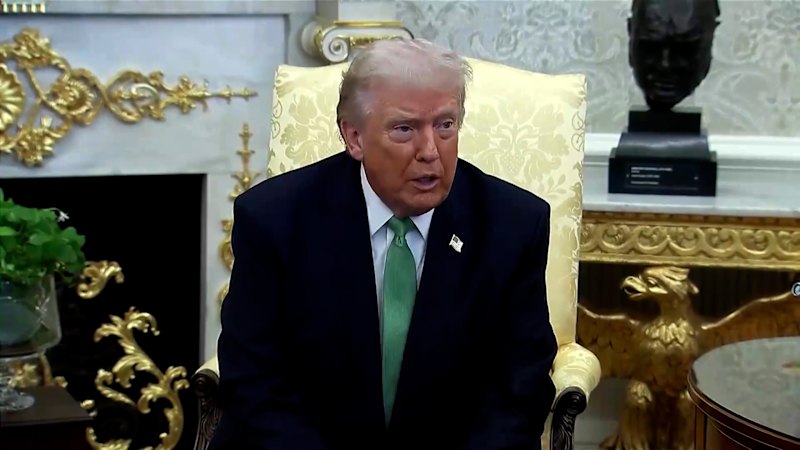
The air in the Oval Office doesn't just sit there; it presses against the glass, heavy with the ghosts of a thousand treaties and the silent expectations of distant continents. When a President speaks, the words don’t just travel across a room. They ripple across oceans, hitting the shores of Canberra and the cobblestones of Brussels like a physical blow.
Recently, those ripples turned into a storm.
Donald Trump didn't just issue a critique of NATO or a casual rebuke of Australia. He reached for the very foundations of the post-war world and shook them to see what would rattle loose. To some, it looked like a negotiation tactic. To those standing in the crosshairs of global tension—the diplomats, the soldiers, and the families living near the Strait of Hormuz—it felt like the floor falling out from under them.
The friction centers on Iran. It is a dry, complex geopolitical standoff, but at its heart, it is about the cost of a promise. For decades, the Western world operated on a simple, unspoken rule: we stand together so that none of us has to stand alone. That rule is currently being rewritten in real-time, and the ink is being replaced by fire.
The Bill for the Shield
Imagine a small-town fire department where one neighbor provides the truck, another provides the hoses, and a third provides the water. For seventy years, the United States provided the truck, the engine, and most of the fuel. NATO was the insurance policy that kept the house from burning down.
When Trump lashes out at NATO, he isn't just talking about spreadsheets. He is talking about the perceived unfairness of a landlord who realizes he’s been paying the utility bills for tenants who have grown wealthy in his building. He sees the 2% GDP defense spending target not as a dry statistic, but as a debt of honor.
"Pay your fair share," is the mantra.
But the "share" isn't just money. It is the blood-equity of collective defense. When the U.S. looks at Iran and sees a shadow lengthening over the Middle East, it expects its oldest allies to be standing right there, flashlights in hand. When they hesitate—when Germany or France suggest a different path—the frustration in Washington turns into a public lashing.
This isn't just about budgets. It’s about the terrifying realization that the shield might not be there the next time the wind shifts. If the U.S. signals that its protection is conditional, the very nature of peace changes. Peace is no longer a constant; it becomes a subscription service.
The Long Walk from Canberra
Australia is different. The relationship between Washington and Canberra has traditionally been less of a legalistic treaty and more of a blood-oath. From the trenches of World War I to the dusty tracks of Afghanistan, "mateship" wasn't just a brochure slogan. It was a lived reality.
So, when the criticism turns toward the Aussies regarding Iran, the sting is deeper. It feels less like a business dispute and more like a family argument at the dinner table.
The tension usually boils down to the "Free Open Indo-Pacific." Australia sits in a precarious geographical vise. They need the U.S. for security, but they need the trade routes of the East for survival. When the U.S. demands a harder line against Tehran, or more naval assets in the Gulf, Australia has to calculate the cost in a way that Washington rarely has to.
Consider a hypothetical naval officer on a frigate in the Persian Gulf. For him, the rhetoric in a tweet or a press conference isn't "news." It is his Rules of Engagement. If the alliance is fractured, his ship is lonelier. If the rhetoric escalates, his horizon becomes more dangerous.
The lashing out isn't just words; it changes the temperature of the water around that ship.
The Ghost of the 2015 Deal
At the center of this hurricane sits the ghost of the Joint Comprehensive Plan of Action (JCPOA). To Trump, it was the "worst deal ever negotiated." To the allies in Europe, it was a flawed but functional cage for a tiger.
When the U.S. walked away, it didn't just leave a deal; it left its partners standing in the rain holding the umbrella. The current anger directed at NATO members is fueled by this divergence. Washington wants "Maximum Pressure." Europe wants "Minimum Chaos."
The two cannot coexist.
The pressure is designed to squeeze the Iranian economy until the leadership breaks. But pressure has a way of leaking. It leaks into shipping lanes. It leaks into the price of gas at a pump in Ohio. It leaks into the security briefings of a prime minister in London.
The "lashing out" is the sound of a superpower trying to bend the world to its will through sheer gravitational force. It is a rejection of the slow, grinding work of traditional diplomacy in favor of the sudden, sharp shock of the "America First" doctrine.
The Human Cost of Uncertainty
We often talk about these events as if they are chess moves played by giants. We forget that the board is made of people.
In a small village in Estonia, a farmer looks at the border and wonders if the NATO promise still holds. In a suburb of Sydney, a mother watches the news and wonders if her son will be sent to a conflict in a desert half a world away because of a diplomatic spat she doesn't fully understand.
This is the invisible cost of the rhetoric.
Security is built on the belief that your friends will show up. Once you start questioning the friendship, the security begins to evaporate, even if the tanks and planes are still there. The "dry, standard facts" tell us that defense spending is up in some sectors and down in others. The human reality tells us that the world feels significantly more fragile.
Trump’s approach is a gamble that the old structures were rot-filled and needed to be kicked down to build something sturdier. He believes that by berating allies, he forces them to find their own strength. It is the "tough love" of a patriarch who is tired of carrying the weight.
But there is a risk.
If you kick a structure hard enough, it doesn't always get stronger. Sometimes, it just collapses.
The Shifting Horizon
The world used to be a place of predictable orbits. You knew where the U.S. stood. You knew where the allies stood. You knew the boundaries of the cage.
Today, the orbits have decayed. The lashing out at Australia and NATO over Iran is a symptom of a much larger transformation. We are moving from a world of "Best Friends Forever" to a world of "Partners for the Moment."
It is a colder, more transactional space. It demands that every nation justifies its existence every single day. There are no more free rides, but there are also no more certainties.
The next time a headline flashes across a phone screen about a heated call or a public snub, don't look at the numbers. Look at the distance between the players. Watch the space where the handshake used to be.
That gap is where the future is being decided. It is a space filled with the silent breath of millions who just want to know that the roof over their heads isn't about to be traded for a better deal.
The weight of that handshake has never been heavier, and the grip has never been more slippery.