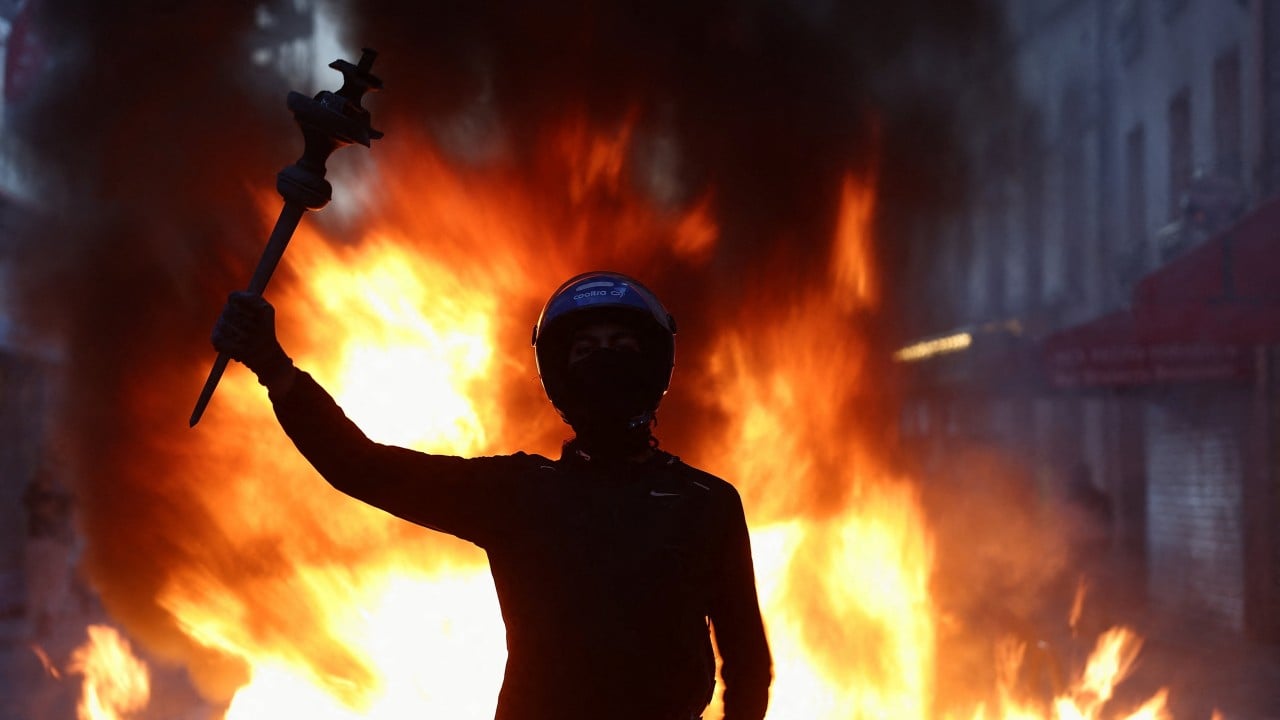
Streets burning in Paris. Tear gas drifting past lycée gates. Headlines screaming that France is losing the academic race to Beijing and that kids are rioting over falling test scores.
Lazy. Lazy reporting. Lazy analysis.
When protests over schooling turn violent in France, commentators reach for the easiest geopolitical scapegoat on the shelf: China. A student throws a paving stone, a minister mutters about compétitivité and niveau scolaire, and suddenly a deeply entrenched domestic social contract gets repackaged as an East-versus-West math tournament.
That framing misses the point by a mile. Teenagers rarely risk arrest and inhalation of tear gas because they are upset about international PISA rankings or worried that Shanghai has higher algebra scores. They revolt when the promise attached to those credentials stops paying out—or when the rules of who gets sorted where start choking their future before they even hit eighteen.
Let’s strip away the geopolitical theater and look at what is actually burning inside the French education system.
The Lazy Consensus Around Declining Standards and China
The standard story goes like this: French academic standards have slipped over the last two decades; East Asian systems—led by China—drill harder, score higher on international assessments, and produce a more technically disciplined workforce; therefore, France must tighten discipline, raise the bar, and catch up before its economic standing erodes further.
It sounds tidy. It also rests on three shaky assumptions.
First, international standardized tests measure a narrow slice of cognitive output under controlled conditions. High marks on math or reading benchmarks do not automatically translate into superior institutional adaptability, civic trust, or domestic economic dynamism. Treating a test score table as a crystal ball for national power is a category error.
Second, French education was never built to be a broad, egalitarian workshop for every single teenager on an identical academic track. Historically, it has been a rigorous, centralized sorting machine designed to identify a small intellectual vanguard—funneled through grandes écoles and elite civil service tracks—while leaving vast numbers of students with rigid labels early in life. Calling a system with deep structural sorting "declining" simply because test averages move or classrooms strain ignores whether the machine itself was ever fit for modern mass scale.
Third, blaming China for French street clashes confuses external competition with internal friction. China’s educational pressures are real, intense, and widely debated inside China itself—complete with its own anxieties over credential inflation, youth burnout, and employment mismatches. Using China as a mirror for France’s riots tells us far more about French political insecurity than it does about what happens on a Parisian boulevard.
Imagine a scenario where every French lycée matched East Asian math drill hours overnight, yet hiring networks, housing costs, and credential gatekeeping remained unchanged. Would the street anger evaporate? Not a chance. You cannot drill your way out of a stalled mobility ladder.
Why School Protests Turn Violent in France
To understand why friction in French schools escalates so fast into clashes with police, you have to look at how education functions in French civic life.
In many countries, school is a local service negotiated between parents, school boards, and municipalities. In France, the state is the schoolmaster. Curriculum, schedules, staffing, reform decrees, and testing rules flow top-down from Paris. When the ministry changes a reform, moves a teacher, alters exam formats, or tightens campus rules, the protest isn’t aimed at a local principal. It hits the state directly.
Add to that the specific pressure cooker of French adolescence:
- Early sorting stings harder: Academic tracks and vocational pathways separate students early. When a teen feels shunted into a dead-end track with weak job prospects, frustration isn’t abstract. It feels personal and permanent.
- Campus flashpoints spill outward: High schools sit inside neighborhoods already carrying tensions over policing, housing, and youth unemployment. A grievance that starts over class sizes or exam changes quickly merges with broader street grievances.
- Protests have a script: In France, mass demonstrations and blockades are a recognized political language. When negotiations feel deaf or abrupt, escalation becomes a lever rather than an anomaly.
A teenager throwing a rock outside a school isn’t writing a policy brief on global GDP shares. They are pushing back against authority, uncertainty, or a system they believe has already decided their ceiling.
What People Are Actually Asking When They Search This
When news breaks of violent school protests tied to standards and global rivals, people usually type frantic, broad questions into search bars. Most of those questions start from a flawed premise.
Are French schools actually failing compared to China?
That question assumes there is a single objective scoreboard called "school quality" and that both countries are playing the same game. They aren’t. France operates a universal public system wrapped in a centralist bureaucracy and intense credential hierarchy. China operates a massive, uneven provincial system with fierce exam competition at key chokepoints and growing domestic pushback against over-pressuring youth. Comparing raw averages without examining social mobility, mental health costs, labor market absorption, and civic stability is comparing apples to circuit boards.
Why do students riot over school standards instead of just studying harder?
Because "study harder" is easy advice when you aren’t the one facing a rigid sorting gate with shrinking payoff. If a student believes the system is stacked, overcrowded, under-resourced, or disconnected from decent work, telling them to hit the books harder sounds like blaming the passenger for a flat tire.
How can Western countries catch up to China in education?
This is the wrong question. "Catching up" locks you into chasing someone else’s treadmill. The real question for France—and any mature economy—is how to build schools that cultivate deep literacy, quantitative fluency, technical skill, and genuine human adaptability without turning childhood into a meat grinder or locking half the population out of upward mobility.
Battle Scars From Watching Institutions Chase Rivals
I have spent years watching large organizations—both corporate and public—panicked into copying a faster, hungrier rival. I’ve seen leadership teams blow millions trying to replicate an outsider’s playbook while ignoring the broken incentives sitting inside their own house.
The pattern is almost always identical. Executives or policymakers look at a competitor’s headline metric, declare a crisis, and impose rigid top-down mandates. Meanwhile, the people actually doing the work—or living inside the system—experience the change as chaos, alienation, or unfairness.
In education, that gap is even wider. You cannot decree high standards through press releases and ministerial circulars if classrooms lack stability, teachers feel burned out, and students see a shrinking return on effort. Standard-setting is a craft built on trust, clarity, and realistic pathways—not panic theater triggered by another country’s test scores.
To be clear on the terminology: academic standards refer to the expectations of what students should know and be able to do at given stages; credentialism is the over-reliance on formal degrees or exam ranks as proxies for competence and social worth. Confusing the two is a chronic mistake. Raising genuine learning expectations is healthy; inflating rigid exam gates while ignoring real skill development creates pressure cookers.
Serious thinkers in comparative education and institutional economics—scholars like Eric Hanushek on cognitive skills and economic growth, Andreas Schleicher on international assessment mechanics, and sociologists such as Pierre Bourdieu on how educational credentials reproduce social hierarchy—have long shown that outcomes depend heavily on institutional design, teacher quality, and social stratification, not slogans alone.
The Honest Trade-Offs of Ditching the "Catch-Up" Obsession
Taking a contrarian stance has real downsides, and pretending otherwise would be dishonest.
If you downplay international test benchmarks and "catch-up" targets, policymakers can use that skepticism as an excuse for complacency. Low expectations hurt kids just as much as frantic test obsession. A system that stops demanding rigor, clear reading and math mastery, and real accountability fails students quietly instead of loudly.
Likewise, questioning rigid sorting mechanisms raises hard questions about merit and standards. Every society has to decide how to recognize excellence, train specialists, and maintain tough benchmarks without turning early setbacks into life sentences. There is no cost-free button to push.
Still, trading panic-driven imitation for honest institutional reform is a far better bet than fighting yesterday’s war with last century’s tools.
What Actually Works When Standards and Streets Collide
If leaders actually want calmer campuses, stronger learning, and durable competitiveness, they need unconventional moves that cut against bureaucratic habit:
- Decouple dignity from a single exam track. Build respected, high-earning technical and applied pathways with real career progression so a non-academic turn at fifteen isn’t treated as social exile.
- Give schools operational breathing room. Stop whipping local staff with constant, uncoordinated top-down reforms that exhaust teachers before a policy even has time to work.
- Measure real capability, not just test-taking polish. Focus on strong foundational literacy, numeracy, problem-solving, and practical execution rather than gaming narrow metrics.
- Fix the economic payoff after graduation. No school reform survives long if young people graduate into stagnant wages, locked housing markets, and dead-end entry jobs.
Stop blaming foreign rivals for domestic rot. Fix the ladder.


