National jurisdiction is bound by physical boundaries, yet global supply chains rely on legal fiction. When the British government announced a policy change allowing the armed forces to board sanctioned Russian shadow fleet vessels transiting domestic waters, it created an immediate expectation of enforcement. The reality has been a stark lesson in operational friction: over 180 sanctioned vessels have completed transit through the United Kingdom's Exclusive Economic Zone (EEZ) and territorial waters since the enforcement framework was updated, with zero physical interdictions executed.
This operational gap is not a failure of tactical capacity or military surveillance. It is the predictable outcome of structural contradictions between domestic sanctions law, international maritime treaties, and the asymmetric cost dynamics of modern grey-zone competition. To evaluate why a policy of active maritime interception yields an actual enforcement rate of 0%, the mechanism must be broken down into its legal, logistical, and strategic variables.
The Legal Constraint Matrix
The primary bottleneck preventing physical boardings is the United Nations Convention on the Law of the Sea (UNCLOS), a foundational treaty that governs maritime sovereignty and limits unilateral state action. The United Kingdom's maritime jurisdiction is split into two distinct zones, each governed by different legal rules:
[Coastline]
   |
   |-- 0 to 12 Nautical Miles: Territorial Waters (Innocent Passage applies)
   |
   |-- 12 to 200 Nautical Miles: Exclusive Economic Zone (Freedom of Navigation applies)
Within the 12-nautical-mile territorial sea, foreign vessels enjoy the right of innocent passage. A transit is legally innocent as long as it is not prejudicial to the peace, good order, or security of the coastal state. Crucially, carrying sanctioned cargo, being owned by a sanctioned entity, or flying a flags-of-convenience registration does not meet the legal threshold required to terminate innocent passage under Article 19 of UNCLOS.
Beyond 12 nautical miles, within the 200-nautical-mile EEZ, the legal barrier thickens. The EEZ guarantees freedom of navigation. Under international law, a vessel on the high seas or within an EEZ is subject to the exclusive jurisdiction of its flag state.
A coastal state cannot legally board a foreign-flagged merchant ship in the EEZ unless it has explicit permission from the flag state, or the vessel is proved to be flying a false flag, operating without registration, or engaged in universally proscribed activities like piracy or slave trading. Because Russia’s shadow fleet utilizes complex, shifting registrations across jurisdictions like Liberia, Guinea, or the Marshall Islands, verifying a fraudulent registration requires administrative discovery that cannot be executed in the timeframe of a standard Channel transit.
The Asymmetric Cost Function
When a government commits to challenging maritime grey-zone activity, it enters an asymmetric cost equation where the state incurs massive operational expenses to achieve negligible economic disruption for the target.
The tracking of shadow fleet vessels requires persistent intelligence, surveillance, reconnaissance (ISR), and surface asset deployment. The Royal Navy relies on Type 23 frigates, River-class patrol vessels, and RAF P-8A Poseidon maritime patrol aircraft to maintain situational awareness. The hourly operating cost of these military platforms exceeds the daily operational costs of the commercial tankers they are monitoring.
Furthermore, the operational calculus changes when state-backed military escorts are introduced. The deployment of Russian Navy assets, such as a Grigorovich-class frigate or Kilo-class submarines, to escort sanctioned tankers through international shipping lanes raises the stakes of any physical intervention.
An interdiction under these conditions shifts from a routine law enforcement boarding to a high-risk military encounter. The risk of escalation creates an operational ceiling: the state must weigh the marginal economic benefit of delaying a single oil tanker against the strategic risk of a kinetic confrontation with a nuclear-armed state.
Strategic Subsea Diversions
The high volume of commercial shadow fleet transits serves a secondary strategic purpose for state adversaries: cognitive overloading and asset dilution. While surface tracking systems register a continuous stream of tankers moving through the English Channel and the North Sea, state actors execute highly specialized operations targeting critical national infrastructure (CNI) elsewhere.
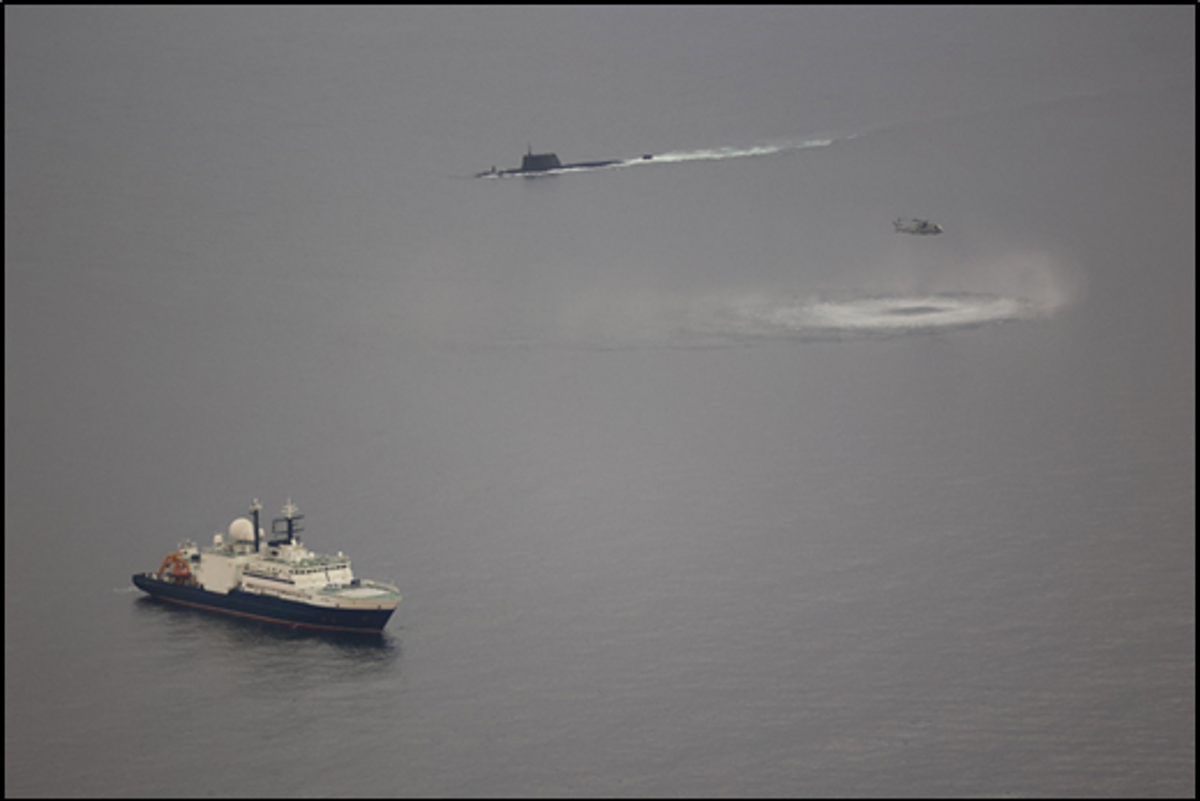
The Main Directorate of Deep Sea Research (GUGI) operates specialized spy submersibles and oceanographic research vessels designed to map, monitor, and potentially disrupt subsea telecommunications and energy cables. These operations frequently run parallel to high-profile surface transits.
[Commercial Shadow Fleet Transits] ---> Dilutes Naval Assets & Focuses Public Attention
                                              |
                                              v
[GUGI Deep-Sea Operations]       ---> Executes Covert Monitoring of Subsea Fiber-Optic Cables
By forcing the Royal Navy and its NATO allies to continuously allocate surface combatants, sonobuoys, and airborne ISR assets to track surface tankers and diversionary military targets, the adversary thins out the defensive perimeter around critical subsea networks. This asset dilution is highly effective; tracking a single covert asset requires continuous, multi-platform surveillance, leaving fewer resources to protect thousands of miles of underwater infrastructure.
Operational Countermeasures and Alternative Interdiction
Physical boarding at sea is an inefficient lever for enforcement. The data demonstrates that announcements of aggressive maritime interception function primarily as political signaling rather than operational realities. However, the absence of physical seizures does not mean the regulatory framework is completely ineffective.
The real pressure on the shadow fleet occurs through non-kinetic, administrative friction that targets the commercial viability of the vessels:
- Rerouting and Transit Delays: Overt shadowing and persistent electronic monitoring by naval forces increase the psychological and operational pressure on merchant crews. This has forced specific sanctioned vessels to abandon short transits through the English Channel in favor of longer, costlier routes around western Ireland and northern Scotland, driving up fuel consumption and charter costs.
- Administrative Interdiction: Seizures executed in port by civil law enforcement, backed by evidence of document fraud or sanctions evasion, are legally secure and logistically simpler than boardings at sea. The retention of the sanctioned tanker Ethera at Zeebrugge by Belgian authorities serves as a blueprint for effective enforcement.
- The Insurance Lockout: Denying access to Western maritime services, particularly the International Group of P&I Clubs which provides protection and indemnity insurance for approximately 90% of global ocean-going tonnage, remains the most scalable mechanism for disrupting shadow operations. Uninsured or poorly insured vessels face severe operational restrictions and restricted access to major global transshipment hubs.
The optimal strategy for managing grey-zone maritime transits shifts enforcement away from risky mid-water interceptions toward aggressive port-state control and financial intelligence. The state must accept that under UNCLOS, the 12-mile limit remains a legal shield for sovereign transit. Rather than dedicating finite naval assets to symbolic surface challenges that yield no physical stops, resources must be prioritized toward automated data tracking at maritime choke points, persistent ASW coverage of subsea CNI corridors, and coordinated international port closures that deny these vessels a destination.


