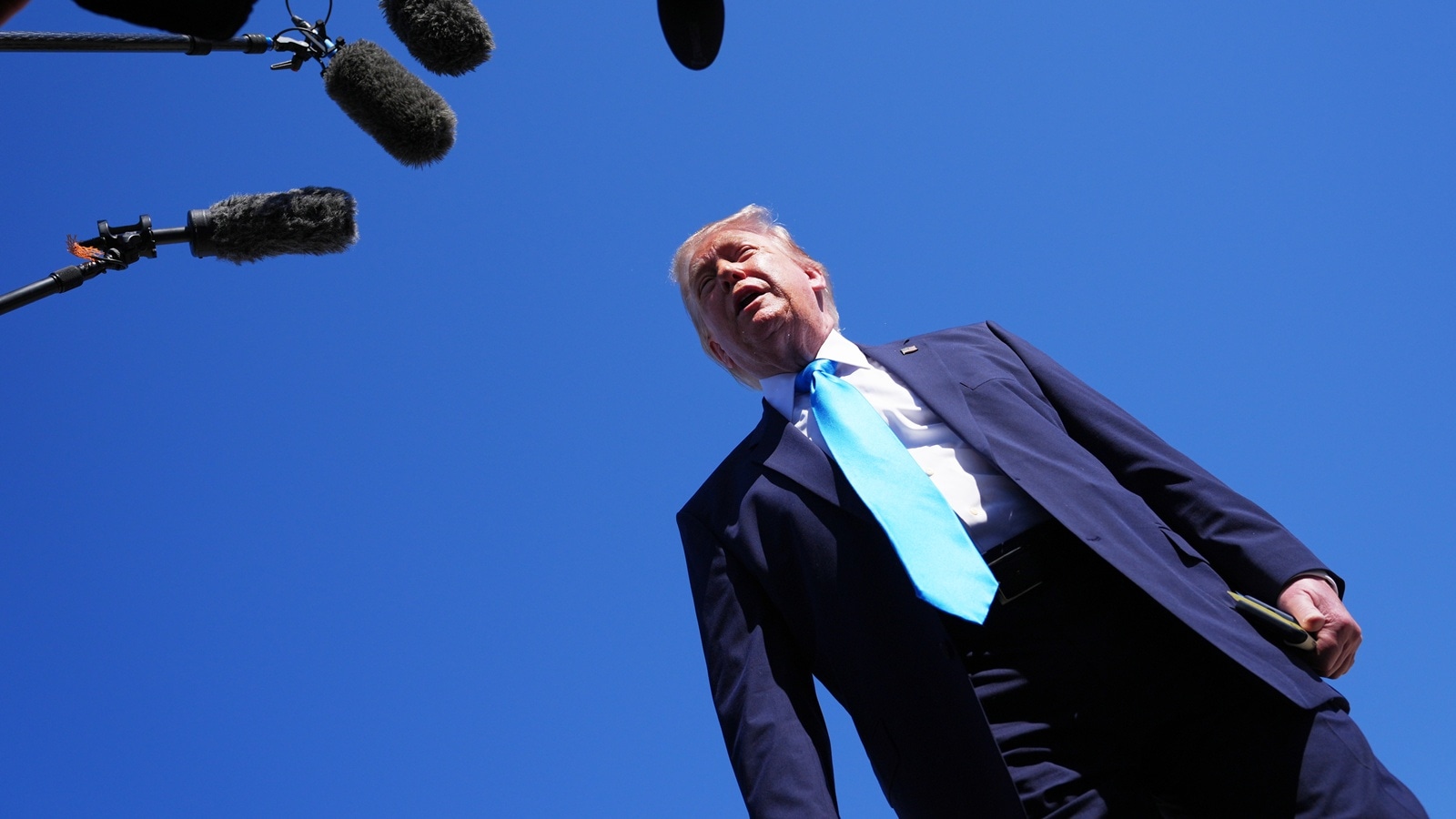
United States foreign policy toward the Islamic Republic of Iran has shifted from a doctrine of managed containment to an explicit escalatory architecture. In his commencement address to the United States Coast Guard Academy on May 20, 2026, President Donald Trump contextualized the ongoing 2026 Iran War through a binary operational choice: "Do we go and finish it up? Are they going to be signing a document?" This framing simplifies a highly complex theater of kinetic warfare, economic warfare, and strategic blockades into a transactional ultimatum. It posits that complete military degradation has already occurred, leaving a diplomatic settlement as the only alternative to total structural liquidation.
An empirical analysis of the theater reveals a profound divergence between administrative rhetoric and the operational realities governing the Persian Gulf. The claim that Iran’s conventional air and naval assets have been entirely eliminated overlooks the asymmetry of Iranian military doctrine. This doctrine prioritizes anti-access/area-denial (A2AD) capabilities and unconventional economic leverage over conventional fleet survival.
The Degradation Asymmetry: Conventional Attrition vs. Asymmetric Resilience
The administration's strategic calculus operates on a classic attrition model. By striking fixed military infrastructure, command hubs, and conventional platforms, Washington measures success through the quantitative reduction of enemy assets. Since the outbreak of large-scale hostilities on February 28, 2026—which followed years of escalating tensions, the June 2025 Twelve-Day War, and the re-imposition of United Nations sanctions—U.S. and Israeli kinetic operations have severely depleted Iran's surface fleet and conventional air wings. Western intelligence estimates suggest over 150 Iranian naval vessels and nearly 200 ballistic missile launchers have been neutralized.
This conventional degradation model suffers from a structural blind spot: it conflates conventional military capacity with the capacity to enforce a strategic blockade. The Islamic Revolutionary Guard Corps Navy (IRGCN) has spent three decades optimizing for a low-signature, decentralized combat environment. The core variables of this asymmetric capability do not rely on large surface combatants or advanced air superiority airframes.
- Subsurface and Swarming Assets: While conventional corvettes and frigates are easily targeted by U.S. carrier-borne strike aircraft, Iran’s hundreds of small, fast-attack craft (FAC) armed with short-range anti-ship missiles, alongside midget submarines (such as the Ghadir class), remain highly survivable in the shallow, cluttered littoral environment of the Persian Gulf.
- Mobile Coastal Defense Cruise Missiles (CDCMs): Land-based anti-ship cruise missile units can be concealed within the rugged terrain of the Iranian coastline and the Zagros Mountains. These assets can operate via zero-emission passive radar systems or remote targeting links, meaning their survivability remains high despite aggressive suppression of enemy air defenses (SEAD) campaigns.
- The Drone and Loitering Munition Inventory: The systematic destruction of industrial infrastructure has slowed production, but significant pre-war stockpiles of low-cost loitering munitions remain cached in underground bunkers. These platforms can be launched from civilian trucks or shipping containers, creating a persistent threat vector to commercial shipping.
The metric of success for Iran is not the preservation of its military order of battle; it is the maintenance of a high risk premium for merchant shipping in the Strait of Hormuz. By defining victory as the absolute elimination of Iranian military capacity, the United States applies a conventional metric to an unconventional system, creating an analytical disconnect between nominal territorial control and actual maritime security.
The Dual Blockade Paradox and Global Supply Chains
The structural bottleneck of the current conflict centers on the Strait of Hormuz, a maritime transit corridor that historically accounts for approximately 20% of global petroleum liquids and liquefied natural gas (LNG) traffic. The closure of the strait by Iran following initial strikes, combined with the subsequent U.S. counter-blockade instituted on April 13, 2026, has established a mutually reinforcing disruption pattern. This dynamic can be modeled through a dual-lock framework.
+------------------------------------------------------------+
|                    THE DUAL-LOCK BLOCKADE                  |
+------------------------------------------------------------+
|                                                            |
|  [IRANIAN CLOSURE MECHANISM]                               |
|  Targets: "Hostile" shipping & Western-allied commerce     |
|  Tools: Mines, FAC swarms, selective tolling               |
|                                                            |
|                            vs.                             |
|                                                            |
|  [U.S. NAVAL COUNTER-BLOCKADE]                             |
|  Targets: Iranian oil exports & "Dark Fleet" tankers       |
|  Tools: Maritime interdiction, embargo enforcement         |
|                                                            |
+------------------------------------------------------------+
|  RESULT: Near-total shipping freeze, depletion of global    |
|          strategic reserves, and systemic price shocks.     |
+------------------------------------------------------------+
The Iranian closure mechanism utilizes selective enforcement. Tehran has allowed partial transits of non-aligned vessels or those willing to pay arbitrary tolls, while actively targeting or threatening hulls linked to the United States, Israel, or their regional allies. Conversely, the U.S. counter-blockade attempts to starve the Iranian state of its residual oil revenue by intercepting dark fleet tankers and enforcing a strict embargo on Iranian ports.
The structural failure of this dual-blockade strategy stems from asymmetric economic elasticity. The United States is facing acute domestic political vulnerabilities due to climbing energy prices, which directly impact consumer price indices and broader macroeconomic stability. While the administration claims it is in "no hurry" to conclude a deal, the depletion rate of Western strategic petroleum reserves creates a hard temporal limit on this stance.
Meanwhile, Iran’s economy has been under structural sanctions for years. Although experiencing severe domestic inflation—exceeding 70% for food items—and widespread internal protests across its 31 provinces, the regime’s political survival mechanism is decoupled from standard macroeconomic performance. The state operates within a wartime command framework designed to absorb prolonged economic isolation, rendering it less sensitive to short-term inflationary shocks than a Western democracy facing electoral cycles.
Game-Theoretic Analysis of the "Two to Three Day" Ultimatum
President Trump’s threat to launch renewed military attacks within a "two to three day" window unless a document is signed can be analyzed through a game-theoretic model of dynamic bargaining under incomplete information. The interactions between Washington and Tehran resemble a game of Chicken, layered with signaling distortions.
                       IRAN
                  De-escalate (Sign)      Hold Line (Resist)
               +-----------------------+-----------------------+
U.S.  No Rush  |  U.S.: High Win       |  U.S.: High Loss      |
      (Wait)   |  Iran: High Loss      |  Iran: Status Quo     |
               +-----------------------+-----------------------+
      Strike   |  U.S.: Moderate Win   |  U.S.: Catastrophic   |
      (Renew)  |  Iran: Total Collapse |  Iran: Severe Damage  |
               +-----------------------+-----------------------+
The United States seeks to present its utility function as entirely indifferent to time, projecting that delays hurt Iran exponentially more due to domestic unrest and structural attrition. However, the credible enforcement of this threat is undermined by three distinct strategic variables.
1. The Cost Function of Further Kinetic Escalation
A renewed U.S. air campaign targeting Iran’s remaining civilian infrastructure—such as power grids, bridges, and domestic energy refineries—would expand the conflict's scope. The Iranian parliament speaker, Mohammad Bagher Ghalibaf, and Revolutionary Guard commanders have signaled that a renewed offensive would prompt a regional spillover. This implies asymmetrical strikes against energy extraction infrastructure across the Arabian Peninsula, specifically targeting desalination plants and oil processing facilities in neutral or Western-aligned states. Such an outcome would shift the global energy crisis from a maritime transit bottleneck to a structural production deficit.
2. Third-Party Mediation and External Safety Valves
The diplomatic choreography involving external actors serves as a critical signaling conduit that prevents total strategic surprise. The scheduled arrival of Pakistan’s interior minister and army chief in Tehran to finalize text variants highlights the presence of an active diplomatic circuit. Furthermore, China's diplomatic stance introduces an external balancing variable. While Beijing has warned Tehran against completely destabilizing commercial routes that disrupt Chinese energy imports, it has refused to support Western-led naval enforcement mechanisms at the UN Security Council. This allows Iran to maintain minimal economic connectivity through alternative land-based networks and clandestine energy transfers, preventing the absolute economic isolation required for total capitulation.
3. The Multi-Axis Deterrence Problem
The assumption that regional actors will act as passive extensions of U.S. strategic willpower is structurally flawed. Although the administration claims regional allies will fully comply with Washington's operational timeline, states like Saudi Arabia and Qatar have actively requested the postponement of scheduled strikes. These regional hubs recognize that they sit within the primary geometry of any Iranian retaliatory strike. The localized cost of a wider conflict—manifested in potential drone swarms targeting infrastructure or disruption to regional finance and aviation hubs—incentivizes regional powers to decouple from a maximalist U.S. military strategy, weakening the collective deterrence framework.
Structural Imperatives for Strategic Realignment
The current U.S. negotiation framework relies on a binary assumption: that total conventional military dominance automatically translates into political leverage. This approach overlooks the realities of asymmetric maritime conflict. To resolve the current strategic deadlock and mitigate global economic fallout, a shift in the analytical framework is required.
First, the metric of regional stability must be decoupled from the formal signing of a comprehensive capitulation document. The insistence on an absolute treaty covering ballistic missiles, regional proxy networks, and complete nuclear dismantlement creates an indivisible bargaining problem. Because the Iranian regime views these capabilities as existential survival guarantees, an ultimatum requiring their immediate elimination ensures a return to kinetic conflict.
The structural bottleneck remains the Strait of Hormuz. A sustainable resolution requires a sequenced approach that prioritizes maritime de-escalation over total political alignment:
- De-linking Maritime Transit from Political Demands: Negotiations should focus on an immediate, verifiable pause of the dual blockade. This requires a simultaneous suspension of Iranian maritime interference and a temporary freeze on targeted U.S. naval interdictions of non-military commercial shipping.
- Transitioning from Attrition to Containment: Rather than attempting to force a definitive signature through short-term ultimatums, the strategy should pivot to a long-term containment posture that accounts for the resilience of Iran's asymmetric capabilities and the vulnerabilities of global energy markets.
The administration’s current timeline, dictated by domestic economic pressures and shifting regional alliances, cannot be sustained indefinitely through tactical threats alone. Without a strategic pivot toward a bounded, sector-specific stabilization framework, the default outcome is an involuntary return to kinetic escalation. In this scenario, the economic and political costs will be borne not just by the immediate belligerents, but by the global trade architecture.