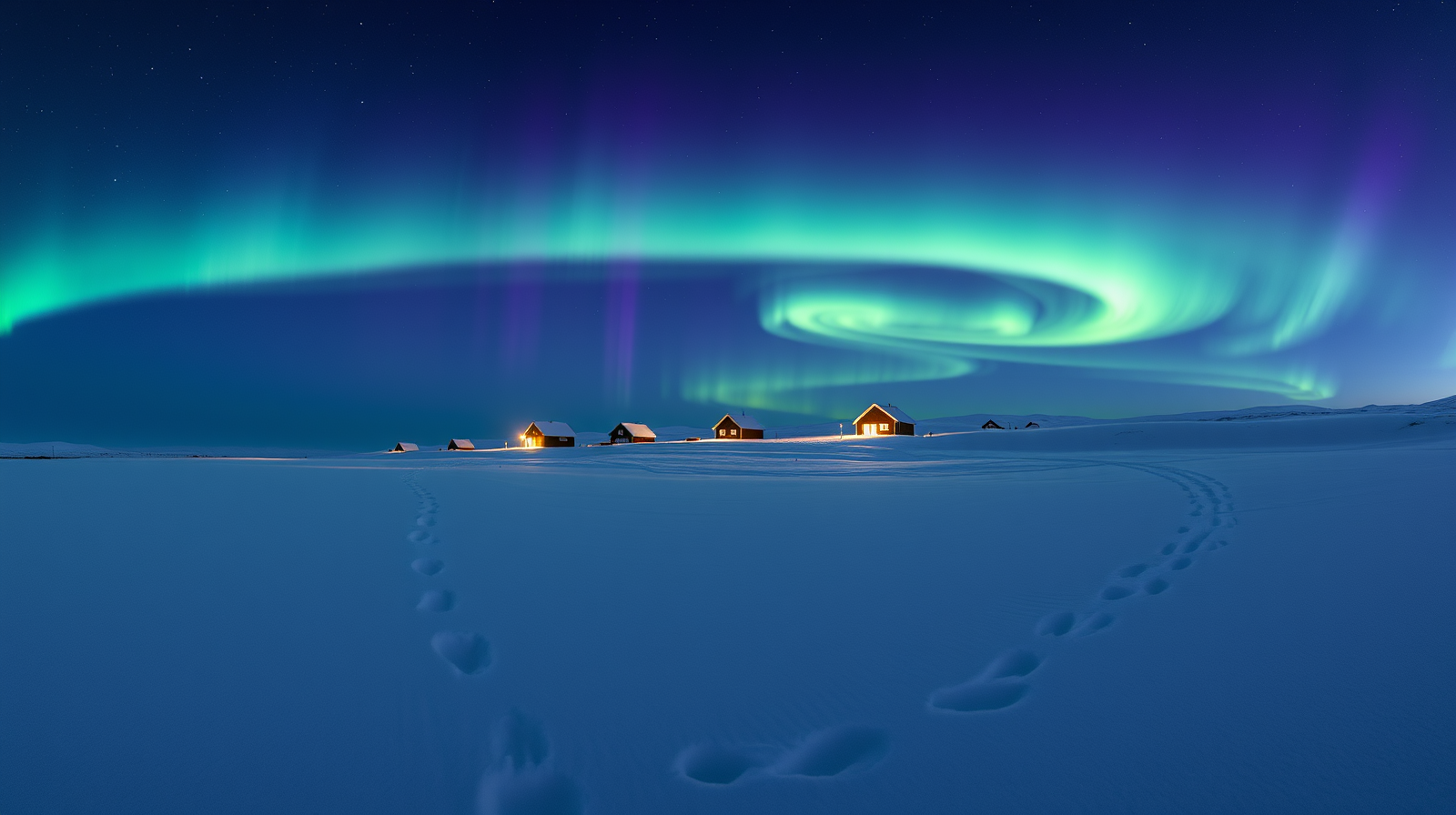
Every November, the northernmost edge of the United States drops off the solar grid. The residents of Utqiaġvik, Alaska—formerly known as Barrow—witness their final sunset of the year, entering a protracted period of darkness that stretches well into January. This phenomenon is known as the polar night. For roughly 65 days, the sun remains entirely below the horizon. It is not a sudden, cataclysmic event, but rather the predictable result of planetary geometry operating on a massive scale.
The mechanism driving this multi-month darkness is simple. The Earth does not rotate upright. Instead, it maintains a constant axial tilt of approximately 23.5 degrees relative to its orbital plane around the sun. During the winter solstice, the Northern Hemisphere tilts sharply away from our solar powerhouse. For areas located well above the Arctic Circle, this tilt pushes the landmass entirely into the planet’s own shadow. The sun never rises because the curve of the Earth blocks it completely.
Understanding this cycle requires looking past basic astronomy textbooks. The atmospheric realities of life at the top of the world tell a far more nuanced story than simple orbital mechanics.
The Illusion of Total Blackness
Many assume that polar night implies pitch-black darkness for two solid months. That is a myth.
Even when the sun fails to clear the horizon, its light still reaches the upper atmosphere. This creates prolonged periods of twilight that puncture the daily routine of northern residents. Meteorologists categorize this light into three distinct phases based on how many degrees the sun sits below the horizon.
- Civil Twilight: The sun is between 0 and 6 degrees below the horizon. This offers enough illumination for most outdoor activities without artificial light. The sky glows with deep blues and vivid pinks.
- Nautical Twilight: The sun dips between 6 and 12 degrees below the horizon. The horizon line becomes difficult to distinguish, and the brightest stars emerge.
- Astronomical Twilight: The sun is between 12 and 18 degrees below the horizon. The sky is dark enough for astronomical observations, though a faint vestige of light persists on the distant horizon.
In Utqiaġvik, civil twilight occurs for a few hours around noon even in the dead of December. This is not the bright sunshine enjoyed by lower latitudes. It is a bruised, surreal half-light that casts long shadows across the tundra. It provides a brief window of visibility before the deep indigo of the Arctic night reclaims the landscape.
The Thermal Lag and the Deep Freeze
The psychological weight of the darkness gets the most attention, but the physical consequences on the environment are immense. When the sun disappears, the ground loses heat rapidly. Without solar radiation to replenish the energy lost to space, the region enters a period of severe thermal decline.
The true depths of the Arctic winter do not actually coincide with the winter solstice in late December.
Instead, the lowest temperatures arrive in January and February. This delay is caused by thermal lag. The landmass and the adjacent Arctic Ocean hold onto a finite amount of summer heat. Once that residual warmth radiates away into the vacuum of space, the temperature drops precipitously. The lack of sunlight prevents any daytime warming cycle, locking the region into a relentless deep freeze where temperatures routinely plummet below minus twenty degrees Fahrenheit.
This prolonged cooling alters local weather patterns. The intense cold builds a dense, heavy mass of high-pressure air over the Arctic. This polar vortex influences weather systems thousands of miles to the south, driving freezing air masses down into the continental United States. The 65 days of darkness in Alaska are not an isolated geographic quirk. They serve as a primary chilling mechanism for the entire Northern Hemisphere.
The Biological Cost of the Shadow
Living through two months without a sunrise demands a massive adaptation from every organism in the region. Human biology is fundamentally wired around the circadian rhythm, which relies on the high-contrast transition between day and night to regulate hormones like melatonin and cortisol.
When the sun stays down, the body struggles to find its footing.
Seasonal Affective Disorder is a well-documented reality here rather than a vague medical footnote. Local populations rely heavily on high-lux light therapy lamps that mimic the spectrum of natural sunlight to keep their endocrine systems functioning normally. Vitamin D supplements become a non-negotiable dietary requirement, as the human skin cannot synthesize this crucial nutrient without UVB radiation from the sun.
The local wildlife handles the darkness through specialized evolutionary strategies. Many migratory birds and marine mammals abandon the region entirely before the final sunset in November. The species that remain, such as the arctic fox and the caribou, shift their behavioral patterns. Caribou alter the structure of their eyes during the polar night. The tapetum lucidum—a reflective layer behind the retina—changes from gold to deep blue. This structural shift increases the eye's sensitivity to blue light, helping the animals navigate the dim twilight and spot predators across the snow-covered plains.
Infrastructure in the Dark
Maintaining a modern community during a 65-day blackout requires intense logistical planning. Municipal infrastructure faces unique strains when the sun vanishes and the temperature bottoms out.
Power grids must operate with absolute reliability. A prolonged power failure in a remote Arctic town during the polar night is not an inconvenience; it is an immediate threat to survival. Diesel generators and localized microgrids are maintained with rigorous redundancy. Standard maintenance tasks, from clearing snow to repairing water lines, must be performed under the harsh glare of industrial floodlights and headlamps.
The darkness also impacts aviation, which serves as the primary lifeline for remote Alaskan communities. With roads nonexistent between many northern villages, planes deliver food, mail, and medical supplies. Pilots navigating the polar night must rely entirely on instrument flight rules. They contend with black-hole approaches, where the lack of ground lighting makes judging altitude and distance visually impossible.
The Return of the Sun
The end of the polar night in late January is marked by a rapid escalation of daylight. Because of the sharp angle of the Earth’s tilt relative to the high latitude, daylight does not return in slow, minute-long increments.
Once the sun cracks the horizon, Utqiaġvik gains anywhere from nine to fourteen minutes of daylight every single day. The transition from total darkness to the continuous sunlight of the summer months happens with astonishing speed. This rapid shift presents its own set of disruptions, forcing the biological clocks of residents to pivot violently from one extreme to the other.
The 65 days of darkness are a stark reminder of the planet's structural reality. The polar night dictates the economy, the biology, and the daily survival strategies of the American Arctic, proving that life at the edge of the world is entirely at the mercy of our planet's axial lean. Ensure your cold-weather gear and indoor lighting systems are vetted well before the November shadows lengthen.


