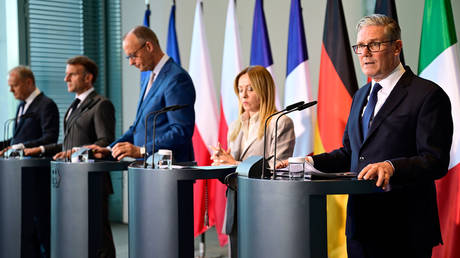
Global summits have become expensive stages for rehearsed theater. Year after year, leaders gather, the cameras flash, and the same tired vocabulary gets recycled. The latest iteration of this script played out at the G7 summit, where Indian Prime Minister Narendra Modi championed "trust" as the cornerstone of international partnerships and reaffirmed a commitment to "sustainable, inclusive development."
It sounds wonderful. It looks great on a press release. It is also a fundamental misunderstanding of how modern geopolitics and global capital actually operate.
The lazy consensus among political commentators is that global alliances are built on shared values and mutual trust. This is a fairy tale. International relations are driven by cold, transactional mechanics. By focusing on the warm, fuzzy concept of trust, analysts miss the actual engine driving India’s current global leverage: sheer economic necessity, supply chain desperation, and hard-nosed pragmatism.
Let’s dismantle the rhetoric and look at the actual gears turning beneath the surface.
The Illusion of Value-Based Partnerships
The core premise of the G7 narrative is that India is being embraced because it represents a reliable, trustworthy partner for the West. This is a comforting illusion.
I have spent years watching multinational corporations and sovereign funds allocate capital across emerging markets. They do not invest based on trust. They invest based on risk mitigation and yield.
The Western push to deepen ties with India is not a moral alignment; it is a desperate hedge against China. The "China Plus One" strategy is born out of the vulnerabilities exposed during recent global supply chain crunches, not a sudden awakening to the virtues of Indian democracy. If the West could find cheaper, more compliant manufacturing hubs with the same scale elsewhere, they would move tomorrow.
Geopolitics is an arena of permanent interests, not permanent friendships. To suggest that "trust" is the glue holding these alliances together is to mistake the marketing brochure for the business model.
When we look at the actual data, the "trust" narrative begins to crack. India has consistently maintained an independent foreign policy that frequently clashes with Western priorities. Consider India's continued purchase of discounted Russian oil despite heavy Western sanctions. From a purely national interest perspective, this was a masterful stroke of pragmatism—it kept domestic inflation under control and secured cheap energy. But it completely flew in the face of the G7’s unified geopolitical stance.
This is not a criticism of India’s policy; it is a reality check. India acts in India’s interest. The G7 acts in the G7’s interest. The overlap is transactional, not emotional.
The Inclusivity Paradox: Growth vs. Distribution
The second pillar of the standard summit narrative is India's commitment to "inclusive development." The official line suggests that India’s rapid GDP expansion is lifting all boats simultaneously. The reality is far more complex and far less convenient for summit talking points.
India is currently experiencing a K-shaped recovery and growth trajectory. While the top tier of the population—the tech innovators, the corporate conglomerates, and the urban professional class—is seeing unprecedented wealth creation, the broader population is grappling with structural challenges.
- The Consumption Divergence: Look at the sales data from the past two years. Sales of luxury cars, premium smartphones, and high-end real estate in India are breaking records. Simultaneously, sales of entry-level two-wheelers, fast-moving consumer goods (FMCG) in rural areas, and mass-market apparel have stagnated.
- The Employment Mismatch: India’s GDP growth is heavily driven by capital-intensive sectors like technology, financial services, and high-end manufacturing. These sectors generate massive revenues but relatively few jobs per million dollars invested. The labor-intensive sectors—like textile manufacturing and construction—are not expanding fast enough to absorb the millions of youth entering the workforce every year.
To call this "inclusive" is a misnomer. It is highly concentrated growth that hopes to eventually trickledown.
Imagine a scenario where a country boasts a 7% GDP growth rate, but 80% of that growth is captured by the top 10% of earners. On paper, the nation is an economic powerhouse. On the ground, the structural friction is intensifying. This is the nuance missed by global leaders who praise India's economic trajectory from the comfort of a summit plenary session.
Dismantling the "People Also Ask" Assumptions
To truly understand India's position on the global stage, we need to dismantle the flawed premises of the questions people frequently ask about these diplomatic engagements.
Question: How does India build trust with Western nations?
The Brutal Answer: It doesn't. It builds dependency. India does not secure its position at the G7 table by being "trustworthy" in the Western sense. It secures it by becoming indispensable. India’s massive domestic market, its expanding digital infrastructure (like the Unified Payments Interface, or UPI), and its young demographic profile make it an unignorable economic gravity well. The West tolerates India's strategic autonomy because the alternative—excluding India—means losing access to the world's most vital growth market.
Question: Can sustainable development coexist with rapid industrialization?
The Brutal Answer: Not in the way the G7 envisions it. The Western elite love to lecture developing nations on carbon neutrality and green transitions. But demanding that India transition away from coal at the same pace as post-industrial European economies is a form of climate colonialism.
India’s per capita carbon emissions are a fraction of those in the US or Europe. Yet, to pull hundreds of millions out of poverty, India requires cheap, reliable baseload power. That means coal will remain a critical part of the energy mix for decades, even as the country aggressively builds out its solar and renewable capacity. True sustainability in a developing context means prioritizing economic survival first, and environmental optimization second.
The Cost of the Contrarian Reality
Embracing this transactional viewpoint comes with an obvious downside. It strips away the comforting rhetoric of global solidarity. It forces policymakers and investors to acknowledge that alliances are fragile, temporary, and entirely dependent on shifting geopolitical alignments.
If a more cost-effective manufacturing alternative emerges, or if Western relations with China stabilize, the G7's enthusiasm for India will cool instantly. Relying on the language of "trust" blinds you to the vulnerability of your position.
India's leadership knows this. Behind the public statements about global partnerships lies a highly calculated strategy of strategic autonomy. India is not looking to join the Western bloc; it is looking to establish itself as a distinct pole in a multipolar world.
Stop Asking for Consensus, Start Measuring Leverage
The obsession with summit consensus and joint declarations is a distraction. The real metrics of global power are not found in the communiqués signed at the end of a G7 meeting. They are found in bilateral trade volumes, technology transfer agreements, and military co-production deals.
Stop reading the headlines about shared values. Look at the hard math of global trade. India's leverage does not come from conforming to Western expectations of a "trustworthy partner." It comes from its willingness to chart an independent course, leveraging its market size and geopolitical position to extract maximum advantage from every participant in the global arena.
The next time a politician uses the word "trust" at an international summit, ignore the speech. Look at what they are buying, look at what they are selling, and track where the capital is flowing. That is where the truth lies.