We assume the mind is a fortress. We believe our ability to look at a cluster of random lines, to instantly isolate a triangle from a square, to trace the sharp corner of a star, is a crown exclusively ours.
It feels special. It feels human.
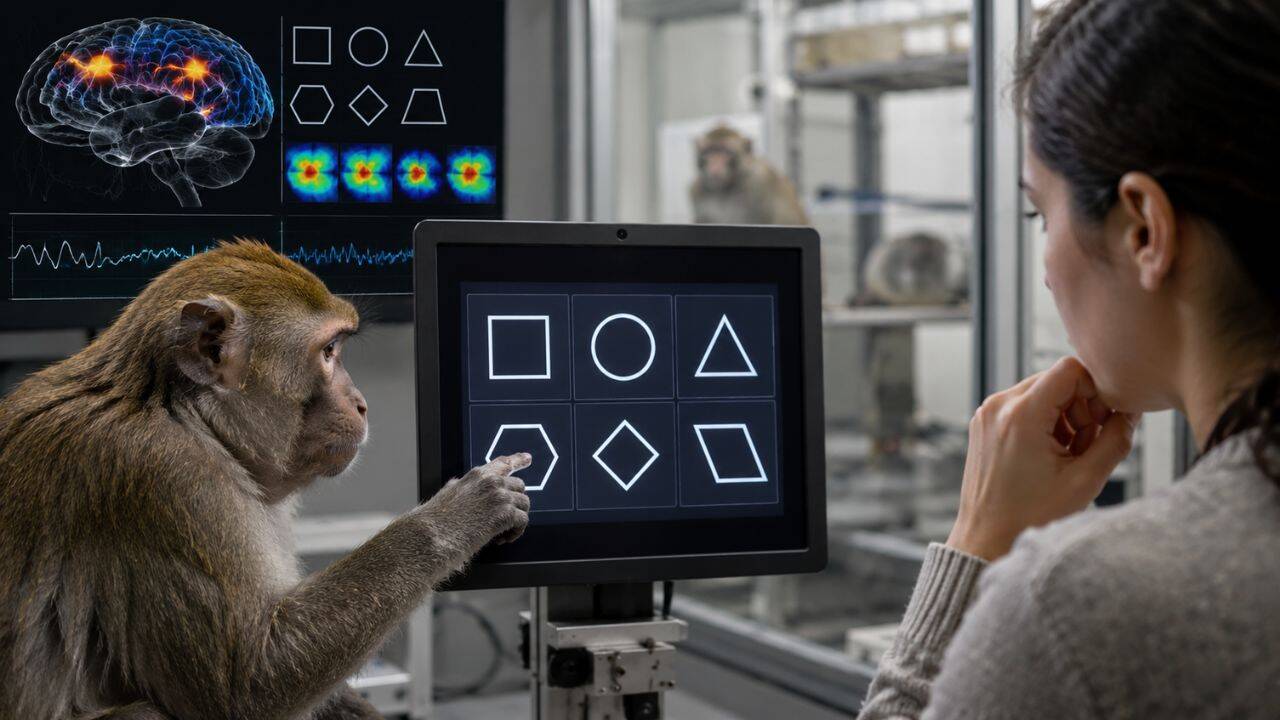
Walk into a quiet laboratory where behavioral scientists watch a screen. On that glass, a small rhesus macaque stares intensely. He is not reading. He is not writing poetry. He is looking at shapes. A circle. A cross. A jagged polygon.
When researchers track how his brain categorizes those forms, something unsettling appears. The curves of his confusion, the speed of his hesitation, the exact weight of his choices mirror our own.
Mirror. Us.
The Shape of Thought
Consider what happens next. You sit at a red light. You glance at a metal sign hanging above the street. Your brain does not process every individual pixel of rust or bolt. It abstracts. It reduces the world to geometry. Square. Arrow. Warning.
We do this effortlessly. We assume this capability requires centuries of abstract education, or language, or the heavy architecture of human civilization.
It does not.
Deep in the evolutionary tree, long before our ancestors picked up a sharp stone or drew ochre on a cave wall, the machinery for geometry was already running. Think of a primate navigating a dense canopy. Branches are not just wood; they are intersecting vectors. A leap requires calculating angles, curves, and distances in split seconds. Missing a geometric assessment by a fraction of an inch means falling.
Survival demanded algebra before we had numbers.
Watching the Machine Inside
To understand how this works, imagine a hypothetical researcher named Dr. Aris Thorne. For fifteen years, he has mapped visual processing in primates. He does not use harsh constraints; he relies on voluntary participation, rewarding sharp eyes with drops of juice.
Thorne watches a monitor display two shapes side by side. One is a distorted square. One is a smooth, continuous loop.
"Look at the error rates," Thorne says, pointing a finger at a rising line of data on his graph.
When a shape is manipulated, stretched, or deformed just slightly past a threshold point, the monkey hesitates. The eye lingers. The neurological signature spikes.
Now, show that exact same deformed shape to a college student in a sterile university basement.
The student hesitates at the exact same moment. The neurological spike occurs at the exact same coordinate of distortion. The human brain and the primate brain are tripping over the same cognitive hurdles, using the same invisible ruler to measure the world.
We share a mental architecture. We are running variations of the same ancient software.
The Mirror of Evolution
Why does this matter? Because for decades, cognitive science fell into a trap of exceptionalism. We wanted to believe that human intelligence was a sudden, miraculous invention, disconnected from the rest of the natural world.
Every time we find a shared trait, we shrink the gap.
Shape recognition is not just about seeing. It is about categorization. It is the fundamental bridge between sensory chaos and conceptual order. When a monkey looks at a triangle and groups it separately from a circle, it is performing an act of abstraction. It is saying: this class of things is dangerous or useful; that class is not.
If our visual cognition is built on a template millions of years old, what else is lingering down there in the dark?
Language has its roots in gesture. Tool use has its roots in cracking nuts with stones. And geometry—pure, silent geometry—has its roots in the branches of ancient forests.
We are not separate from the wild. We are simply the loudest descendants of a very long line of creatures who needed to know which way the sharp edge pointed.
The screen goes dark in the laboratory. The macaque blinks, turns away, and reaches for a reward. On the desk, the data streams sleep quietly, mapping the geometry of a shared mind, waiting for us to finally accept what the shapes are telling us.