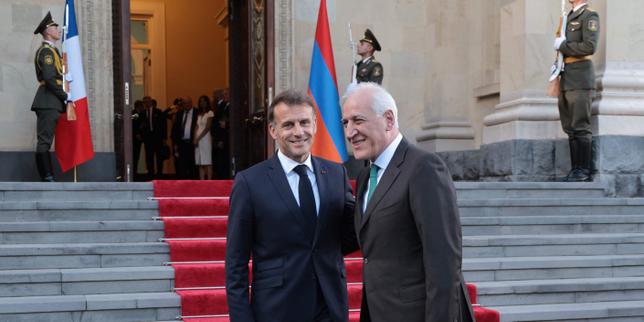
The signing of a formal strategic partnership between France and Armenia during Emmanuel Macron’s state visit marks the transition of bilateral relations from cultural affinity to a hard-power security architecture. This shift is not merely symbolic; it represents a calculated recalibration of French influence in the South Caucasus and a fundamental pivot in Armenian foreign policy. By formalizing this bond, Paris is providing a counterweight to regional revisionism while Yerevan is seeking to diversify its security dependencies away from a paralyzed Russian-led framework.
The Tripartite Framework of the Partnership
The agreement functions across three distinct operational layers: defense procurement and interoperability, diplomatic institutionalization, and infrastructure resilience. Understanding the partnership requires deconstructing these layers as interdependent variables. Also making waves in related news: The Real Reason Turkey and Saudi Arabia are Killing the Visa.
1. Defense Procurement and Military Interoperability
The core of this partnership is the shift from "observer" status to "supplier" status. Armenia’s traditional reliance on Soviet-era hardware created a technical bottleneck that prevented integration with Western doctrine. The partnership addresses this through:
- The Air Defense Variable: The acquisition of Thales Ground Master (GM200) radar systems and Mistral short-range air defense missiles creates a defensive perimeter. These systems function as force multipliers, allowing Armenia to monitor its airspace with precision previously unavailable under the CSTO (Collective Security Treaty Organization) umbrella.
- Human Capital Optimization: Beyond hardware, the agreement establishes a permanent French military advisory presence. This is designed to retrain Armenian officer corps in NATO-adjacent tactical standards, focusing on mountain warfare and decentralized command structures.
- The Logistical Constraint: France faces a geographical barrier. Armenia is landlocked between Turkey and Azerbaijan, both of whom view French involvement with hostility. To succeed, the partnership necessitates a secondary diplomatic track with Georgia to ensure a sustainable transit corridor for defense materiel.
2. Diplomatic Institutionalization
France is utilizing the state visit to elevate Armenia's status within European institutions. This moves the "Armenian Question" out of the bilateral vacuum and into the broader European Political Community (EPC) framework. This institutionalization serves two strategic functions: Additional details regarding the matter are explored by The Guardian.
- Multilateralizing Risk: By embedding the partnership within EU-led missions (such as the EUMA monitoring mission), France reduces the likelihood of unilateral Azerbaijani incursions, as any escalation would technically involve a challenge to an EU-mandated presence.
- Normalization of the "Pivot": The agreement provides Yerevan with the political cover necessary to continue its drift away from Moscow. It signals to the Kremlin that Armenia has a viable alternative, even if that alternative lacks the immediate geographical proximity of Russian forces.
3. Infrastructure and Economic Resilience
Hard power is unsustainable without economic sovereignty. The partnership targets specific sectors to decouple Armenia’s critical infrastructure from Russian state-owned enterprises:
- Energy Diversification: Civil nuclear cooperation, specifically aimed at modernizing or replacing the Metsamor nuclear power plant, is a long-term play to reduce dependency on Russian Gazprom and Rosatom.
- Transport Logistics: Investment in the "Crossroads of Peace" initiative, which aims to position Armenia as a hub between the Black Sea and the Persian Gulf, is now backed by French technical expertise.
The Cost Function of Regional Alignment
Strategic partnerships do not exist in a vacuum; they incur specific costs and trigger predictable reactions from regional stakeholders. The Franco-Armenian alignment shifts the equilibrium of the South Caucasus "3+3" regional format (Armenia, Azerbaijan, Georgia + Russia, Turkey, Iran).
The Azerbaijani Reaction and the Deterrence Gap
Baku views French involvement as a violation of the status quo that followed the 2020 Nagorno-Karabakh war. The primary risk is the "Preemptive Strike Incentive." If Azerbaijan perceives that Armenia will be significantly stronger in 24 months due to French training and equipment, the logic of preventive war dictates an escalation now while the power gap is still in Baku's favor. French strategy must therefore balance the speed of military buildup with the visibility of diplomatic deterrence to avoid inadvertently triggering the conflict it seeks to prevent.
The Russian Retrenchment
For Moscow, the partnership is a direct intrusion into its "Near Abroad." Russia’s current preoccupation with Ukraine has created a power vacuum that France is exploiting. However, Russia maintains significant leverage through:
- Economic Asymmetry: Armenia remains heavily dependent on Russian remittances and energy.
- Security Presence: The 102nd Military Base in Gyumri remains operational. The French partnership creates a paradox where two ideologically opposed security frameworks coexist within the same borders, creating significant friction in intelligence and operational security.
Geopolitical Mechanisms of the "French Pivot"
France’s decision to deepen ties with Armenia is driven by domestic and Mediterranean interests. The "French Pivot" is a manifestation of strategic autonomy applied to the Caucasus.
- The Eastern Mediterranean Link: France views the South Caucasus as the northern flank of its Mediterranean interests. By checking Turkish influence in Azerbaijan, France reinforces its position as the primary European power capable of projecting influence against Neo-Ottoman expansionism.
- The Diaspora Factor: While often cited as purely political, the Armenian diaspora in France acts as a reliable domestic constituency that supports long-term budget allocations for foreign aid and defense credits. This provides the "Strategic Partnership" with a degree of internal stability that other French foreign interventions often lack.
Strategic Vulnerabilities and Limiting Factors
The partnership faces three critical bottlenecks that could render the agreement purely symbolic.
- The Geographical Paradox: France is a distant power. In a high-intensity conflict, the time-to-deployment for French support—even logistically—is measured in days or weeks, whereas regional adversaries measure it in hours.
- The Budgetary Ceiling: Armenia’s defense budget, while increasing, is a fraction of its neighbors'. French equipment is expensive. Without significant subsidies or long-term credit lines from the French Treasury, the volume of hardware will remain insufficient to achieve a true "balance of power."
- The EU Consensus Gap: While France is the lead actor, other EU members (notably Germany and Italy) have deep energy ties with Azerbaijan. The lack of a unified EU front limits the effectiveness of the sanctions lever that France might wish to pull in the event of an escalation.
Analytical Forecast
The success of the Franco-Armenian Strategic Partnership will be determined by its ability to transition from defense procurement to defense production. If the partnership remains limited to the sale of finished French goods, it will eventually fail due to the logistical and financial constraints mentioned above.
The logical progression is the establishment of joint-venture maintenance and assembly facilities within Armenia. This would solve the "transit problem" by creating a domestic supply chain and would deepen the French commitment by putting French industrial assets—and personnel—on the ground.
Strategically, the next 18 months are the high-risk window. Armenia must utilize French diplomatic cover to finalize a peace treaty with Azerbaijan while simultaneously integrating French defensive systems. Failure to achieve a diplomatic breakthrough before the military hardware reaches critical mass will likely result in a localized military challenge from Baku intended to test the depth of Paris's commitment. The strategic play for Yerevan is to use the French partnership as a hedge, not a replacement, ensuring that the cost of any future aggression is high enough to be prohibitive.