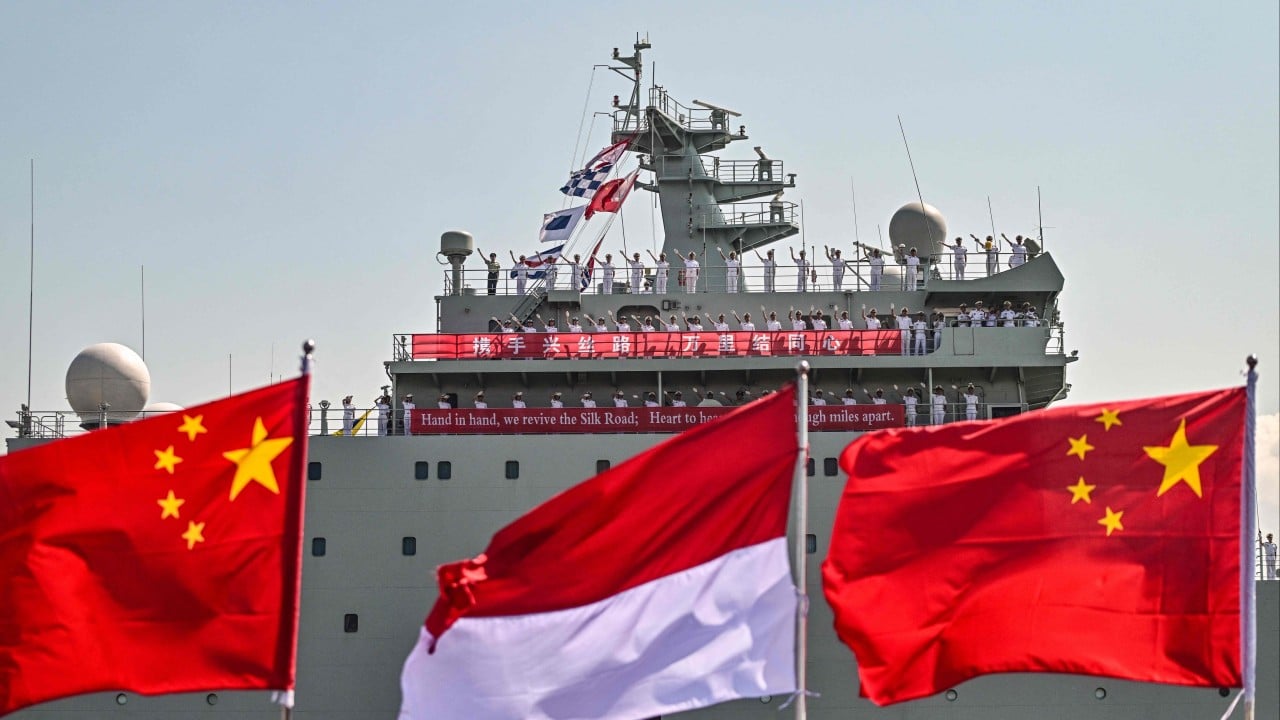
Geopolitical signaling rarely occurs in a vacuum, but the execution of a joint naval transit exercise between the People's Liberation Army Navy and the Indonesian Navy in the strategic waters east of Taiwan represents a calculated shift in maritime operational norms. Standard media commentary often reduces such maneuvers to routine diplomatic theater or sudden regional anomalies. A quantitative and structural breakdown reveals a precise tactical objective: normalizing foreign naval presence in contested exterior chokepoints to alter the baseline of jurisdictional perception.
The Structural Mechanics of the Exercise
The operational parameters of the deployment involved specific participating units—the Chinese naval vessel Honghe and the Indonesian Navy frigate KRI I Gusti Ngurah Rai. Rather than conducting high-intensity amphibious assault simulations or complex anti-submarine warfare engagements, the exercise scope was strictly confined to functional maritime transit operations:
- Communication signaling protocols using tactical codes and flags
- Formation maneuvering
- Replenishment at sea (RAS)
- Controlled separation protocols
This functional minimalism is the core of the strategy. By selecting basic transit and communication drills, the organizers insulated the deployment from direct accusations of immediate combat provocation while firmly establishing a structural precedent. Operating in the Philippine Sea and the Pacific approaches east of Taiwan places these assets outside traditional domestic training zones, directly intersecting with the exterior defensive perimeter managed by Taipei.
Strategic Intent and Jurisdictional Lawfare
From Beijing's perspective, the primary utility of this deployment resides in jurisdictional lawfare. Taiwan's Mainland Affairs Council correctly identified the core friction point: the attempt to manufacture international acceptance of administrative or operational oversight in the waters east of the island.
When a non-claimant Southeast Asian state participates in naval maneuvers within these specific coordinates, the diplomatic friction coefficient for Beijing drops significantly. For decades, foreign military presence east of Taiwan has been dominated by unilateral patrols or allied transit operations aligned with Western deterrence frameworks. Introducing a major Association of Southeast Asian Nations member into these exact waters creates an alternative diplomatic narrative. It signals to regional observers that exterior maritime zones adjacent to Taiwan are open to multi-lateral operational frameworks dictated by mainland logistics.
The Indonesian Calculus and Strategic Hedging
For Jakarta, the cost-benefit analysis governing participation relies on traditional non-aligned hedging strategies. The Indonesian military characterized the operation as a standard passing exercise (PASSEX), noting that naval vessels routinely conduct cooperative communication drills during transit home from distant deployments, such as port calls in Russia.
However, operationalizing this principle east of Taiwan diverges sharply from standard transit routes back to the Java Sea. This divergence exposes Jakarta to structural risks:
- Diplomatic blowback from regional neighbors involved in overlapping sovereignty disputes in the South China Sea
- Perceptual alignment with Beijing's maritime claims, despite formal state denials regarding the validity of expansive jurisdictional boundaries like the nine-dash line
- Complication of bilateral defense dialogues with Western and regional partners who view unilateral normalization of these waters as a security hazard
The underlying motivation points to economic pragmatism and defense diplomacy. Recent high-level diplomatic statements emphasizing joint maritime development in overlapping zones indicate that Jakarta is testing the limits of strategic autonomy. By engaging in low-threshold naval cooperation with the primary regional power, Indonesia secures immediate diplomatic and economic dividends while attempting to maintain plausible deniability through the legal classification of a passing exercise.
The Immediate Security Fallout for Taipei
For the defense establishment in Taipei, conducting these drills concurrently with annual domestic exercises, such as the Han Kuang training framework, compounds operational strain. The primary threat is not the kinetic capacity of a single Indonesian frigate paired with a PLA corvette; it is the erosion of exclusive defensive space.
The strategic geography east of Taiwan serves as a critical zone for submarine dispersal, air defense early warning, and logistical lifeline protection from the Pacific. Normalizing joint operations by foreign navies in this sector degrades the exclusivity of Taiwan's air defense identification zone and maritime operational boundaries. It forces the Taiwanese naval command to reallocate surveillance assets to monitor gray-zone cooperation that carries legal and political ramifications far exceeding its tactical footprint.
The Strategic Trajectory
The execution of this bilateral exercise marks a shift from unilateral assertion to multilateral co-optation in maritime dispute zones. By embedding a regional partner into operational vectors traditionally guarded by counter-balancing forces, Beijing establishes a template for future gray-zone normalization. Future analysis of regional stability must measure naval movements not by armament density, but by the diplomatic caliber of the participating flags and the precedent set for jurisdictional access.