Global maritime trade is fracturing along geopolitical fault lines, threatening Hong Kong’s historic status as a premier transshipment hub, yet the city possesses an unmatched structural advantage if it successfully pivots toward high-value maritime services and deeper logistical integration with mainland China.
For decades, the formula in Victoria Harbour was simple. Goods flowed out of the Pearl River Delta, crossed the border into Hong Kong, and boarded mega-vessels bound for North America and Europe. That era is over. Between Red Sea diversions, escalating tariff regimes, and aggressive competition from neighboring mainland ports, the physical movement of containers through Kwai Tsing is no longer the primary engine of growth. Survival now depends on transforming from a sheer volume port into the indispensable financial, legal, and green-fuel nerve center for China’s massive industrial hinterland.
The Anatomy of a Maritime Squeeze
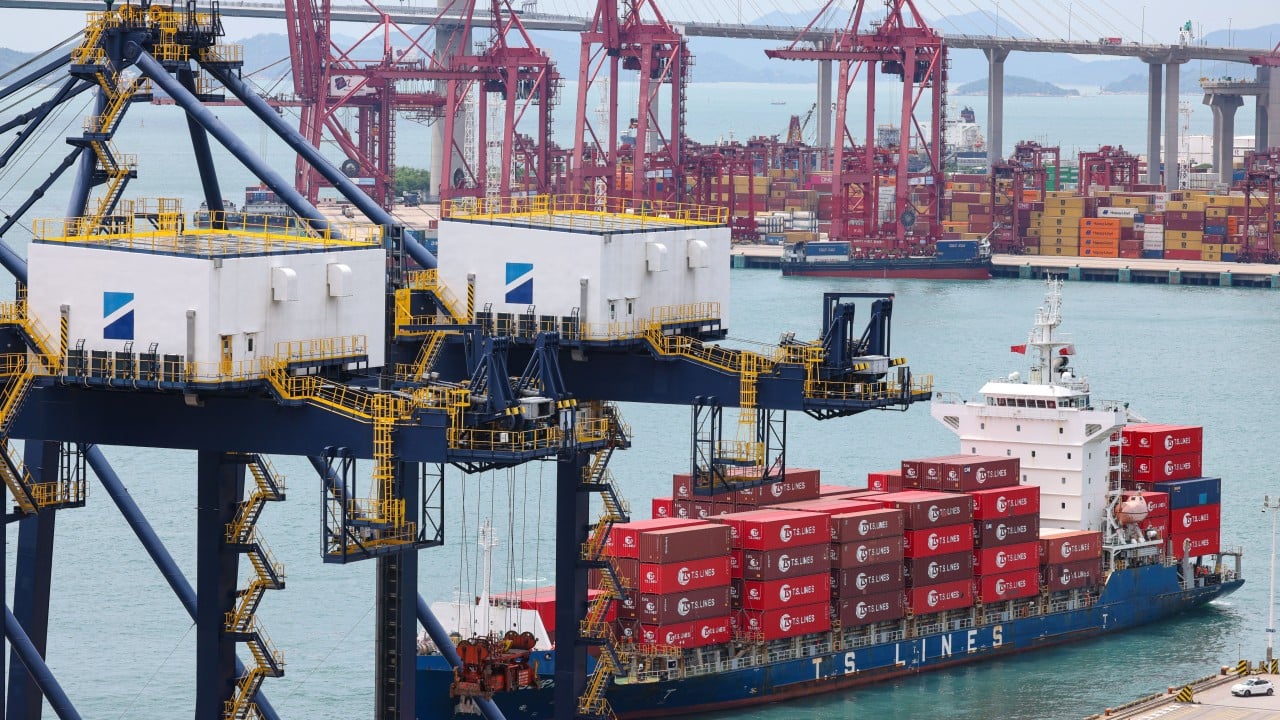
Walk along the container terminals in Kwai Chung today and the silence speaks louder than any quarterly earnings report. Cranes that once operated at relentless, around-the-clock capacity now move at a measured pace.
The numbers tell a stark story. Over the past decade, Hong Kong has steadily slipped down the global container throughput rankings, overtaken not just by Singapore, but by its own neighbors just across the Shenzhen River—Yantian, Shekou, and Nansha. When direct shipping routes from mainland ports to Western markets matured, the economic logic of trucking goods across the border to Hong Kong evaporated for standard cargo. Why pay double handling fees and navigate customs friction when a vessel can load directly in Shenzhen or Ningbo?
Then came the geopolitical shocks.
Tariff walls erected between Washington and Beijing forced multinational manufacturers to adopt a "China Plus One" strategy, shifting final assembly lines to Vietnam, India, and Mexico. While intermediate components still flow out of mainland factories to these new assembly hubs, the routing patterns have changed. Intra-Asian trade routes operate on smaller feeder vessels that frequently bypass deep-water transshipment hubs entirely.
Simultaneously, security crises in the Red Sea and shifting alliance structures have prompted major shipping alliances to redraw their global networks. When ocean carriers reorganize their vessel-sharing agreements, ports are dropped with ruthless efficiency. Every alliance reshuffle leaves Hong Kong fighting harder to retain direct mainline calls.
Why Mainland Integration is More Than a Slogan
Whenever Hong Kong faces an economic headwind, the reflex among policymakers and commentators is to point toward the Greater Bay Area (GBA). Usually, this is presented as an automatic safety net. In reality, integrating with mainland China’s maritime ecosystem is a complex, friction-heavy operational challenge that requires rewriting decades-old commercial habits.
The mainland’s manufacturing base remains the undisputed factory of the world, particularly in high-tech sectors like electric vehicles, lithium batteries, and solar components. Moving these goods requires sophisticated supply chain orchestration. However, mainland ports have spent billions building automated terminals that rival or exceed Hong Kong’s physical infrastructure. Hong Kong cannot win a price war on crane lifts.
Instead, the real opportunity lies in the friction points of cross-border trade.
Consider how intermodal transport actually functions in the Pearl River Delta. By utilizing barge networks along the Pearl River and streamlined air-sea transshipment corridors via the Hong Kong-Zhuhai-Macao Bridge, Hong Kong can act as a specialized consolidation valve. High-value, time-sensitive mainland cargo—such as pharmaceuticals, precision electronics, and cross-border e-commerce parcels—still relies heavily on Hong Kong International Airport’s unmatched air cargo network. Integrating sea freight from mainland ports directly into Hong Kong’s air cargo terminals creates a hybrid logistics pipeline that regional competitors struggle to replicate.
The Regulatory Moat
Beyond physical cargo, Hong Kong retains one asset that Shenzhen and Shanghai cannot simply build with concrete and steel: its common law legal system and free capital flow.
International shipping runs on English common law. From charterparty agreements to marine insurance claims and vessel financing, global shipowners and cargo interests demand predictable, internationally recognized legal frameworks. When a dispute arises over a delayed shipment or a damaged hull, parties want arbitration in a jurisdiction whose awards are enforceable globally.
Mainland Chinese shipping companies, state-owned enterprises, and private exporters are expanding their global fleets at an unprecedented pace. As these fleets operate in contested waters and navigate complex sanctions regimes, they require sophisticated legal insulation, maritime arbitration, and marine insurance underwriting. Hong Kong’s role is to serve as the offshore headquarters for mainland maritime capital—a place where mainland shipowners can raise international finance, register vessels under a respected flag, and resolve disputes without leaving the Chinese orbit.
The Invisible Shift Toward High-Value Maritime Services
To understand where Hong Kong’s shipping industry is actually making money, stop looking at the docks and start looking at the office towers in Central and Admiralty.
The global shipping industry is undergoing a massive, capital-intensive transition driven by decarbonization mandates from the International Maritime Organization (IMO). Vessels ordered today must run on dual-fuel engines capable of burning liquefied natural gas (LNG), green methanol, or ammonia. Financing these vessels costs hundreds of millions of dollars per ship, requiring complex leasing structures, green bonds, and specialized tax incentives.
Hong Kong has aggressively rolled out tax concessions for ship leasing, marine insurance, and ship management companies. The logic is straightforward. A single ship management firm based in Hong Kong might oversee the crewing, technical maintenance, and regulatory compliance for fifty vessels that never once drop anchor in Victoria Harbour.
Consider a hypothetical scenario involving a mid-sized mainland bulk carrier fleet. Rather than setting up offices in London or Singapore—where geopolitical tensions might expose their assets to sudden regulatory scrutiny—the owners establish their commercial management, shipbroking, and financing arms in Hong Kong. They utilize Hong Kong’s tax exemptions for qualifying ship lessors, tap into local banks for green-vessel financing, and use the Hong Kong Shipping Register. The cargo moves from Brazil to Qingdao, never touching Hong Kong waters, yet the high-margin economic value of that voyage is captured in Hong Kong.
This is the blueprint for survival. Volume is vanity; value-add is sanity.
Green Bunkering and the Infrastructure Race
If Hong Kong wants to keep physical ships calling at its port, it has to solve the fuel equation. Ocean carriers are rapidly phasing out heavy fuel oil, and they will only route mainline vessels to ports that can reliably supply alternative green fuels.
Singapore recognized this existential threat early and moved aggressively to establish itself as the world’s premier green bunkering hub, conducting landmark methanol and ammonia bunkering trials while locking in supply chains. Hong Kong has been slower off the mark, hampered by high land costs, strict environmental permitting, and a lack of domestic green fuel production.
This is where mainland China’s industrial scale becomes decisive.
Mainland China is currently the global leader in green hydrogen and green methanol production capacity, with massive projects underway in Inner Mongolia, Northeast China, and Guangdong. Hong Kong does not have the land to manufacture green methanol, nor does it have the space for sprawling chemical tank farms. However, by establishing dedicated cross-border supply pipelines and barge networks from production and storage hubs in Guangdong, Hong Kong can position itself as the international refueling station for mainland-produced green fuels.
Without this mainland supply line, Hong Kong’s bunkering sector risks obsolescence. With it, the city becomes a critical refueling node for vessels transiting between Northeast Asia and the Strait of Malacca.
The Structural Vulnerabilities Nobody Wants to Admit
Optimism about mainland integration often glosses over harsh operational realities. Relying on the mainland hinterland is not a frictionless solution, and industry veterans point to several stubborn obstacles that threaten the pivot.
First is the customs and regulatory border. Despite decades of "One Country, Two Systems," moving goods between Shenzhen and Hong Kong still involves crossing a customs boundary. For standard containerized freight, that border represents time and money. While initiatives like "single-window" customs clearance and pre-inspection schemes have reduced delays, they have not eliminated them. Every hour a truck sits at a border crossing is an argument for a shipper to use Yantian or Nansha instead.
Second is the talent bottleneck. High-value maritime services require a deeply specialized workforce: admiralty lawyers, marine underwriters, naval architects, and carbon-accounting specialists. Hong Kong faces a severe demographic squeeze and fierce competition from Singapore, Dubai, and London for experienced maritime professionals. Tax breaks can attract corporate registrations, but they cannot conjure veteran marine surveyors out of thin air.
Third is the reality of secondary sanctions and compliance risks. As geopolitical friction intensifies, international banks, insurers, and classification societies operating in Hong Kong face mounting pressure to ensure they do not fall foul of Western sanctions regimes when dealing with certain vessels or cargoes. Navigating this compliance minefield increases operational costs and makes international financiers cautious.
Rewriting the Playbook for a Fractured World
The global maritime industry is no longer governed purely by the economics of efficiency. For forty years, globalization meant optimizing supply chains for lowest cost and just-in-time delivery. Today, supply chains are optimized for resilience, political alignment, and regulatory compliance.
Hong Kong’s shipping sector cannot turn back the clock to the 1990s, when it sat unchallenged as the sole gateway to southern China. Those container volumes are gone, permanently absorbed by the massive port infrastructure China built along its own coastline.
The city’s survival as a maritime power rests entirely on its ability to execute a delicate balancing act. It must use its international legal heritage, financial depth, and tax architecture to serve the global expansion of mainland Chinese maritime enterprises, while simultaneously building the cross-border green fuel and air-sea logistics infrastructure needed to remain physically relevant. If Hong Kong fails to bridge the regulatory gap with Guangdong or lags behind Singapore in green bunkering, it will slowly devolve into a regional feeder port. If it succeeds, it will prove that in a divided world, being the indispensable middleman is still the most profitable seat at the table.