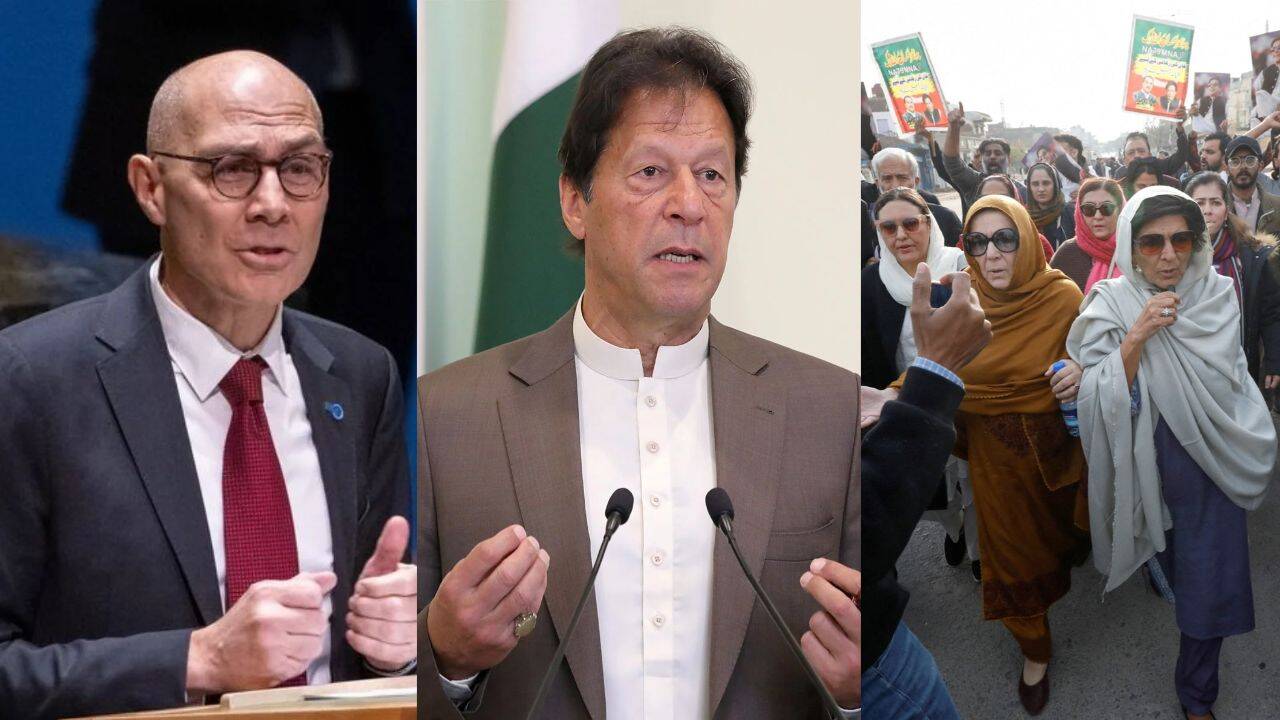
When United Nations High Commissioner for Human Rights Volker Türk publicly called for the immediate release of former Pakistani Prime Minister Imran Khan, he converted a domestic judicial standoff into an international diplomatic liability. Standard news coverage treats this intervention as an isolated humanitarian plea, yet doing so obscures the structural power dynamics at play. To understand the trajectory of Pakistan's political crisis, analysts must examine the detention not merely as a legal dispute over prison conditions, but as a multi-variable strategic bottleneck involving international treaty obligations, domestic judicial enforcement failures, and civil-military deterrence theory.
The Three Pillars of International Intervention
Türk’s statements during his interview with CNN, alongside formal communications from UN Special Rapporteurs and Amnesty International, establish a clear legal and diplomatic framework. Rather than relying on generic appeals to fairness, international observers are operationalizing three specific pressure mechanisms against Islamabad.
- Treaty-Based Legal Accountability: Organizations such as Amnesty International have anchored their critique in Article 10 of the International Covenant on Civil and Political Rights (ICCPR), which mandates that all individuals deprived of their liberty be treated with humanity and respect for inherent dignity. Pakistan is a state party to the ICCPR. By framing Khan’s detention conditions—specifically reports of prolonged solitary confinement lasting up to twenty-two hours a day—as a direct breach of binding international law, human rights monitors shift the burden from discretionary domestic policy to treaty non-compliance.
- Medical Vulnerability as an Escalation Trigger: High-profile detentions carry an asymmetric risk profile: the physical deterioration of a detainee transforms a manageable political containment strategy into an uncontrollable national crisis. UN experts have explicitly highlighted Khan’s pre-existing physiological vulnerabilities, including a 2013 spinal injury and gunshot wounds from a 2022 assassination attempt, alongside acute symptoms such as weight loss, nausea, and vomiting. Simultaneously, the reported denial of adequate ophthalmological care for his wife, Bushra Bibi, compounds the humanitarian exposure. In risk management terms, custodial authorities face a binary outcome where inadequate medical provisioning yields zero strategic upside while carrying catastrophic reputational and civil-unrest downside.
- Confidence-Building De-escalation: Türk explicitly framed Khan’s release as a "confidence-building measure" necessary to diffuse systemic political tension. In conflict resolution theory, confidence-building measures (CBMs) are unilateral or bilateral actions designed to reduce uncertainty and signal non-hostile intent between entrenched adversaries. By labeling release a CBM rather than a judicial exoneration, the UN provides a diplomatic off-ramp that allows state institutions to lower the political temperature without conceding legal defeat in pending cases, such as the Toshakhana proceedings or Anti-Terrorism Act trials.
The Institutional Enforcement Gap
A critical failure point in Pakistan’s governance structure is the divergence between judicial orders and executive implementation. On November 16, Khan issued an open letter from Adiala Jail to Pakistan’s senior judiciary, asserting that existing court directives regarding medical access and family visitation remained unimplemented.
This dynamic illustrates a classic principal-agent breakdown within state institutions. Even when superior courts issue orders—such as granting access to personal physicians or permitting telephone contact with Khan’s sons, Kasim and Sulaiman—the operational execution rests with provincial prison administrations and security apparatuses. When lower-level custodial authorities delay or restrict compliance, the judiciary’s enforcement mechanism relies entirely on contempt proceedings, which prove slow and politically fraught when executive power is consolidated elsewhere.
The isolation of a political leader from legal counsel, family members, and reading materials functions operationally as an information blockade. By restricting communication channels since December 2025, state authorities aim to degrade the detainee's command-and-control capability over the Pakistan Tehreek-e-Insaf (PTI) party apparatus. However, this tactic generates an unintended counter-effect: it removes moderate, institutional channels of political negotiation while amplifying radicalized rhetoric from external actors, including family members and diaspora advocates who frame the situation in existential terms.
The Deterrence Trap and Economic Exposure
From the perspective of Islamabad's ruling coalition and military establishment, maintaining strict containment of Khan serves a clear deterrence objective. Following the May 9, 2023 protests, state strategy shifted toward demonstrating that challenging institutional red lines carries severe, prolonged personal and political costs. Releasing Khan prematurely risks signaling institutional weakness, potentially triggering mass mobilization that could destabilize the governing administration.
Yet this deterrence model collides directly with Pakistan’s macroeconomic vulnerabilities. Developing economies reliant on multilateral lending facilities, sovereign debt restructuring, and preferential trade agreements cannot insulate domestic judicial practices from external scrutiny. International scrutiny from the Office of the High Commissioner for Human Rights (OHCHR) feeds directly into the risk assessments conducted by Western legislatures, development banks, and trade blocs.
When UN Special Rapporteurs formally document substandard cell conditions—such as inadequate ventilation, lack of natural light, extreme seasonal temperature exposure, and insect infestations—those findings enter the permanent diplomatic record. Foreign ministries in Washington, London, and Brussels utilize these documented baselines when calibrating bilateral aid conditions, Generalized Scheme of Preferences (GSP+) trade reviews, and diplomatic engagement levels. Thus, a domestic containment tactic imposes a recurring, compounding tax on foreign policy bandwidth and economic recovery efforts.
Evaluating Strategic Pathways for Islamabad
State authorities in Pakistan currently face three distinct operational pathways, each carrying specific trade-offs and limitations.
Pathway A: Status Quo Containment
Maintaining twenty-two-hour solitary confinement and restricting external access preserves short-term domestic deterrence and prevents Khan from directly organizing street protests. The primary limitation of this approach is fragility. Any acute medical emergency affecting either Khan or Bushra Bibi would instantly validate international accusations of custodial neglect, triggering severe domestic unrest and irreversible diplomatic damage.
Pathway B: Procedural Normalization Without Release
Authorities could fully enforce Supreme Court directives by restoring regular family visits, unrestricted legal consultations, consistent access to personal physicians, and standard jail conditions compliant with ICCPR Article 10. This option mitigates immediate humanitarian liability and neutralizes UN criticism regarding cruel or inhumane treatment without surrendering custodial control. The limitation lies in political signaling: restoring communication channels allows Khan to reassert direct tactical control over PTI’s political messaging and mobilization strategy.
Pathway C: Negotiated De-escalation and Conditional Bail
Following Türk’s CBM framework, the state could facilitate judicial bail or medical parole tied to structured political dialogue. This resolves international diplomatic pressure and removes the custodial health risk. However, this pathway carries the highest immediate domestic volatility for the incumbent government, as an active, unincarcerated opposition leader would immediately challenge the legitimacy of the current political arrangement.
The Optimal Strategic Play
For Islamabad, continuing along Pathway A represents an unsustainable risk-reward asymmetry. The diplomatic and economic costs of defying UN human rights mechanisms will continue to escalate, while the physical health risks of prolonged solitary confinement create a ticking operational liability.
State authorities should immediately execute Pathway B as an interim stabilization measure while laying the groundwork for Pathway C. Specifically, the Ministry of Interior and Punjab provincial authorities must enforce existing judicial orders to the letter: terminate prolonged solitary confinement, guarantee independent medical oversight for both Imran Khan and Bushra Bibi, and restore verified communication access for legal counsel and immediate family. Neutralizing the humanitarian crisis strips international critics of their most potent moral and legal leverage, buying the Pakistani state the diplomatic breathing room required to negotiate a durable domestic political settlement on its own terms.