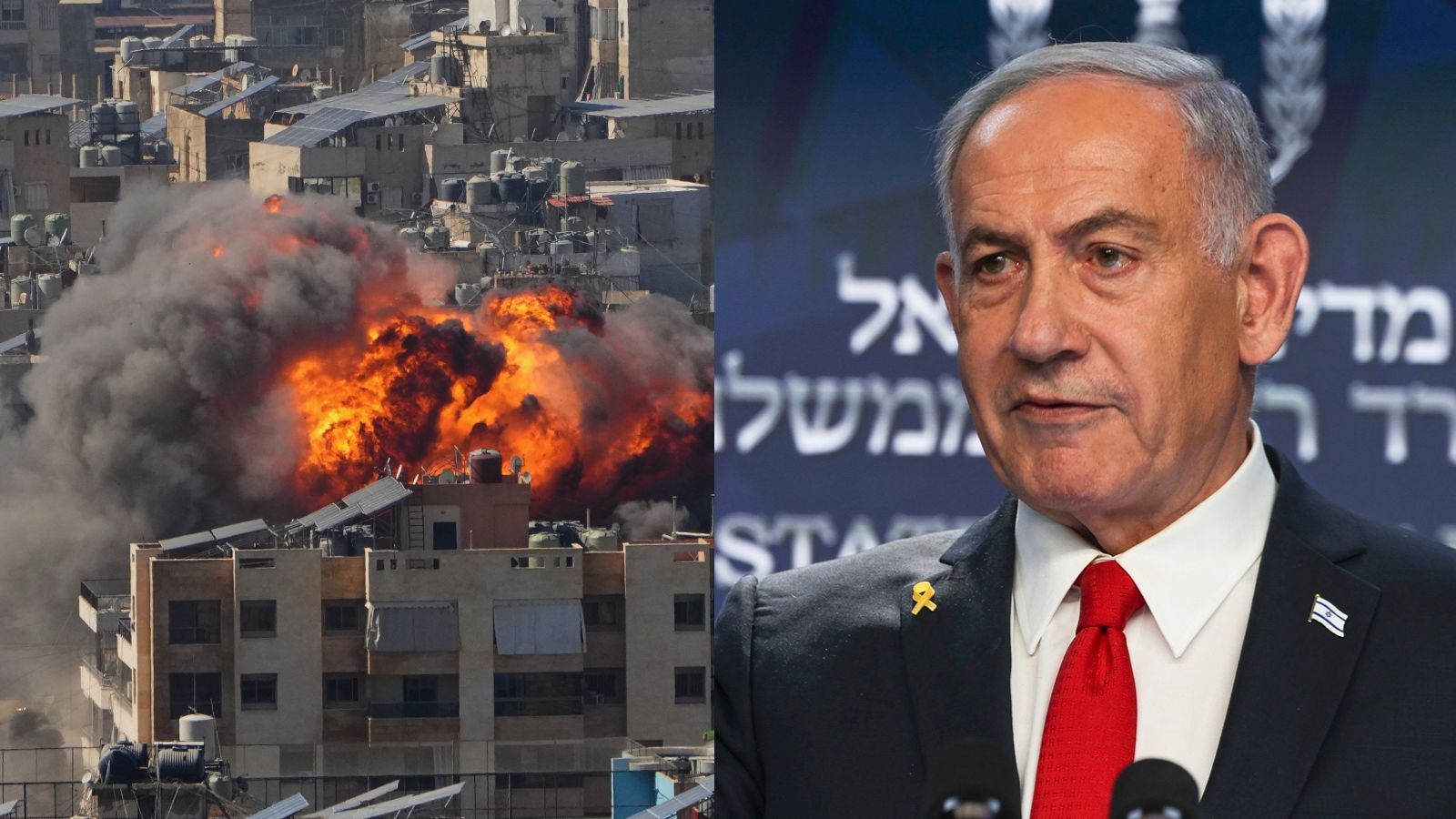
The current conflict between Israel and Iran has transitioned from a "gray zone" shadow war into a direct kinetic engagement characterized by a fundamental shift in the regional security architecture. While rhetoric regarding "breaking bones" suggests a decisive military conclusion, the strategic reality is defined by a complex feedback loop involving missile telemetry, energy infrastructure vulnerability, and the breakdown of traditional deterrence. Understanding the trajectory of this war requires an analysis of the structural mechanics of attrition and the logistical constraints governing both Tehran and Jerusalem.
The Asymmetric Attrition Function
The conflict is currently operating under an asymmetric attrition function where the cost of defense for Israel and its allies significantly outweighs the cost of offense for Iran. This economic disparity is the primary driver of Iranian persistence.
- Interceptor Economics: The unit cost of a Long-Range Interceptor (such as the Arrow-3 or Patriot PAC-3) ranges from $2 million to $4 million. In contrast, the Iranian-made Shahed-136 loitering munition costs approximately $20,000 to $50,000.
- Saturation Thresholds: Iran’s strategy relies on "saturation firing"—launching a mix of low-cost drones, cruise missiles, and medium-range ballistic missiles (MRBMs) to overwhelm radar processing capabilities and deplete interceptor stocks.
- The Probability of Leakage: No missile defense system maintains a 100% intercept rate against a synchronized multi-vector attack. Even a 90% success rate allows 10% of high-explosive payloads to reach urban or industrial centers, which, in a high-volume scenario, constitutes a catastrophic failure of domestic security.
Strategic Depth and the Gulf Power Vacuum
The expansion of Iranian attacks toward Gulf Cooperation Council (GCC) states is not a peripheral consequence of the war but a calculated maneuver to externalize the costs of the conflict. By targeting energy infrastructure and shipping lanes in the Persian Gulf, Tehran forces a global economic recalculation.
This strategy operates on three specific vectors:
- Supply Chain Interdiction: Threatening the Strait of Hormuz creates an immediate risk premium on Brent Crude, impacting global inflation and putting diplomatic pressure on Western powers to restrain Israeli kinetic responses.
- Regional Neutralization: By demonstrating the vulnerability of desalination plants and oil refineries in neighboring states, Iran aims to coerce Gulf nations into denying the United States or Israel the use of their airspace for offensive operations.
- The Proximity Paradox: Despite increased defense spending, Gulf states lack the integrated missile defense architecture required to stop short-range, low-altitude cruise missiles launched from across the water. Their geographic proximity to Iran reduces early warning times to under three minutes, rendering most high-altitude systems ineffective.
The Architecture of Israeli Kinetic Response
Israel’s stated objective of "breaking Tehran’s bones" refers to a systematic degradation of the Islamic Revolutionary Guard Corps’ (IRGC) command-and-control (C2) and its ability to project power through proxies. This is being executed through a tiered offensive framework.
Tier 1: Logistical Decapitation
This involves targeting the "land bridge" stretching through Iraq and Syria. By destroying transshipment hubs and weapon storage facilities, Israel reduces the volume of advanced precision-guided munitions (PGMs) reaching Hezbollah. The efficacy of this tier is measured by the "interdiction-to-launch ratio"—the percentage of Iranian hardware destroyed before it can be deployed against Israeli territory.
Tier 2: Precision Attrition of Leadership
The focus here is the elimination of high-value targets (HVTs) within the IRGC-Quds Force. This creates a temporary vacuum in operational expertise and disrupts the highly personalized networks that maintain proxy cohesion. However, the limitation of this strategy is the "hydra effect," where bureaucratic structures within the IRGC are designed to absorb leadership losses and promote junior officers with hardened ideological stances.
Tier 3: Economic and Infrastructure Neutralization
Israeli planners are increasingly evaluating the "Critical Infrastructure Index." Targeting Iranian oil terminals or power grids serves to delegitimize the central government by highlighting its inability to provide basic services. The risk inherent in Tier 3 is the "escalation ladder" problem: attacking sovereign economic assets often triggers a proportional response against Israeli offshore gas rigs or high-tech manufacturing hubs.
Technical Constraints of Modern Missile Warfare
The shift from proxy skirmishes to direct state-on-state missile exchanges highlights a critical technological bottleneck: the production rate of precision components.
- Guidance Systems: Both nations rely on sophisticated GPS-independent inertial navigation systems (INS) and optical seekers. Sanctions have hampered Iran’s access to high-grade microelectronics, but "dual-use" supply chains through third-party intermediaries have allowed for continued production of the Fattah-1 and Kheibar Shekan missiles.
- Solid vs. Liquid Fuel: Iran has transitioned much of its arsenal to solid-fuel rockets. This is a critical tactical development because solid-fuel missiles can be stored in a fueled state and launched with minimal preparation time, significantly narrowing the "window of vulnerability" during which Israeli intelligence can detect and neutralize a launcher before it fires.
- Hypersonic Claims: While Iranian claims of functional hypersonic maneuverable reentry vehicles (MaRVs) are subject to skepticism, the underlying physics—missiles traveling at Mach 5+ with the ability to change course mid-flight—represent the next phase of the technological arms race. Traditional ballistic trajectories are predictable; maneuvering warheads are not.
The Nuclear Threshold and the Doctrine of Last Resort
The underlying tension in the current war is the proximity of Iran to "breakout capacity"—the point at which it possesses enough highly enriched uranium (HEU) for a nuclear device.
The Israeli "Begin Doctrine" mandates that no enemy state in the region be allowed to acquire weapons of mass destruction. This creates a hard ceiling on how long Israel can engage in a conventional war of attrition. If Tehran perceives that its conventional "bones" are truly being broken, the incentive to cross the nuclear threshold increases as a final guarantee of regime survival. Conversely, the more Israel degrades Iranian conventional capabilities, the more it feels compelled to strike nuclear sites like Natanz or Fordow before the "zone of immunity" is reached.
The current conflict is not a series of isolated events but a structured progression toward a systemic realignment. Israel is attempting to reset the regional balance of power through superior kinetic precision and intelligence. Iran is countering by leveraging its geography and the vulnerability of global energy markets to ensure that the cost of an Israeli "victory" is higher than the international community is willing to pay.
The immediate tactical priority for regional stability is the establishment of a multi-national integrated air and missile defense (IAMD) network that spans from the Mediterranean to the Arabian Sea. Without this structural synchronization, the Middle East remains trapped in a cycle where offense is cheap, defense is expensive, and the margin for error is non-existent.
The strategic play now is a transition from reactive defense to proactive neutralization of launch platforms. This requires a shift in intelligence focus from "threat detection" to "launch-cycle disruption," targeting the industrial facilities where the Shahed and Fattah platforms are assembled. Success will not be found in rhetoric, but in the systematic destruction of the manufacturing base that fuels the asymmetric attrition function.