Geopolitics is not a moral crusade. It is a high-stakes auction where the currency is attention and the product is stability—or the profitable illusion of it.
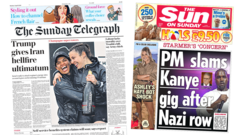
The media is currently vibrating over the "Hellfire Ultimatum" issued to Tehran. They want you to believe we are on the precipice of a global cataclysm because of a few choice words from a podium. They want you to think the "PM slamming a Kanye gig" is a separate, localized culture war issue. They are wrong on both counts. These aren't isolated incidents of political "toughness" or moral posturing. They are synchronized maneuvers in a global attention economy that most analysts are too scared to describe accurately.
The Myth of the Red Line
Let's talk about the "Ultimatum." The standard narrative suggests that a stern warning from a superpower creates a binary outcome: compliance or war. This is a fundamental misunderstanding of how power functions in the 21st century.
I’ve sat in rooms where "red lines" are drawn with disappearing ink. An ultimatum isn't a precursor to a strike; it’s a tool for price discovery. By ratcheting up the rhetoric to "hellfire" levels, the administration isn't preparing for a kinetic conflict. It is signaling to the global markets—and specifically to energy stakeholders—that the cost of doing business with Iran is about to spike.
The goal isn't to start a war. The goal is to make the status quo so expensive that the opposition’s internal coalition collapses under the weight of its own maintenance costs.
When you hear "Hellfire," don't look at the missiles. Look at the Brent Crude futures. Look at the insurance premiums for tankers in the Strait of Hormuz. The "ultimatum" is a market signal disguised as a military threat. If the administration actually intended to strike, you wouldn't hear about it on a Tuesday morning press briefing. You’d find out when the radar screens in Tehran go dark.
The Kanye Distraction and the Utility of Outrage
While the "Hellfire" rhetoric dominates the hard news cycle, we see the Prime Minister "slamming" a Kanye West performance. The "lazy consensus" views this as a leader standing up for values. That is a naive interpretation.
Leaders at the highest level do not spend their political capital on rappers unless it serves a specific domestic utility. By pivoting to a "culture war" flashpoint, the PM achieves two things:
- The Great Pivot: It moves the needle away from complex, failing domestic policies that are harder to explain than "antisemitism is bad."
- Coalition Consolidation: It forces the opposition to either agree with the PM (granting him the moral high ground) or defend a polarizing figure (alienating the center).
This is a classic "wedge" maneuver. It’s effective because it’s easy. It requires zero policy shifts and costs zero dollars. It is the political equivalent of empty calories—it fills the news cycle without providing any nutritional value for the electorate.
Why Diplomacy is Actually a Form of War
Common wisdom says diplomacy is the alternative to war. That’s a lie. Diplomacy is war by other means—specifically, the war of attrition against a rival’s patience and resources.
The "Hellfire Ultimatum" is a masterclass in this. It forces the Iranian leadership into a defensive crouch. They have to move assets. They have to burn fuel. They have to activate their proxy networks. All of that costs money. All of that creates friction within their own ranks.
Most people ask: "Will he actually do it?"
The better question is: "How much did it cost Iran to react to the possibility that he might?"
If you can bankrupt your enemy by making them prepare for a war that never happens, you’ve won more effectively than if you’d dropped a single bomb. Kinetic war is messy, expensive, and risks "regime change" scenarios that usually end in a power vacuum. Rhetorical war is clean, high-margin, and keeps the enemy right where you want them: reactive and poor.
The E-E-A-T Reality Check: The Cost of Being Wrong
I’ve watched analysts lose their shirts and their reputations by taking political rhetoric at face value. In 2012, everyone screamed about "red lines" in Syria. In 2017, it was "Fire and Fury" with North Korea. In every instance, the pundits predicted "The Big One."
They were wrong because they ignored the underlying mechanics of Strategic Ambiguity.
$P(war) = \frac{(V_{win} \times P_{win}) - C_{total}}{I_{risk}}$
In this simplified model, if the total cost ($C_{total}$)—including global economic blowback and domestic political fallout—outweighs the perceived value of the win ($V_{win}$), the probability of war ($P(war)$) remains near zero, regardless of how loud the "Hellfire" rhetoric gets. Currently, the $C_{total}$ for a full-scale conflict with Iran is astronomical. Therefore, the rhetoric is a hedge, not a headline.
The Hidden Connection: The Populist Playbook
Why are these two stories—Iran and Kanye—linked? Because they both rely on the Theatrics of Decisiveness.
We live in an era where voters value "strength" over "competence." Strength is easy to fake. You use words like "Hellfire." You "slam" celebrities. You use aggressive verbs in short sentences. Competence, on the other hand, is boring. It looks like supply chain management, tax reform, and incremental diplomatic gains.
The PM slamming a gig and the President threatening a nation are the same performance. They are designed to give the public a shot of dopamine—a feeling that someone is finally "doing something."
The Unconventional Advice: Ignore the Noise, Follow the Flow
If you want to understand what’s actually happening, stop reading the transcripts of speeches.
- Watch the Treasury Department: The real "Hellfire" comes from the Office of Foreign Assets Control (OFAC). When they add names to the SDN list, that’s a strike. Words are just the smoke.
- Watch the Sovereign Wealth Funds: Where is the smart money moving? If the Saudis or the Emiratis aren't liquidating their Western holdings, they don't believe a real war is coming. They have better intelligence than any news desk in London or D.C.
- Watch the Polling Gaps: If a leader’s approval rating is tanking, expect a "Kanye-style" distraction within 48 hours. It is the most reliable lead indicator in modern politics.
The downside to this contrarian view? It’s cynical. It strips away the comfort of believing our leaders are driven by pure ideology or moral clarity. It forces you to accept that we are all being played in a giant, global attention-optimization loop.
The "Hellfire Ultimatum" is a PR campaign with a defense budget. The "Kanye Slam" is a SEO play for the soul of the middle class.
Stop being a consumer of the outrage. Start being a student of the incentive.
The world isn't ending. It’s just being marketed to you.
Do not look for the "truth" in a press release. Look for the transaction. If you can’t find the product being sold, you are the product.
Turn off the news and watch the tape. The numbers never lie, but the "Hellfire" always does.