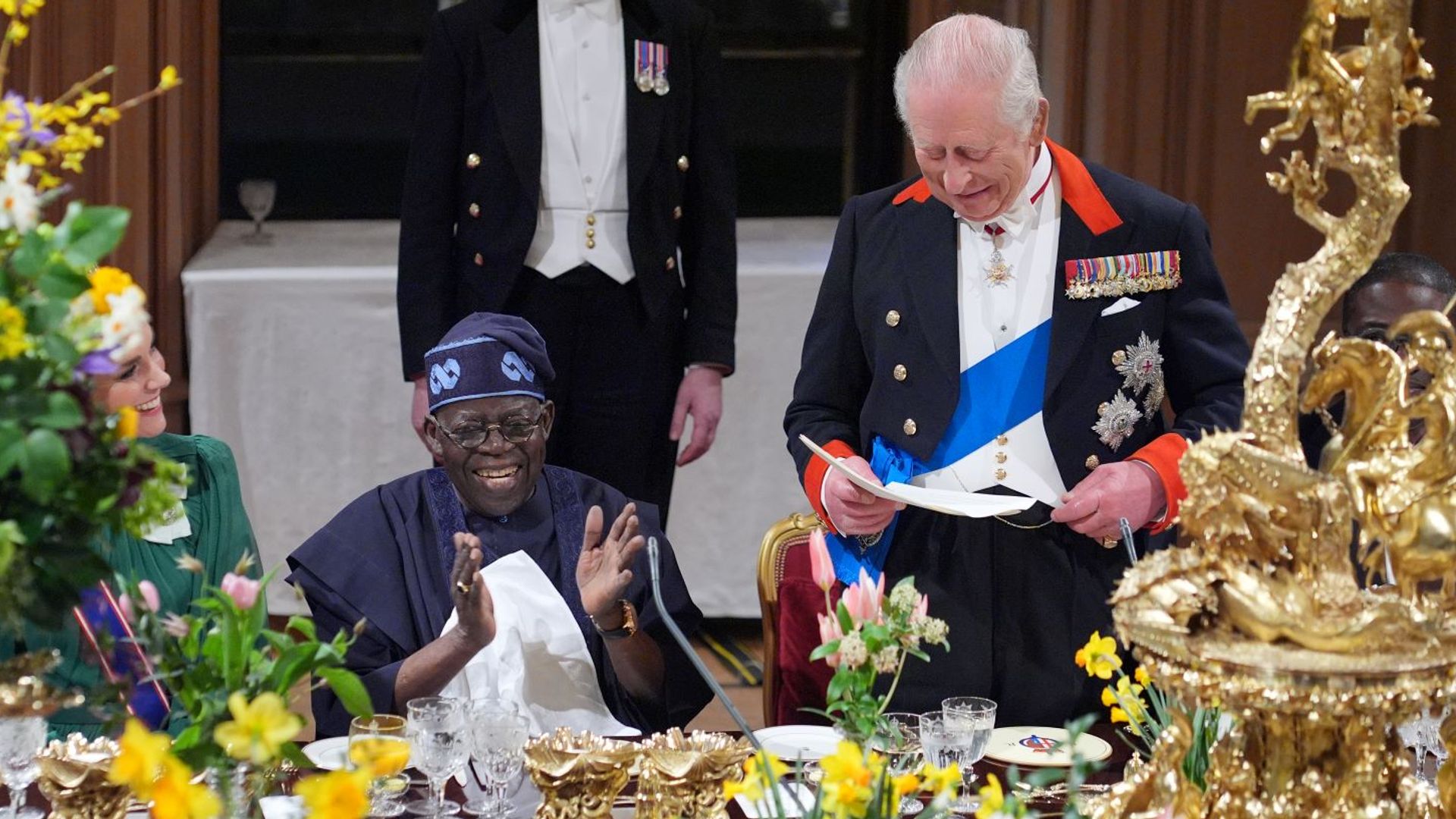
The British Monarchy serves as the primary soft-power deployment mechanism for the United Kingdom’s Foreign, Commonwealth & Development Office (FCDO). While media coverage of a state banquet focuses on the ceremonial aesthetic, the functional objective is the stabilization and expansion of the UK-Nigeria bilateral trade relationship, currently valued at approximately £7 billion annually. King Charles III’s characterization of the UK as being "blessed" by Nigerian influence is not a sentimental observation; it is a recognition of the demographic and economic integration required to offset the UK's post-Brexit isolation.
The Strategic Logic of Sovereign Hospitality
State visits are high-yield diplomatic investments designed to bypass standard bureaucratic friction. In the case of Nigeria—Africa’s largest economy and most populous nation—the UK is competing against aggressive capital deployment from China and the European Union. The banquet serves as a formal "seal of approval" for institutional investors, signaling that the Nigerian administration is a preferred partner for long-term infrastructure and energy projects.
The logic follows a three-stage conversion funnel:
- Validation: The highest level of British protocol is used to validate the legitimacy and importance of the visiting head of state.
- Access: The event brings together the UK’s cabinet ministers, City of London financiers, and Nigerian industrial titans in a setting that facilitates informal "soft" commitments.
- Momentum: The ceremony provides the political cover necessary for civil servants to finalize trade agreements that may have stalled in technical committees.
Demographic Arbitrage and the Diaspora Multiplier
The King’s emphasis on the "extraordinary" contribution of the Nigerian diaspora reflects a critical economic reality: the UK’s healthcare, tech, and creative sectors are increasingly dependent on Nigerian human capital. This is not merely a matter of labor volume; it is a matter of high-skill migration that provides a net positive fiscal impact.
The diaspora functions as a living bridge for bilateral trade through several mechanisms:
- Remittance Flows: Substantial capital transfers from the UK to Nigeria support consumer demand in West Africa, creating a larger market for British exports.
- Knowledge Transfer: Dual-national professionals facilitate the entry of British firms into the complex Nigerian regulatory environment, reducing the "cost of entry" for UK SMEs.
- Cultural Export: The global dominance of Nigerian music, film (Nollywood), and fashion provides a halo effect that increases the "cool factor" of Commonwealth-aligned markets, driving soft-power alignment.
The Energy and Security Bottleneck
For the UK, the relationship is a hedge against energy insecurity. Nigeria possesses some of the world’s largest natural gas reserves. As Europe pivots away from Russian hydrocarbons, securing long-term Liquefied Natural Gas (LNG) contracts with Nigeria is a matter of national security.
However, this supply chain faces a significant bottleneck: internal security within Nigeria. The "blessing" the King referred to is tempered by the reality of oil theft in the Niger Delta and insurgencies in the North. British military assistance and training programs are the "price of admission" for these energy guarantees. The state visit serves to reaffirm the UK’s commitment to providing the tactical expertise and equipment necessary for Nigeria to stabilize its export corridors.
The Commonwealth as an Economic Bloc
The Commonwealth is often criticized as a vestigial organ of empire, but in a fractured global trade environment, it represents a pre-aligned regulatory framework. Nigeria is the anchor tenant of the African Commonwealth. If the UK can deepen its integration with Nigeria, it gains a strategic foothold in the African Continental Free Trade Area (AfCFTA).
The structural advantage of the Commonwealth lies in the "Common Law Advantage." Because both nations share a legal heritage, the cost of litigating cross-border contracts is lower than it would be between the UK and a non-Commonwealth state. This shared legal architecture acts as a hidden subsidy for British law firms and insurers operating in Lagos and Abuja.
Addressing the Colonial Friction Point
A rigorous analysis cannot ignore the historical friction that complicates this partnership. The King’s rhetoric of "blessing" and "shared history" is a tactical attempt to manage the growing demand for reparations and the return of cultural artifacts like the Benin Bronzes.
The UK’s strategy here is one of "Constructive Engagement without Admission of Liability." By focusing on the future economic benefits of the partnership, the British state seeks to satisfy the Nigerian political class’s desire for respect and investment, thereby de-prioritizing more contentious historical grievances that could lead to financial liabilities.
The Currency and Liquidity Constraint
The primary risk to this bilateral strategy is the volatility of the Naira. Nigeria’s recent currency reforms and the removal of fuel subsidies have created a period of intense inflationary pressure. For British exporters, this creates a "transfer risk"—the inability of Nigerian partners to access the foreign exchange (USD or GBP) necessary to pay for British goods and services.
The UK’s Export Finance (UKEF) agency is the lever used to mitigate this. By providing government-backed guarantees, the UK allows Nigerian buyers to purchase British equipment on credit, effectively subsidizing the trade and ensuring that British firms remain the preferred choice despite the macroeconomic headwinds in West Africa.
Structural Interdependence in Healthcare
The National Health Service (NHS) represents the most direct point of contact between the two nations. Nigeria is one of the top sources of foreign-trained doctors and nurses in the UK. This creates a moral and strategic tension: the UK benefits from Nigeria’s "brain drain," while Nigeria suffers from a shortage of medical professionals.
To maintain the "blessed" relationship, the UK must move beyond simple recruitment and toward a model of "Managed Migration." This involves:
- Reinvestment: Funding medical training schools in Nigeria to ensure a surplus of professionals.
- Circular Migration: Creating pathways for Nigerian professionals to work in the UK for fixed periods before returning home with enhanced skills.
- Technology Licensing: Exporting British MedTech and e-health platforms to Nigeria to allow fewer doctors to treat more patients effectively.
Final Strategic Play
The UK must stop treating Nigeria as a developing nation to be "helped" and start treating it as a strategic venture capital play. The Nigerian economy is projected to be among the world's top ten by 2050. British firms that do not establish deep, localized roots in the Lagos-Ibadan-Kano corridor within the next 36 months will find themselves permanently locked out by Chinese and Indian competitors who are already comfortable with the region’s risk profile.
The recommendation for British stakeholders is to move capital into "Nigeria-Plus" strategies: using Nigeria as the manufacturing and logistical hub for the broader West African market. This requires a shift from transactional trade (selling finished goods) to structural investment (building local assembly plants and data centers). The state banquet was the opening bell; the real value will be captured by those who treat the subsequent trade missions as high-stakes procurement exercises rather than mere diplomatic courtesies.
Deepen the UK Export Finance (UKEF) limits for Nigeria specifically to support the transition from fossil fuel extraction to grid-scale renewable infrastructure, locking in British engineering firms as the primary architects of Nigeria’s industrial modernization.