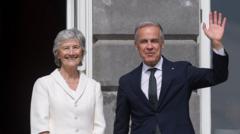
State visits by G7 heads of government are rarely dictated by sentimentality. While standard media narratives frame Canadian Prime Minister Mark Carney June 2026 visit to Aghagower, County Mayo, as a localized, personal homecoming, a rigorous analysis reveals a highly calculated execution of soft-power deployment. By leveraging ancestral capital, the Canadian administration seeks to optimize bilateral trade channels, secure diplomatic leverage ahead of Ireland's rotating European Union presidency, and reinforce domestic political branding regarding migration frameworks.
The mechanics of this state visit operate across three distinct functional layers: macroeconomic alignment, institutional trust building, and the conversion of personal heritage into state-level negotiating equity.
The Tri-Axe Framework of Heritage-Enabled Diplomacy
The deployment of personal narrative in international relations serves as a mechanism to minimize friction in bilateral negotiations. For a leader with Carney's background—spanning the governorships of two central banks before entering executive political office—the optimization of these informal networks follows a deliberate structural logic.
1. The Institutional Trust Conduit
Diplomatic alignment accelerates when historical institutional linkages are brought to the forefront. Prior to departing Dublin for County Mayo, Carney accepted an official commendation from the national police service of the Republic of Ireland, An Garda Síochána. The historical connection is precise: Carney’s grandfather, Robert Carney, was among the inaugural cohort of officers integrated into the force upon its foundation in 1922.
This interaction is not merely ceremonial; it establishes a baseline of institutional reciprocity. By linking the foundational architecture of the Irish state to the lineage of a contemporary G7 executive, the Canadian delegation converts historical labor migration into modern diplomatic credit. This credit is immediately deployable in security and intelligence-sharing frameworks between the two nations.
2. Regulatory Arbitrage and Trade Capitalization
The timing of the Mayo visit intersects with a critical macroeconomic bottleneck. Canada and Ireland operate under the structural parameters of the Comprehensive Economic and Trade Agreement (CETA). However, full ratification remains incomplete across several EU member states, including persistent legal and political hurdles within the Irish legislative ecosystem.
Ireland assumes the six-month rotating presidency of the European Union in the latter half of 2026. This position grants Dublin significant agenda-setting authority over the European Council. The strategic utility of Carney's deployment to Aghagower is tied directly to this timeline:
- The Access Point: Cultivating local executive relationships—evidenced by concurrent meetings with Irish President Catherine Connolly at Westport House and ongoing briefings with Taoiseach Micheál Martin—creates direct channels to bypass traditional bureaucratic delays in Brussels.
- The Leverage Mechanism: By establishing deep, localized goodwill in the West of Ireland, the Canadian administration builds domestic public pressure within Ireland to resolve outstanding CETA ratification hurdles. It frames economic cooperation not as a technocratic corporate mandate, but as a reciprocal historical debt.
3. Domestic Migration Narrative Engineering
A central challenge for the current Canadian administration involves stabilizing domestic support for immigration policy amidst structural housing and infrastructure constraints. Carney’s public rhetoric during the Mayo press conference targeted this specific domestic friction point, utilizing a feedback loop that connects ancestral emigration with modern immigration logic.
The mechanism operates as follows:
$$\text{Historical Emigration (Ireland, 1925)} \longrightarrow \text{Canadian Capital Absorption} \longrightarrow \text{Global Executive Leadership (2026)}$$
By referencing his grandparents, Robert Carney and Nora Moran, who exited County Mayo aboard the steamship Montnairn in July 1925 as tenant farmers, Carney validates the concept of human capital appreciation through migration. Framing Canada as an economic engine that absorbs global labor, integrates it, and yields generational leadership allows the administration to defend its immigration models to an increasingly skeptical domestic electorate.
Structural Constraints of Heritage Diplomacy
While the deployment of ancestral capital yields immediate soft-power returns, its efficacy is bounded by severe structural limitations. Leaders cannot rely on heritage to resolve hard economic divergence.
First, prior to assuming the Canadian prime ministership, Carney was required to formally renounce both his British and Irish citizenships to satisfy domestic constitutional expectations and eliminate conflicting allegiances. This legal reality creates a hard boundary. The Irish state recognizes him strictly as a foreign head of government; the ancestral connection cannot legally influence statutory decision-making regarding corporate tax rates or data privacy laws within the EU framework.
Second, emotional capital does not alter the fundamental cost functions of international business. While local establishments in Aghagower modify consumer offerings to mark the event, the underlying commercial realities of the Ireland-Canada Business Association rely on quantifiable metrics:
- Regulatory alignment on digital asset management.
- Tariff reduction schedules for agricultural exports.
- Double-taxation treaty optimizations.
The soft-power surplus generated by a public walkabout or a symbolic tree-planting ceremony with the Aughagower Community Council provides, at best, a short-term reduction in negotiating friction. It cannot alter the structural demands of sovereign self-interest.
The Immediate Strategic Play
The Canadian delegation's next operational move must focus on converting the symbolic capital generated in County Mayo into explicit policy concessions ahead of the EU presidential transition. This requires a three-part execution strategy.
First, use the direct channel established with President Connolly and Taoiseach Martin to secure a formal commitment for an extraordinary bilateral trade summit in Dublin during the autumn 2026 EU leadership meetings.
Second, instruct Global Affairs Canada to leverage the local goodwill generated in the West of Ireland to launch a targeted sub-national investment framework. This framework should focus on technological and green-energy joint ventures between Canadian firms and enterprises located outside the Dublin corporate hub, specifically targeting counties like Mayo to institutionalize the economic relationship.
Finally, embed the imagery and rhetoric of the Aghagower homecoming into domestic Canadian policy communications. Use the historical reality of the 1920s Irish diaspora to structurally justify current talent-acquisition immigration pathways, countering domestic populist resistance with a tangible, high-profile example of long-term migration yields.