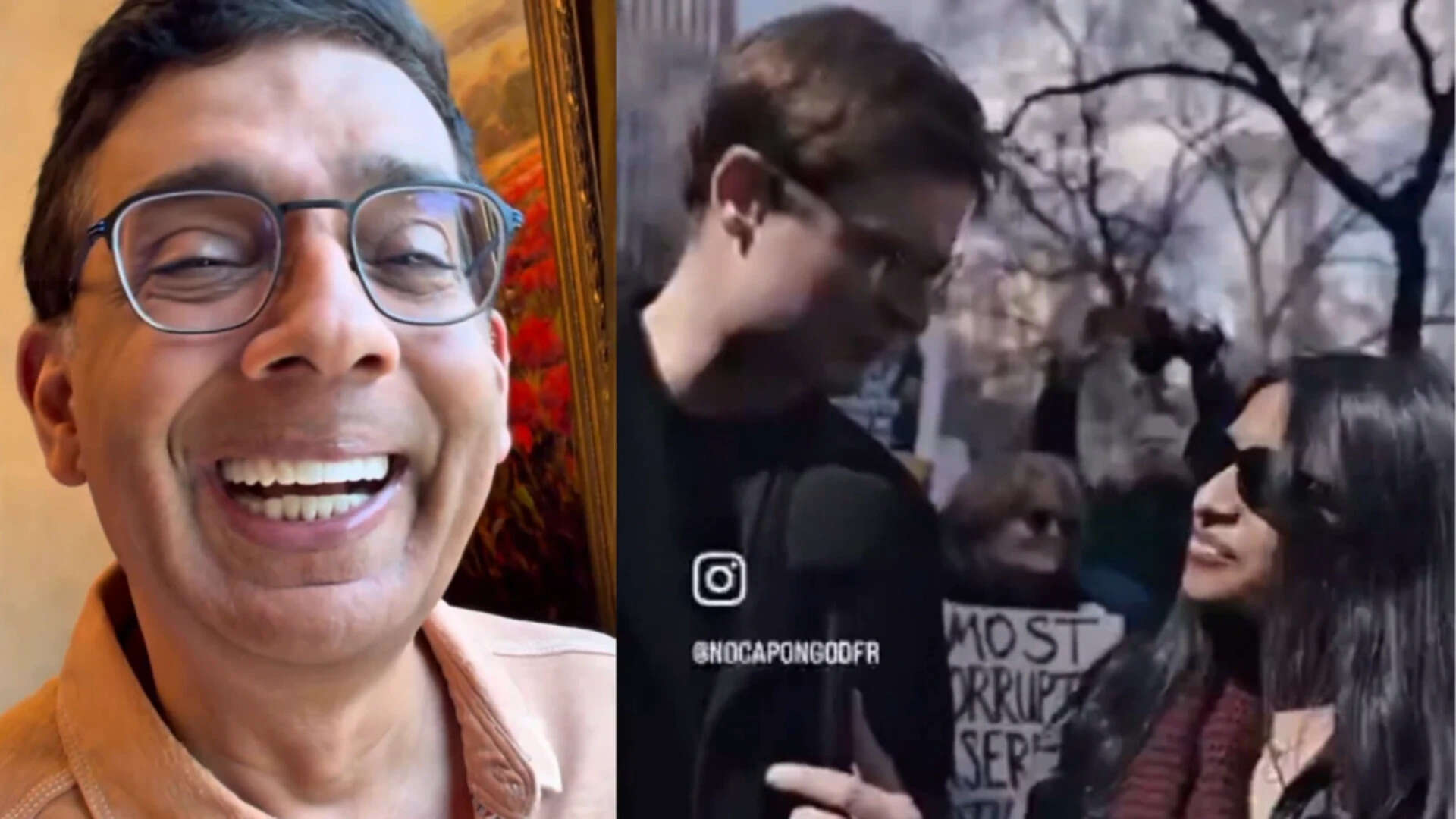
The recent intersection of viral protest media and high-profile political commentary—specifically the reaction to the "gays of Hormuz" remark—represents more than a fleeting internet controversy. It serves as a case study in the fragmentation of the Indian diaspora’s political alignment and the mechanics of "identity arbitrage." When Dinesh D’Souza critiques specific subsets of the Indian population based on ideological performance, he is not merely expressing personal distaste. He is applying a diagnostic filter designed to separate ideological assets from perceived liabilities within a specific conservative framework. Understanding this requires an analysis of three distinct vectors: the linguistic weaponization of geography, the bifurcation of the diaspora, and the incentive structures of the viral outrage economy.
The Linguistic Mechanics of the Hormuz Construct
The phrase "gays of Hormuz" functions as a rhetorical payload designed to achieve maximum cognitive dissonance. To analyze why this specific combination of terms generated significant friction, one must break down its component parts. The Strait of Hormuz is one of the world's most sensitive chokepoints, through which approximately 20% of the world’s petroleum consumption passes. It is a zone defined by hard power, naval tension, and existential energy security.
By prefixing this geopolitical flashpoint with a reference to sexual identity, the speaker attempts to create a "category error" that triggers a visceral reaction from traditionalist or realist audiences. The intent is to highlight what the speaker perceives as the absurdity of applying Western progressive social frameworks to regions governed by hyper-realist security concerns and divergent cultural norms. The viral success of the protest video stems from this deliberate clashing of incompatible semiotic worlds.
The Bifurcation of the Indian Diaspora
D’Souza’s reaction—stating a "problem with certain Indians"—reveals a growing schism in the South Asian expatriate experience. This is not a monolith, yet it is often treated as one by Western political observers. The friction can be categorized into two competing models of identity.
The Integrationist Traditionalist Model
This cohort views the diaspora’s success as a product of meritocracy, technical proficiency, and an alignment with the foundational values of the host nation (often the United States). For this group, radical or performative activism that mirrors Western "woke" tropes is viewed as a betrayal of the cultural pragmatism that enabled their socio-economic mobility. D’Souza identifies with this faction, positioning himself as a gatekeeper of "proper" Indian-American alignment.
The Transnational Progressive Model
Conversely, a younger or more academically aligned segment of the diaspora views their identity through the lens of global intersectionality. To them, the struggle for rights in the West is inextricably linked to anti-imperialism and social justice movements globally. The "gays of Hormuz" comment is an artifact of this mindset—an attempt to synthesize disparate regional struggles into a single ideological front.
The conflict between these two groups is a zero-sum game for the "representative voice" of the community. When D’Souza critiques "certain Indians," he is attempting to de-legitimize the second group’s claim to the ethnic label, suggesting their ideological leanings render them "inauthentic" or counter-productive to the community's standing.
The Outrage Incentive Structure
The velocity of this story is driven by a feedback loop common in digital media strategy. The process follows a predictable four-stage cycle:
- The Provocation: A protestor makes a statement designed to be jarring or counter-intuitive (the original video).
- The Amplification: Large-scale accounts aggregate the content, often stripped of context, to provoke a "common sense" reaction from their base.
- The Counter-Reaction: A high-authority figure (D'Souza) applies a corrective narrative, validating the audience's discomfort and framing it as a broader cultural crisis.
- The Monetization of Friction: The resulting engagement—clashes between supporters of the protestor and supporters of the critic—is captured by platform algorithms, ensuring the content remains visible long after its factual relevance has peaked.
This cycle produces high "engagement ROI" but low "informational utility." The actual geopolitical reality of the Strait of Hormuz or the nuanced history of the Indian diaspora is discarded in favor of a binary conflict that fits within the vertical scroll of a social media feed.
Geopolitical Realism vs. Identity Performance
The protest video and subsequent reactions expose a fundamental misunderstanding of hard-power constraints. In the realm of international relations, the "cost function" of a protest is measured by its ability to influence policy or disrupt logistics.
In the Strait of Hormuz, the primary variables are:
- Transit Security: The ability of tankers to navigate without seizure.
- Insurance Premiums: The fluctuating cost of maritime insurance based on kinetic risk.
- State Sovereignty: The competing claims of Iran, Oman, and the UAE.
When identity politics are injected into this equation, they function as a "soft power" tool that has almost zero impact on the "hard power" variables. The disconnect highlighted by D’Souza is the perceived futility of applying social identity labels to a theater where the only relevant metrics are tonnage, firepower, and regional hegemony. The critique is essentially a demand for "theological" or "ideological" realism over performative activism.
The Strategic Risk of Diaspora Internal Conflict
For the Indian government and global Indian business interests, this internal friction poses a reputational risk. The Indian diaspora has historically been a powerful lobby for favorable trade relations and technology transfers. If the diaspora becomes synonymous with high-friction, polarized domestic protests, its influence as a stabilizing, professional middle-class force may be diluted.
The "problem" D’Souza identifies is effectively a branding crisis. From his perspective, the "certain Indians" involved in radical protests are damaging the "Model Minority" equity that has been built over decades. This creates a bottleneck in political influence: instead of moving as a cohesive voting or lobbying bloc, the community is forced to spend its energy on internal policing and ideological purging.
The Mathematical Impossibility of Radical Intersectionalism in Hard-Power Zones
There is a logical ceiling to the effectiveness of the protestor's rhetoric. If we model the influence of social activism ($A$) against the inertia of regional religious or military governance ($G$), the influence follows a decay curve. In environments where $G$ is high and backed by non-secular legal frameworks, the impact of Western-style identity protests $A$ approaches zero.
$$I = \frac{A}{G^n}$$
Where $I$ is influence and $n$ represents the degree of authoritarian or traditionalist entrenchment. The frustration expressed by commentators like D’Souza is a reaction to the perceived refusal of activists to acknowledge this equation. They see the protest not as a brave stand, but as a failure of logic—an attempt to solve a multi-variable geopolitical problem with a single-variable social solution.
Deployment of Controlled Controversy as a Growth Strategy
From a consulting perspective, D’Souza’s move is a masterful use of "antagonistic growth." By identifying a specific "other" within his own ethnic group, he creates a high-trust environment for his core audience. He signals that he is a "truth-teller" who is willing to critique his own, which perversely increases his authority among non-Indian conservatives. This is a strategic pivot away from identity-based solidarity toward value-based or party-based solidarity.
This strategy assumes that the "center" of the diaspora is moving rightward, or at least becoming more exhausted by radicalized rhetoric. If this hypothesis is correct, the "certain Indians" mentioned will find themselves increasingly isolated from the economic and political centers of gravity within their own community.
Strategic Recommendation for Observers
The primary play is to decouple the viral aesthetic from the underlying data. The "gays of Hormuz" comment is a linguistic anomaly, not a policy shift. Stakeholders should monitor the degree to which this intra-diaspora friction affects donor behavior in major political cycles. The real data point to watch is the shift in campaign contributions and the formation of new, more conservative PACs within the Indian-American community. This will be the definitive metric of whether D’Souza’s "problem" is a personal grievance or a bellwether for a structural realignment of South Asian political capital.
The strategy for navigating this landscape is to maintain an "operational distance" from performative identity clashes while reinforcing the technical and meritocratic narratives that define the diaspora's primary value proposition. Any deviation into the high-friction "identity arbitrage" zone results in immediate loss of broad-based influence and entrapment in the outrage cycle.