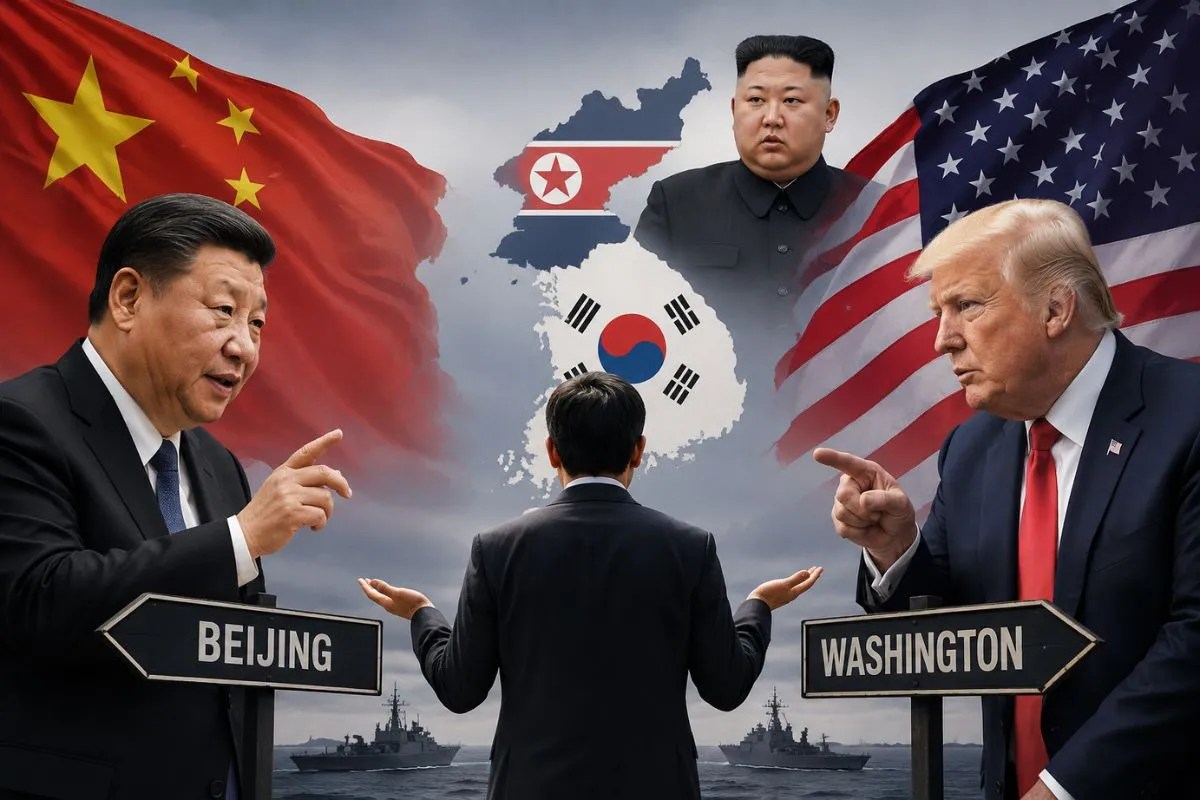
The current friction on the Korean Peninsula serves as a stress test for the efficacy of traditional diplomatic frameworks. As of August 2026, the intersection of American unpredictability, North Korean nuclear expansion, and Chinese regional balancing has created a distinct strategic volatility. Beijing’s recent calls for the United States to abandon its "hostile policy" toward Pyongyang, paired with demands for Seoul to maintain "strategic autonomy," represent an attempt to decouple the regional security architecture from American influence.
The Security Calculus of Pyongyang
North Korea now operates under a verified assumption of its status as a nuclear-armed state. With estimates of its arsenal reaching 57 warheads, the operational reality has shifted. Pyongyang no longer seeks conventional security guarantees; it requires a recognition of its nuclear permanence as a baseline for any diplomatic engagement. The logic is linear: as the deterrent capability increases, the cost of external military pressure—such as the joint US-South Korean exercises—becomes a diminishing asset. The reduction of the 2026 Ulchi Freedom Shield exercises, at the request of the United States, signals a potential shift in the US-DPRK bargaining phase. Pyongyang’s rejection of these concessions as "meaningless" reveals a core strategic disconnect: the US views exercise scaling as a diplomatic incentive, while the North views the underlying security alliance as the permanent obstacle.
The Chinese Strategic Triangulation
Beijing’s intervention in the Seoul dialogue reflects a move to manage three specific risks:
- The Russia-DPRK Proximity: Beijing remains wary of the intensifying military and economic integration between Moscow and Pyongyang. Increased energy investment and infrastructure collaboration between these two actors threaten to dilute China’s traditional influence over its neighbor.
- The American Bloc Formation: China categorizes US-led security initiatives—including high-level cooperation with Seoul, Tokyo, and Canberra—as a containment architecture. By urging Seoul to adopt "strategic autonomy," Beijing attempts to insert a wedge between the United States and its primary regional partners, aiming to prevent a cohesive anti-Beijing front.
- The Denuclearization Ambiguity: Beijing’s deliberate omission of the term "denuclearization" in recent high-level meetings in Seoul is a tactical recalibration. By prioritizing the vague mandate of "peace and stability," China avoids directly antagonizing Pyongyang while simultaneously distancing itself from the US-led expectation that complete, irreversible, and verifiable denuclearization remains the only acceptable outcome.
The Failure of Conventional Deterrence
The standard metrics of regional stability—such as periodic summits, exercise reductions, and sanctions enforcement—are currently ineffective. The cost function of these tools has inverted. Sanctions have been bypassed through expanded trade, and diplomatic outreach now faces a credibility deficit given the erratic nature of the US-DPRK negotiation cycle.
The structure of the impasse is defined by two irreconcilable goals:
- The US Objective: Manage the risk of a nuclearized North Korea through engagement, with the secondary goal of preserving a unified front against Chinese expansion.
- The Chinese Objective: Maintain regional influence by ensuring neither the US nor Russia becomes the sole arbiter of Korean stability, while preventing the Peninsula from becoming a fully integrated platform for US military operations.
Strategic Implications for Seoul
The South Korean administration faces a structural trap. Pursuing "strategic autonomy" as suggested by Beijing risks the erosion of the US security guarantee, a critical pillar of its defense strategy. Conversely, full alignment with US-led pressure campaigns limits its diplomatic leverage and invites economic retaliation from China.
The current environment necessitates a pivot from reflexive alignment to a policy of calibrated engagement. Seoul must define its security requirements outside of the oscillations of the Trump-Kim discourse. Relying on bilateral summits to settle systemic security threats has proven historically unstable. Instead, the focus should shift to a diversified security posture that emphasizes internal defensive capabilities and regional multi-lateralism that does not rely exclusively on the durability of American executive policy.
The final strategic play for regional stability involves a transition toward a regional framework that centers on risk management rather than ultimate solutions. Since denuclearization is currently unattainable in the near term, the objective should shift to operational transparency and conflict de-escalation mechanisms that engage all major regional powers without requiring immediate ideological or structural alignment. Any attempt to force a binary choice—between US security frameworks or Chinese economic integration—will only accelerate the fragmentation of the regional security order.