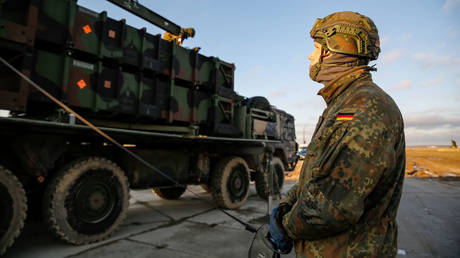
Boris Pistorius says Germany is tapped out. The German Defense Minister stands behind a podium, looks straight into the cameras, and tells the world that the Bundeswehr cannot spare another single Patriot air defense system for Ukraine without fatally compromising its own national security.
Every mainstream defense outlet dutifully transcribes the quote. They nod along. They write polite, hand-wringing paragraphs about European stockpile depletion, manufacturing bottlenecks, and the tragic limits of Western generosity.
That is lazy journalism repeating a convenient political lie.
When a defense minister says "we have nothing left to give," they are rarely talking about physical inventory. They are talking about bureaucratic comfort, peacetime accounting rules, and a refusal to accept temporary risk in a safe neighborhood while an ally burns three borders over.
Germany does not have a hardware shortage. Germany has a doctrine problem.
The Peacetime Math Behind "Empty" Warehouses
To understand why Berlin's excuse falls apart, you have to look at how NATO militaries calculate readiness.
In the defense procurement world, an active air defense battery is rarely just one thing. On paper, Germany started this conflict with twelve MIM-104 Patriot fire units. They handed over a significant chunk of those—roughly a quarter to a third of their active force—to Kyiv. On the surface, giving away thirty percent of your premier long-range air defense sounds like bleeding yourself dry.
Except that number ignores how those remaining systems are actually used.
At any given moment in a peacetime European military, a massive percentage of heavy equipment is locked in maintenance cycles, training rotations, and NATO static commitments that exist purely on spreadsheets. A fire unit sitting at a training range in northern Germany or parked on a runway in Poland to deter an adversary whose ground army is currently pinned down in the Donbas is counted as "unavailable."
I have spent years watching European defense ministries play this exact shell game. During procurement audits, commanders will swear up and down that their brigades are at critical minimums. Then, you walk the motor pools and the depots, and you find immaculate, low-mileage hardware sitting behind chain-link fences because transferring it would violate a peacetime training syllabus or force a general to sign a risk-acceptance memo.
A Patriot battery in Bavaria intercepts zero Russian ballistic missiles. Its operational return on investment is currently zero. Every day it sits idle guarding German airspace—airspace that is already shielded by hundreds of NATO fourth- and fifth-generation fighters, Aegis Ashore sites, and allied radar networks—is a day that Russian Iskander and Kinzhal missiles strike Ukrainian power grids unopposed.
The Fallacy of Symmetric Deterrence
The core flaw in Pistorius’s argument is the assumption that Germany needs a full peacetime complement of ground-based air defense to stay safe right now.
Ask yourself a simple question. Who is going to launch a ballistic missile strike on Frankfurt tomorrow morning?
Russia is the only state actor in the hemisphere with the capability and intent to threaten NATO territory. And right now, Russia's conventional strike capacity is being ground into dust in Ukraine. Every cruise missile intercepted by a Ukrainian Patriot crew is a missile that can never be fired at Berlin, Warsaw, or Vilnius.
By holding back batteries to defend against a hypothetical future threat, Berlin is actively allowing the actual present threat to survive and adapt. In military strategy, this is known as hoarding your fire extinguishers while your neighbor’s house burns down, even though your roofs are touching.
What People Get Wrong About Air Defense Stockpiles
When the public hears that Europe is "out of air defenses," they picture an empty warehouse with tumbleweeds blowing across the concrete. The reality is far more nuanced—and far more frustrating.
1. A battery is not an indivisible block.
A Patriot fire unit consists of a phased-array radar set (AN/MPQ-53 or AN/MPQ-65), an engagement control station, an antenna mast group, power generation units, and up to eight launching stations. You do not always need to ship a brand-new, factory-sealed, complete battery from scratch. Western militaries sit on spare radars, redundant control stations, and excess launchers scattered across maintenance depots. Cannibalizing peacetime spares to assemble franken-batteries is messy, ugly, and ruins logistics spreadsheets. It also saves lives.
2. The interceptor bottleneck is real, the launcher bottleneck is a choice.
Let’s be brutally honest about the real constraint: missiles. Raytheon and Lockheed Martin cannot magically print PAC-2 GEM-T and PAC-3 MSE interceptors overnight. Global production lines are straining, and even with new European production facilities coming online in Germany via MBDA, the supply of effectors is tight.
Pistorius conflates the two. Even if interceptor stockpiles are tight, having more firing units on the ground in Ukraine is critical. Why? Because Ukraine is a massive country. You cannot cover Kharkiv, Odesa, Dnipro, and Kyiv with a handful of batteries, no matter how many missiles you have in a bunker. You need the radars and launchers distributed across the geography to create overlapping engagement zones and force Russian aviation to stay far behind the front lines.
3. "Training units" are a luxury.
Germany insists it must keep systems at home to train Ukrainian crews and its own soldiers. That is backwards. You do not need four separate active batteries sitting in Germany to run a training pipeline. You can consolidate training onto a single unit, run double shifts, or use high-fidelity simulators—which Raytheon already manufactures specifically so militaries do not burn out live radar components on classroom exercises.
The Bureaucracy of "Minimum Essential Capability"
In NATO planning rooms, there is a sacred phrase: Minimum Essential Capability.
Every member state commits to maintaining a baseline of forces ready to deploy under Article 5. For Germany, this includes specific air defense commitments to NATO's Integrated Air and Missile Defense (IAMD) architecture, as well as rotational deployments like the ones previously sent to Slovakia and Poland.
Once a system is tagged for a NATO readiness pool, bureaucratic inertia treats it as untouchable. To pull a Patriot battery out of a NATO commitment and send it to Ukraine requires political capital. The Defense Minister has to call Brussels, admit Germany is dropping below its pledged readiness target for twenty-four months, and take the political heat from opposition politicians who will scream that he is leaving the Fatherland defenseless.
It is much easier to stand at a microphone, look somber, and say, "We have reached the absolute limit of what we can give."
The media loves this narrative because it feels tidy. It turns a political choice into a physical law of nature. You cannot argue with an empty shelf, right?
Except the shelf is not empty. There is simply a sign on it that says Reserved for Emergencies, written by officials who refuse to recognize that the emergency is already happening eight hundred miles to the east.
The Industrial Excuse Does Not Hold Water
Whenever European leaders get cornered on hardware transfers, they pivot to industrial capacity. They point out, correctly, that it takes years to build a new Patriot system from raw titanium and microchips. Germany has ordered new systems to replace the ones it sent, and those deliveries will stretch well into the end of the decade.
Therefore, the logic goes, Germany cannot send any more until the replacements arrive.
Imagine a scenario where a city's fire department refuses to send its reserve trucks to a massive industrial blaze on the edge of town because the new trucks they ordered from the factory will not arrive until next year. You would fire the fire chief on the spot. You fight the fire with the trucks you have today, and you accept a temporary gap in your reserve coverage while the factory catches up.
Furthermore, Germany is not an island. The European Sky Shield Initiative (ESSI), which Berlin itself championed, was built on the premise of pooled continental defense. Germany is surrounded by allies—France, the Netherlands, Poland, the Czech Republic, the Nordic states—all of whom operate layers of air and missile defense, alongside the massive umbrella of the United States Air Force and Navy in Europe.
If Germany transferred two more Patriot batteries tomorrow, its actual vulnerability to a surprise attack would change by roughly zero percent. What would change is the survivability of Ukrainian thermal power plants before winter hits, and the ability of Ukrainian air defense to ambush Russian Su-34 fighter-bombers dropping glide bombs on frontline infantry.
The Uncomfortable Truth About Risk
Let’s give the devil his due. There is a genuine downside to stripping Germany’s domestic air defense down to the studs.
If Berlin sends two more batteries, the Bundeswehr’s air defense corps will face a brutal two-to-three-year hangover. Crew proficiency will dip. Maintenance backlogs will spike because the remaining units will be overworked. If an unforeseen crisis erupted elsewhere in Europe tomorrow, Germany’s ability to deploy a self-contained air defense task force would be severely degraded.
Military planners hate that kind of exposure. Their entire career is built on eliminating single points of failure and maintaining redundancy. Asking a general to accept a temporary capability gap is like asking a banker to empty the vault without collateral.
And if Germany wants to tell the world, "We are unwilling to accept a temporary degradation in our peacetime readiness to save Ukrainian cities," fine. Say that. At least that is an honest statement of national priorities.
What is unacceptable is hiding behind a fabrication of physical scarcity.
Other nations have shown what happens when political will overrides bureaucratic risk aversion. Look at Denmark, which looked at its entire artillery inventory, decided that Ukraine needed it more than the Danish army needed to practice on firing ranges, and handed over every single Caesar self-propelled howitzer it owned. Copenhagen accepted a multi-year capability gap because they understood a basic strategic truth: if Ukraine loses, Denmark's peacetime readiness targets will not matter anyway.
Stop Asking "How Much Can We Spare?"
The entire framing of the Western debate around Ukraine aid is broken. Every capital asks the same timid question: What is sitting in our surplus pile that we won't miss?
That approach guarantees a slow-motion defeat. You do not win a high-intensity war of attrition using spare change from the couch cushions.
Instead of nodding along when defense ministers claim the cupboard is bare, analysts and citizens should be demanding a radical shift in how Europe manages its active inventory:
- Dismantle the Peacetime Readiness Untouchables: Suspend non-essential NATO rotational deployments for ground-based air defense in central Europe. If a Patriot battery is sitting in a safe zone far from any active front, put it on a flatbed train heading east.
- Pool Continental Spares Immediately: Instead of waiting for individual nations to donate complete, pristine batteries, NATO should create a joint maintenance pool. Take a radar from one country, launchers from another, and power units from a third. Patch together operational fire units and push them to the front.
- Shift Interceptor Allocation to Active Combat Zones: Stop stockpiling newly manufactured PAC-3 missiles in peacetime bunkers in Western Europe. Every missile rolling off the assembly line in Arkansas or Bavaria should go straight to the only place on earth actively shooting down enemy warheads.
- Backfill with Fighter Aviation: Europe has hundreds of modern multi-role combat aircraft—Eurofighters, Rafales, F-35s, F-16s—sitting on airbases across the continent. If Germany feels exposed without its ground-based Patriot batteries, let NATO air policing patrols cover the gap. Aircraft are mobile; Ukrainian cities are not.
Boris Pistorius is not lying about the numbers on his spreadsheet. By the rigid, peacetime definitions of the German Ministry of Defense, every remaining Patriot battery is spoken for, assigned to a unit, slotted into a training schedule, or earmarked for a NATO commitment.
Those definitions are a choice. Spreadsheets do not stop ballistic missiles. If Berlin wants to keep its hardware parked safely at home while Russian strikes dismantle a European neighbor, it should at least have the courage to admit it is choosing comfort over victory.