The Weight of a Broken Club
The iron hit the turf with a sickening, metallic crack. It was not the sound of a clean strike. It was the sound of a man trying to shatter the earth beneath his feet.
For years, Wyndham Clark carried a darkness onto the golf course that no amount of pristine California sunlight could bleach away. To the casual spectator watching from behind the gallery ropes, a professional golfer looks like the embodiment of privilege and calm. They see the ironed polo shirts, the synchronized swings, the quiet claps of an polite crowd. They do not see the internal wreckage. They do not smell the stale sweat of a hotel room where a young man sits with his head in his hands, wondering why a game designed to bring joy feels entirely like a punishment.
Golf is an isolating sport. You are alone with your thoughts for five hours a day, walking miles across manicured grass, chased by the mistakes of your past. Every missed putt is an indictment. Every sliced drive is a personal failure. For Clark, the anger was not just about golf. The anger was a protective shield against a grief so profound it threatened to swallow his entire career whole.
He wanted to quit. He came close, multiple times, throwing clubs into lakes and driving away from tournaments before the second round had even begun. The scoreboard said he was failing to make cuts. The truth was, he was failing to breathe.
A Mother’s Final Whisper
To understand the man who stood on the seventeenth tee at the U.S. Open, you have to go back to a hospital room in 2013.
Lise Clark was the emotional anchor of Wyndham’s life. She was the one who introduced him to the game, driving him to junior tournaments, sitting in the gallery through rain and wind, always offering the same piece of advice before he teed off.
"Play big."
Two words. They did not mean hit the ball as hard as you can. They meant live with courage. They meant do not let the smallness of fear dictate the boundaries of your life.
When breast cancer took her away during his college years at Oklahoma State, the compass went missing. Clark found himself wandering through a desert of performance anxiety and hot-headed outbursts. He transferred to Oregon, trying to outrun the memories, but the ghost followed him. He would hit a bad shot and immediately spiral, convinced that he was letting her down, that his inability to control a white dimpled ball was proof of his own inadequacy.
Grief does strange things to an athlete. It can be a fuel, but more often, it is a lead weight. For nearly a decade on the professional circuit, Clark was just another name in the middle of the pack, a talented ball-striker who lacked the mental fortitude to survive the meat-grinder of a major championship. The sports world loves a prodigy, but it quickly forgets the men who stall out in the transition from promise to reality. He was becoming a footnote.
The Mental Trap of Los Angeles Country Club
Then came the summer of 2023. The U.S. Open traveled to the Los Angeles Country Club, a hyper-exclusive enclave nestled against the backyards of Playboy Mansions and Beverly Hills estates. It was a strange venue for a golf tournament, surrounded by the ultimate symbols of American noise, glamour, and superficiality.
The course itself was a psychological horror film disguised as a playground. The fairways looked wide, but the slopes were treacherous, funnelling seemingly perfect shots into thick, coarse bermudagrass rough that caught clubfaces like wet cement. The barrancas cut through the property like open wounds.
Consider what happens to a man prone to spiralling when he enters an environment like that.
Every single shot requires absolute conviction. If you hesitate for a fraction of a second, the course devours you. On top of the physical challenges, Clark was staring down a leaderboard that looked like a list of golf’s royalty. Rickie Fowler was experiencing a career renaissance, capturing the hearts of the fans. Rory McIlroy, a generational titan, was stalking the lead from just a few shots back, hunting for his first major in nine years.
The narrative was already written by the media. Clark was the placeholder. He was the guy who would inevitably falter on Sunday afternoon, clearing the path for a more marketable superstar to lift the trophy. The noise was deafening. It was in the newspapers, on the television screens in the locker room, and in the whispers of the gallery.
But the real problem lay elsewhere. It was inside Clark's own head.
Turning the Noise into Silence
The turning point did not happen on the driving range. It happened when Clark hired a sports psychologist named Julie Elion.
For years, sports psychology was viewed in locker rooms with a degree of skepticism, seen as a last resort for the broken. But Clark was desperate. Elion did not give him generic platitudes about staying in the moment or taking deep breaths. She forced him to confront the anger. She helped him separate his identity as a human being from his score on the card.
Most importantly, she helped him bring his mother back into the space, not as a source of pressure, but as a source of peace.
During the final round of the U.S. Open, the demons made their run. Clark started well, but the back nine at LACC is where hopes go to die. On the par-eighteen eighth, he found himself in a horrific lie in the rough. A few years prior, he would have swung with rage, hacked it into deeper trouble, and watched his tournament evaporate.
Instead, he paused. He looked at the ball. He took a breath that seemed to last an eternity.
He played conservatively, accepted a bogey, and moved on. It was a masterclass in emotional regulation. He was no longer trying to fight the golf course; he was allowing himself to stumble without falling apart.
McIlroy was applying pressure, hitting magnificent shots but failing to convert his birdie putts. The tension was palpable, a heavy fog settling over the back nine. When Clark bogeyed the fifteenth and sixteenth holes, his lead shrunk to a single shot. The stadium was screaming for a playoff. The Hollywood crowd wanted the drama of an extra day. They wanted the collapse.
The Walk to the Eighteenth Green
One shot lead. One hole to play.
The eighteenth at LACC demands a long, precise tee shot followed by an approach into a green guarded by a amphitheater of hillsides. Clark’s drive found the fairway. His second shot landed on the green but rolled to the back fringe, leaving him a treacherous two-putt for the victory.
The walk up that final hill is the longest walk in sports. Your legs feel like lead. The putter feels like it weighs a hundred pounds.
He lagged the first putt to within a few feet. The par putt was short, but in golf, a two-foot putt for a U.S. Open title can look like it is miles away. The silence around the green was absolute. Thousands of people holding their collective breath.
Swing. Click. Drop.
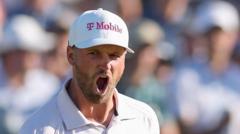
The ball disappeared into the cup. The noise returned in a tidal wave of sound, but Clark did not hear it. He covered his face with his hat and began to sob.
These were not the tears of a man who had just won a golf tournament and a multi-million dollar paycheck. These were the tears of a boy who had finally made it back to the shore after a decade of drowning in the ocean. He looked up at the sky, his eyes red, his face contorted with an agonizing joy.
"I felt like my mom was watching me today," he said later, the trophy sitting on the table beside him. "She was telling me, 'Play big.'"
He had not played a perfect round of golf. He had stumbled. He had missed fairways, he had bogeys, he had moments where the anxiety threatened to choke his swing. But he did not break. In a world that demands flawless execution and robotic stoicism, Wyndham Clark won the toughest test in golf by embracing his own fragile humanity, blocking out the roar of the world, and listening to a whisper from the past.