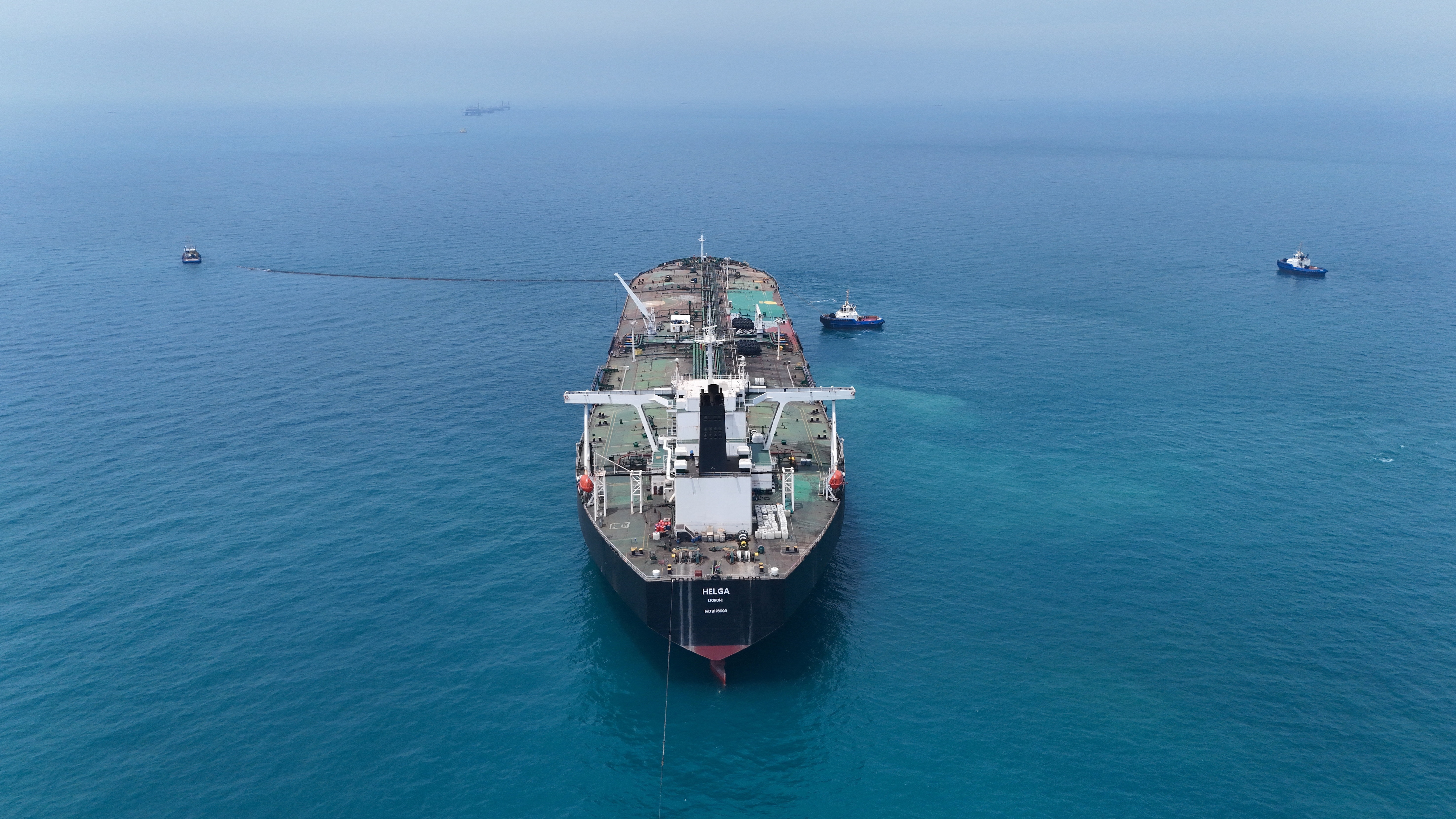
A man stands on a rusted deck in the middle of the Gulf of Oman. His boots are stained with grease, and his eyes are fixed on the horizon, where the blue of the water meets the hazy heat of a desert afternoon. He is a sailor on a VLCC—a Very Large Crude Carrier. These vessels are the cathedrals of the modern age, steel giants capable of carrying two million barrels of oil. But this ship isn't moving. It hasn't moved in weeks.
Underneath his feet, sixty-nine million barrels of "black gold" sit in total silence. This is the weight of a nation’s ambition, trapped in a steel cage.
The numbers are easy to glance at in a financial report. Sixty-nine million barrels of crude oil. It sounds like a statistic from a dry textbook on global logistics. To understand the gravity of that figure, you have to look at the grocery stores in Tehran or the silent factories in Isfahan. This isn't just oil. This is medicine that hasn't been bought, infrastructure that hasn't been built, and a currency that is evaporating into the hot salt air.
The Invisible Net
For years, the global energy market functioned like a heartbeat. Iran pumped, the world bought, and the money flowed back into the coffers of a regional superpower. That heartbeat has slowed to a crawl. The United States has draped an invisible net over the Persian Gulf. They call it a blockade, but it doesn't look like the naval battles of old. There are no broadsides or sinking ships. Instead, there is a suffocating layer of paperwork, satellite tracking, and financial threats.
Think of the global economy as a high-stakes party. To get in, you need an invite, a valid ID, and a way to pay for your drinks. The U.S. has effectively told the bouncers that anyone who talks to Iran is kicked out of the party forever.
Most countries, even those who need the oil, aren't willing to lose their access to the American financial system just for a few million barrels. So, the ships sit. They drift. They wait for a buyer who is willing to risk everything to sail into the shadows.
The Mechanics of Silence
When a ship becomes "stranded," it doesn't just disappear. It enters a twilight zone of maritime law. These sixty-nine million barrels are currently stored on tankers that serve as floating warehouses. This is an incredibly expensive way to do business.
The costs are astronomical.
- Daily Charter Rates: Keeping a massive tanker stationary still costs tens of thousands of dollars a day in maintenance, crew wages, and insurance—if you can even find an insurer willing to touch a sanctioned vessel.
- Physical Degradation: Oil isn't like wine; it doesn't get better with age. Stored crude can separate, and the tanks themselves begin to corrode under the constant stress of the sea.
- The Opportunity Cost: While this oil sits, the global price fluctuates. Iran is watching its primary asset lose value while the cost of living for its citizens skyrockets.
Imagine having a bank account with a billion dollars in it, but the bank is locked, the windows are boarded up, and the manager has lost the keys. You are technically wealthy, yet you cannot buy a loaf of bread. This is the paradox of the stranded barrels.
A Game of Cat and Mouse in the Dark
To bypass the blockade, the "Ghost Fleet" has emerged. These are older tankers, often nearing the end of their lives, that operate with their transponders turned off. They move at night. They engage in "ship-to-ship" transfers in the middle of the ocean, pumping oil from one vessel to another to hide its origin.
It is a desperate, dangerous dance.
One hypothetical captain—let’s call him Abbas—knows the risks. If he stays in the light, his ship is a sitting duck. If he goes dark, he risks a collision in some of the world’s busiest shipping lanes. He is carrying a cargo that his country desperately needs to sell, but he is treated like a smuggler of contraband.
The pressure is relentless. U.S. satellite imagery can track the heat signatures of these ships. Intelligence agencies monitor the wakes of vessels even when their GPS is "dark." Every time a barrel of Iranian oil actually reaches a refinery in a place like China, it has traveled through a gauntlet of risk that would break a normal logistics firm.
The Human Toll of Macroeconomics
We often talk about "the economy" as if it’s a weather pattern—something that happens to us, but isn't us. In Iran, the economy is a heavy, physical presence. When sixty-nine million barrels are stranded, the rial devalues.
A father in Shiraz goes to the pharmacy to get insulin for his daughter. The price has tripled since last month. Why? Because the "net" that caught the oil also caught the foreign currency needed to import specialized medicine. The factory worker in Karaj loses his job because the machinery needs parts from Germany, but the German company won't take Iranian money because that money is tainted by the oil sanctions.
The blockade is quiet. It doesn't make the sound of an explosion. It makes the sound of a shutter closing on a small business. It is the sound of a young couple realizing they can no longer afford to get married.
The Strategy of Suffocation
The goal of a blockade is rarely to start a war; it is to make the status quo so unbearable that something has to give. By stranding these barrels, the U.S. is betting that the internal pressure within Iran will eventually force a diplomatic retreat.
But there is a flaw in this logic that history often points out. When you corner a person, they don't always surrender. Sometimes, they become more resourceful. Sometimes, they become more dangerous.
Iran has begun to pivot. If they cannot sell oil to the West or the traditional allies of the West, they look East with more intensity. They build deeper ties with nations that are also tired of the "party bouncers." The stranded oil is forcing a realignment of global power that might last long after the sanctions are eventually lifted.
The Weight of the Unsold
Consider the sheer volume of sixty-nine million barrels. If you lined up those barrels end-to-end, they would stretch from New York to London and back, with enough left over to circle the UK. This is a mountain of energy, enough to power entire cities for weeks, just floating, bobbing in the tide.
It represents a massive environmental risk as well. These "ghost" ships are often not maintained to the highest standards. They are old. They are stressed. A single accident, a single hull breach in the Strait of Hormuz, would turn an economic tragedy into an ecological catastrophe that would haunt the region for a century.
The blockade isn't just a political maneuver. It is a high-stakes gamble with the very ocean itself.
The Stalemate
There is no easy way out. For the U.S., lifting the blockade without concessions feels like a defeat. For Iran, caving to the pressure feels like a betrayal of sovereignty.
So the ships remain.
The sailors on those decks watch the sun go down over the Gulf. They fish off the side of the tankers to pass the time. They are the guardians of a treasure they cannot spend. They are the human faces of a geopolitical chess match where the pawns are made of steel and the board is the open sea.
The oil is there. The world needs it. The people of Iran need the money it represents. But for now, the sixty-nine million barrels remain a monument to the power of a quiet war—a war fought not with bullets, but with the cold, hard reality of a door that refuses to open.
A single gull lands on the railing of a motionless tanker. It is the only thing moving in a graveyard of energy. Below the bird, the dark, thick liquid remains still, waiting for a day that may never come, while an entire nation holds its breath.