The tunnel smells like wet iron, ozone, and ninety years of brake dust.
If you stand on the platform at 5:45 in the morning, waiting for the downtown express, you can feel the train before you hear it. A low tremor starts in the soles of your shoes, climbs through your ankles, and rattles the coffee cup in your hand. Then the headlights pierce the dark, screaming down the tracks at forty miles an hour, screeching to a halt within six inches of a faded yellow line.
You step aboard. You don't look at the front cab. Nobody does. We assume—with the quiet, unquestioning faith of people who just want to get to work on time—that a tired human being in a reflective vest is sitting behind that heavy steel door, gripping a brass lever, watching the dark ahead.
Soon, that room might be empty.
Across the United States, transit agencies from San Francisco to New York, and from Honolulu to Washington, D.C., are quietly weighing a radical gamble. Facing historic budget cliffs, chronic operator shortages, and aging infrastructure that groans under the weight of modern cities, American transit leaders are looking at automated train operation—driverless trains—not as a futuristic novelty, but as an urgent lifeline.
To understand why this shift feels so jarring, you have to understand what we are actually asking a machine to replace. And you have to look at the people standing on the platform when the doors slide shut.
The Anatomy of a Delay
Let’s step into a hypothetical Tuesday morning in Chicago, or Boston, or New York. Meet Marcus.
Marcus is a composite, a fictional stand-in for the hundreds of thousands of essential workers who keep American cities breathing before sunrise. He is a respiratory therapist heading to a twelve-hour shift. His margin for error is razor-thin. If his train is twenty minutes late, a nurse on the night shift misses her childcare handoff, a patient waits longer for a breathing treatment, and the invisible gears of a major hospital grind against one another.
Today, Marcus is staring at a flickering LED sign that reads: DELAYED DUE TO SIGNAL TROUBLE.
A sigh ripples through the crowded platform. Someone checks their watch. Someone else curses under their breath.
What Marcus doesn't see is the cascade of human limitations happening three miles up the track. A train operator had to brake manually for a yellow signal, misjudged the slickness of early morning dew on the steel rails, and triggered an emergency stop. Because human reaction time averages roughly a quarter of a second—and because human eyes cannot see through blind tunnel curves—older transit systems have to enforce massive safety buffers. Trains must stay miles apart, moving like cautious elephants tied together by an invisible, slackening rope.
Now, strip away the human at the controls.
In an automated system, specifically what engineers call Grade of Automation 4, or GoA 4, there is no cab. There is no driver. There isn't even an attendant on board to press a button when the doors close. Instead, the train becomes a rolling node in a unified nervous system. Using a technology known as Communications-Based Train Control, or CBTC, the tracks and the trains talk to each other continuously via radio signals.
Think of the difference between driving down a foggy highway using only your headlights versus driving with a live satellite feed of every car within ten miles.
Human-driven trains rely on fixed blocks—rigid, miles-long segments of track. Only one train can enter a block at a time, whether it’s moving at five miles an hour or fifty. Automated systems use moving blocks. The computer knows the exact speed, weight, braking distance, and GPS-level position of every train on the line down to the centimeter, updating multiple times per second. Because the computer knows precisely how fast the train ahead is decelerating, it can safely tuck the following train much closer behind it.
The result isn't just slightly faster travel. It is a massive expansion of capacity without pouring a single yard of new concrete or digging a single foot of new tunnel. You can run trains every ninety seconds instead of every four minutes.
For Marcus, standing on that cold platform, ninety-second headways mean he doesn't even check a schedule anymore. He just walks down the stairs, and a train is there.
Why America Fell Behind
If this technology is safer, faster, and already proven, a glaring question hangs in the air: why are American riders still waiting twenty minutes for a rattling subway car while commuters in Paris, Singapore, Tokyo, and São Paulo glide effortlessly on driverless lines?
The answer is a tangled knot of history, geography, and deeply entrenched American politics.
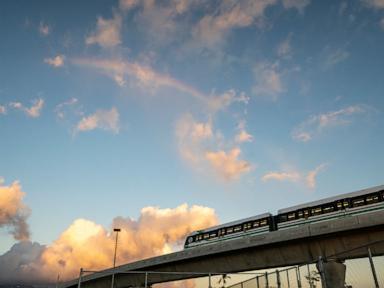
Look at Honolulu. In 2023, the city opened Skyline, the first fully automated, driverless heavy-rail metro system in the United States. It is sleek, quiet, and elevated high above the Oahu traffic. Yet its journey to opening day was a cautionary tale of American infrastructure development—plagued by billions of dollars in cost overruns, political infighting, and construction delays that stretched over a decade.
Honolulu had one massive advantage, however: it was building from scratch.
Most major U.S. transit systems are living museums. New York’s subway opened in 1904. Boston’s Tremont Street subway dates back to 1897. Chicago’s "L" began running in 1892. Trying to install automated train controls onto these sprawling, century-old networks is like trying to perform open-heart surgery on a marathon runner without asking them to stop running.
I spent a rainy afternoon a few years ago walking the catwalks of an active rail yard in the Northeast, watching signal maintainers work on equipment that looked like it belonged in a Victorian clock tower. Relays clicked inside glass boxes. Thick bundles of cloth-wrapped copper wire snaked into dark conduits installed before the Great Depression. To automate a line like that, you don't just buy new trains. You have to rip out the entire central nervous system of the railroad, replace miles of trackside hardware, install platform screen doors so passengers can't fall onto the tracks, and do it all during four-hour maintenance windows in the middle of the night while keeping millions of daily commuters moving.
The price tag is staggering. Converting a single legacy subway line to full automation can easily run into the billions of dollars. And in the United States, where public transit is perpetually starved for capital funding and treated as a political football rather than a basic utility, finding that kind of money requires Herculean political will.
Then, there is the human wall.
The Resistance in the Cab
Walk into any transit union hall in America and mention the phrase "driverless trains." Watch the temperature in the room drop ten degrees.
To a transit agency executive staring at a $500 million budget deficit, automation looks like salvation. Labor typically accounts for 60 to 70 percent of a transit agency's operating costs. Worse, agencies across the country are struggling to hire and retain operators. The hours are brutal—split shifts, weekends, holidays—and the stress of sitting alone in a dark cab for eight hours, knowing that a single lapse in concentration could end a life, takes a heavy psychological toll.
To a union leader, however, automation looks like an existential threat. It feels like a betrayal of the men and women who showed up during the darkest days of the pandemic, risking their lives to keep trains moving for doctors, grocery clerks, and delivery drivers when the rest of the world stayed home.
This friction is not theoretical. It is happening right now in cities weighing their options.
Consider the San Francisco Bay Area. BART, the regional rail system, has actually been partially automated since it opened in 1972. For decades, computers have controlled the speed and braking of BART trains between stations, while the human operator in the cab primarily monitors the tracks, opens and closes the doors, and takes over during emergencies. Yet moving from mostly automated to fully driverless remains a political third rail. Unions argue, with genuine conviction, that removing the human from the train strips away the eyes and ears of the system.
Who helps a wheelchair user when a ramp malfunctions? Who intervenes when a medical emergency erupts in car four? Who calms a panicked crowd when the power goes out in an underwater tunnel?
These are not trivial objections. When we talk about automating trains, we often fall into the trap of thinking a train operator’s only job is to push a throttle forward and pull a brake backward. In reality, an operator is a rolling first responder, a customer service representative, and a crisis manager rolled into one.
The Psychology of Trust
Even if transit agencies find the money, retrofit the tunnels, and strike historic agreements with labor unions to retrain operators into roving station ambassadors, one final hurdle remains: us.
Human beings have a deeply irrational relationship with risk.
We accept, without blinking, that roughly 40,000 people die every year on American highways because human drivers get tired, look at their phones, or drive drunk. Yet the moment a machine makes a single mistake—a self-driving car grazes a fender, or an automated shuttle stops abruptly—it makes national headlines. We demand perfection from algorithms while forgiving catastrophic negligence in ourselves.
Riding a train without a driver triggers a primal anxiety. I felt it the first time I rode the fully automated Line 14 in Paris. I stood right at the front glass, where the driver's cab would normally be, staring straight down the tracks into the rushing dark of the tunnel. My knuckles turned white on the metal handrail. Every instinct wired into my brain screamed that this was wrong. A massive steel tube hurtling through the earth at fifty miles an hour with nobody at the wheel felt like a runaway rollercoaster.
It took three stops for the panic to fade. By the fifth stop, I was reading a book. By the tenth, I realized something profound: the ride was smoother than any train I had ever taken in New York or Chicago. There were no jerky starts. No sudden, coffee-spilling lurches as a tired driver tapped the brakes too hard. The acceleration was a seamless, mathematical curve.
Globally, the data backs up that gut feeling. Driverless metro systems have been operating safely since the 1980s—starting with systems like Vancouver's SkyTrain and Lille’s VAL in France. Today, there are over forty cities worldwide operating hundreds of miles of fully automated metro lines. Statistically, they are significantly safer than human-operated trains. Computers don't suffer from highway hypnosis. They don't have bad days at home. They don't misread a signal because the sun was glaring off the glass at a weird angle.
The Invisible Stakes
So, why does this debate matter to you if you don't work for a transit agency, don't belong to a rail union, and maybe don't even ride the train every day?
Because American cities are choking.
Every time a transit system fails to run reliably, thousands of people give up on it. They buy a used car. They order an Uber. They pour onto the highways, turning twenty-minute commutes into ninety-minute slogs, pumping carbon into the air, and fracturing the economic vitality of downtown cores. A city without fast, frequent, reliable public transit is a city slowly hardening its own arteries.
We are standing at a fork in the tracks.
Down one path lies the status quo: patching together century-old systems with duct tape and overtime pay, watching fares rise while service shrinks, and asking exhausted human operators to perform superhuman feats of concentration in dark tunnels.
Down the other path lies a painful, expensive, politically bruising transition toward automation. It requires billions in upfront investment. It demands that we treat transit workers with dignity, offering ironclad guarantees that automation will shift their roles from isolated cab drivers to visible, empowered safety and customer service staff rather than tossing them onto the unemployment line. And it asks riders to let go of an illusion of control—to trust that a network of sensors and algorithms can guide us safely through the dark.
Think back to Marcus, our respiratory therapist waiting on that cold platform at 5:45 in the morning.
He doesn't care about the elegance of moving-block signaling algorithms. He doesn't care about the philosophical debates between union leaders and transit board members. He just wants to get to the hospital before his shift starts, do his job, and make it home in time to eat dinner with his kids.
The next time you step onto a train, walk all the way to the front car. Look through the small glass window into the operator's cab, or press your nose against the panoramic windshield of an automated line. Whether there is a human hand resting on the throttle or an invisible current of code guiding the wheels, the promise is the same. It is a fragile, unspoken pact between a city and its people: step inside, close the doors, and we will get you where you need to go.