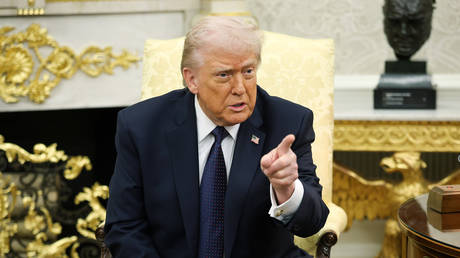
In a small, humid kitchen in Little Havana, the steam from a stovetop espresso maker hissingly competes with the low hum of a television. For Roberto, a man whose skin is a roadmap of seventy years between two worlds, the news coming across the screen isn't just a political update. It is a pulse check on a dying dream. When he hears the American President speak of regime change in Cuba as a "question of time," Roberto doesn't see a spreadsheet of sanctions or a map of geopolitical influence. He sees the peeling turquoise paint of his childhood home on Calle Villegas. He feels the weight of every year spent waiting for a door to open that has been bolted shut since 1959.
This is the human frequency beneath the high-level rhetoric. While diplomats in Washington and Havana trade icy statements, millions of people live in the vibrating tension of the "when."
The Architecture of Patience
The current American administration has shifted the tone from "if" to "when." It is a bold gamble on the inevitable. The logic used by Donald Trump is rooted in a specific brand of pressure—a belief that if you tighten the screws on the financial arteries of the island, the heart of the revolutionary government will eventually skip a beat.
The facts are stark. The Cuban economy, long propped up by a rotating cast of international patrons, is facing its most significant internal pressure in decades. When the Soviet Union collapsed, Cuba entered the "Special Period," a time of bicycles and blackouts. Today, the support from Venezuela has thinned to a trickle as that nation grapples with its own gravity-defying inflation and political instability. The American strategy is to ensure that no new patron steps in to fill the void.
But patience is a luxury of the powerful. For a family in Central Havana, "time" is measured in the hours spent standing in line for eggs or the months spent waiting for a relative in Miami to navigate the labyrinth of new remittance restrictions. The policy is designed to be a vice. Each turn of the handle is a new regulation, a restricted travel category, or a blacklisted hotel owned by the Cuban military.
The Myth of the Monolith
We often talk about "the regime" as if it were a single, unthinking machine. It isn't. It is a collection of people, many of whom are looking at their watches just as anxiously as Roberto in Miami. There is a generational tectonic shift occurring under the surface of the Cuban Communist Party. The old guard, the men who climbed the Sierra Maestra with rifles and beards, are fading into history.
Consider a hypothetical official named Alejandro. He is forty-five, educated, and well-aware that his children are watching YouTube videos of a world they cannot touch. He is a believer in the system because the system is his life, but he is also a pragmatist. When he hears the White House declare that the end is a matter of time, he doesn't just feel defiance. He feels the cold calculations of survival. He wonders if the bridge to the future will be built with his help, or over his head.
The stakes are invisible until they aren't. They manifest in the sudden silence of a neighborhood when the power goes out, or the hushed conversations in a paladar about the rising cost of pork. The American gamble relies on the idea that this friction will eventually create a spark.
The Weight of the Embargo
The U.S. embargo is the longest-running trade prohibited in modern history. To its supporters, it is the only moral response to a government that stifles dissent and denies basic democratic freedoms. To its critics, it is a blunt instrument that harms the very people it claims to want to liberate.
Let's look at the numbers that define this standoff. Since the 1960s, the economic impact is estimated in the hundreds of billions. But those digits are too large to mean anything. They are better understood through the lens of a doctor in Matanzas who has the skill to perform a surgery but lacks the specific American-made suture thread required to do it safely. Or the farmer who has the land and the seeds but cannot fix his tractor because the parts are trapped behind a wall of paperwork and history.
The U.S. administration’s current stance is that the "thaw" of the previous decade was a failure. They argue that opening travel and trade only lined the pockets of the military-run tourism industry without trickling down to the average citizen. So, they have reversed the flow. They have closed the valves.
The Florida Factor
Politics is never just about the destination; it is about the voters who help you get there. The rhetoric regarding Cuba is inextricably linked to the geography of Florida. In the suburbs of Miami, the scars of the Bay of Pigs and the Mariel boatlift are not ancient history. They are the dinner table conversations of today.
For a politician, the "question of time" is a powerful campaign slogan. it promises a resolution to a sixty-year-old grudge. It speaks to a community that has felt betrayed by half-measures and broken promises. But the reality on the ground in Cuba is less like a countdown clock and more like a game of high-stakes poker where both sides are playing with someone else’s chips.
What happens if the time runs out? History suggests that collapses are rarely as clean as the speeches predict. When the wall fell in Berlin, it was a moment of euphoria followed by years of difficult integration. In Cuba, the fear is not just of the status quo, but of the chaos that could fill the vacuum.
The Silent Evolution
While the headlines focus on the shouting match between leaders, the Cuban people have begun a quiet, unauthorized evolution. The "cuentapropistas"—the self-employed barbers, taxi drivers, and Airbnb hosts—have created a shadow economy that the government can neither fully control nor survive without.
These are the people caught in the crossfire of the "question of time." When American policy gets tougher, their businesses wither. When the Cuban government gets defensive, their regulations tighten. They are the grass being stepped on while the elephants fight.
The rhetoric of "regime change" carries a heavy historical baggage in Latin America. It conjures images of 1970s interventions and dark rooms in Langley. By framing it as a matter of time rather than a matter of force, the current administration is attempting to position itself as the observer of an inevitable tide. They are saying, "We don't need to push; we just need to wait."
But waiting is an active, painful process for those on the island. It is the sound of a daughter crying because she hasn't seen her father in five years. It is the sight of a crumbling facade on a once-grand colonial building that can no longer be repaired.
The Closing Window
There is a specific kind of light in Havana just before sunset. It turns the salt-sprayed Malecón into a golden ribbon, and for a few minutes, the city looks exactly as it did in 1950. It is a trick of the eye. The reality is that the clock is ticking, but it isn't a clock that follows the rules of Washington’s time zones.
The "question of time" implies a finish line. It suggests that there is a point on the horizon where the old world ends and the new one begins. But for Roberto, back in that kitchen in Miami, the time has already passed. His parents died in a country they no longer recognized, waiting for a change that never came. His children speak Spanish with an accent and have only seen Cuba in the background of his old photos.
The tragedy of the "question of time" is that the answer often arrives too late for the people who needed it most. We speak of regimes and administrations as if they are the protagonists of the story. They aren't. They are the weather. The protagonists are the ones trying to keep their umbrellas open in the storm.
The sun sets over the Florida Straits, the ninety miles of water that feel like an ocean of light-years. Whether the change happens tomorrow or in a decade, the scars of the waiting will remain. A country is not a government; it is a collection of memories and a shared hope for a Tuesday that is slightly better than Monday. Until that Tuesday arrives, the rhetoric remains just words, floating over a sea of people who are tired of being a "question" and are ready to be the answer.