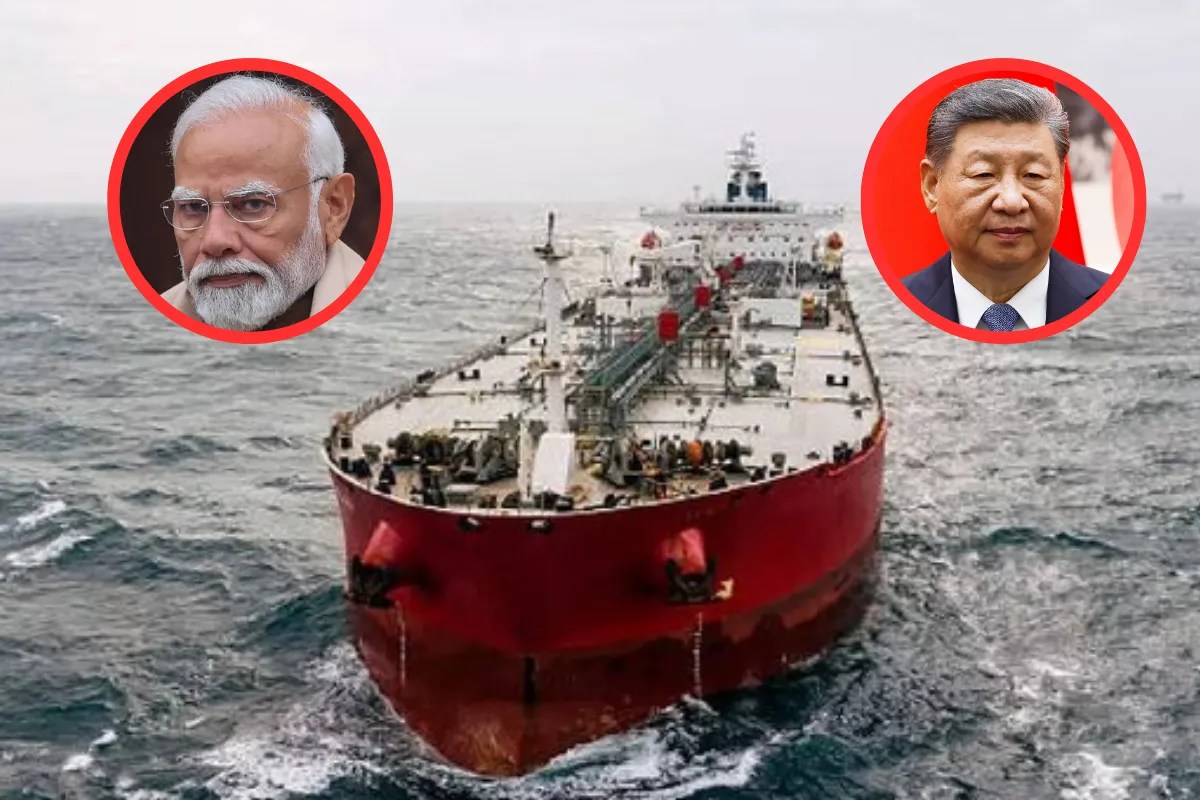
The sea does not care about borders, but the men who sail it are haunted by them. Imagine standing on the bridge of a massive crude carrier, the MT High Stakes. Under your feet, two million barrels of oil thrum with a low, rhythmic vibration. To your left, the jagged coastline of Iran looms like a sleeping predator. To your right, the vast, open promise of the Indian Ocean. You were supposed to turn south toward the refineries of Gujarat. You were supposed to deliver the lifeblood of India’s economy.
Instead, the order comes through the wire. Change course. North-east. Toward China.
This isn’t a mechanical failure. It is a geopolitical kidnapping of a shadow fleet.
The recent diversion of oil tankers originally destined for India toward Chinese ports isn't just a logistical hiccup. It is the visible pulse of a cold war turning feverish. As tensions between Washington and Tehran escalate into a series of surgical strikes and retaliatory threats, the ocean has become a chessboard where the pawns are made of steel and carry enough fuel to power a city for a month.
The Invisible Hand on the Tiller
Why would a captain, mere days from the Indian coast, suddenly swing the wheel? The answer lies in the murky desperation of the "Shadow Fleet."
Iran, strangled by years of Western sanctions, has perfected the art of the ghost trade. They use aging vessels, shell companies registered in island nations you’ve never heard of, and "dark" transponders that blink out of existence when the ship enters sensitive waters. India has long been a willing partner in this dance, balancing its need for cheap energy with its strategic alliance with the United States.
But the wind changed.
The United States recently tightened the screws, blacklisting specific vessels and the shipping firms that manage them. For India, the risk became too high. Indian refiners, many of which have deep ties to the global banking system, cannot afford to touch "contaminated" cargo. If a ship is flagged by the U.S. Treasury, the oil inside it becomes economic poison.
China, however, plays by a different set of rules.
Beijing doesn't just buy Iranian oil; they provide the sanctuary for it. When the U.S. Navy steps up its presence in the Persian Gulf, and when Indian ports begin to hesitate out of fear of secondary sanctions, Iran looks for the one buyer who doesn't blink. The diversion of these tankers is a frantic realignment. It is Iran saying: If the world won't let us sell to our friends, we will sell to our protector.
The Human Cost of a Binary Choice
Think of the crew on these diverted ships. They are often sailors from Eastern Europe, South Asia, or the Philippines, caught in a high-stakes game of hide-and-seek. When a tanker goes "dark"—turning off its Automatic Identification System (AIS)—the crew becomes invisible to the world. They are sailing a bomb through one of the most heavily militarized waterways on the planet, without the protection of international law or the transparency of a standard commercial voyage.
Every time a tanker like the ones destined for India pivots toward China, a ripple effect hits the local petrol pump in places like Mumbai or Bengaluru.
India’s energy security is built on a delicate equilibrium. We rely on the Middle East for the vast majority of our crude. When Iran—one of the few suppliers willing to offer deep discounts and rupee-based trade—is forced to divert its supply to China, India loses more than just oil. It loses leverage. It loses the "friends' discount."
The math is brutal. If India has to replace Iranian barrels with more expensive Brent crude from the open market, the cost isn't just measured in dollars. It’s measured in the price of a bus ticket in Delhi, the cost of transporting vegetables from a farm in Punjab, and the inflation that eats away at a family’s savings.
The Dragon’s Appetite
China’s role in this isn't merely passive. They are the world’s ultimate "buyer of last resort." By absorbing the oil that India is too cautious to take, China secures a massive energy reserve at prices no one else can match. They are effectively subsidized by the very sanctions the West intended to use as a weapon.
This creates a lopsided reality. While India tries to walk the tightrope of international diplomacy—keeping Washington happy while keeping its own lights on—China simply builds a bigger warehouse.
Consider the "Switching" maneuver. Often, these tankers don't even go all the way to a Chinese port. They meet mid-ocean. Under the cover of night, in a Ship-to-Ship (STS) transfer, the Iranian oil is pumped into another tanker, mixed with crude from a different origin, and rebranded. By the time it reaches a refinery, its digital footprint has been scrubbed clean.
It is a masterpiece of deception. But it is a desperate one.
A New Map of Power
The diversion of these ships marks the end of an era where oil was just a commodity. Today, every barrel is a political statement.
We are witnessing the fragmentation of the global energy market. On one side, you have the "Transparent Market," governed by Western sanctions, insurance protocols, and dollar-based transactions. On the other, you have the "Opaque Market," a growing network of nations that have decided the risk of being cut off from the global financial system is worth the reward of cheap, untracked energy.
India finds itself at the exact center of this fracture.
New Delhi’s decision to let these tankers slip away toward China isn't a sign of weakness; it’s a sign of the impossible complexity of the current moment. To force the ships to dock would be to invite the wrath of U.S. sanctions. To let them go is to lose a vital resource.
The real tragedy is that this isn't about a lack of oil. The world is swimming in it. This is about the pipes, both literal and metaphorical, that carry it. When the pipes of diplomacy break, the oil flows to whoever has the largest bucket and the fewest scruples.
The tankers currently steaming toward the South China Sea are more than just vessels. They are the heralds of a world where the old alliances are being tested by the cold reality of a gas gauge hitting empty. As they disappear over the horizon, they leave behind an India that must now find a way to fuel its future without becoming a casualty of someone else's war.
The ocean remains silent, but the wake these ships leave behind is screaming a warning we can no longer ignore. The map of the world is being redrawn, not by explorers, but by captains taking orders from shadows.