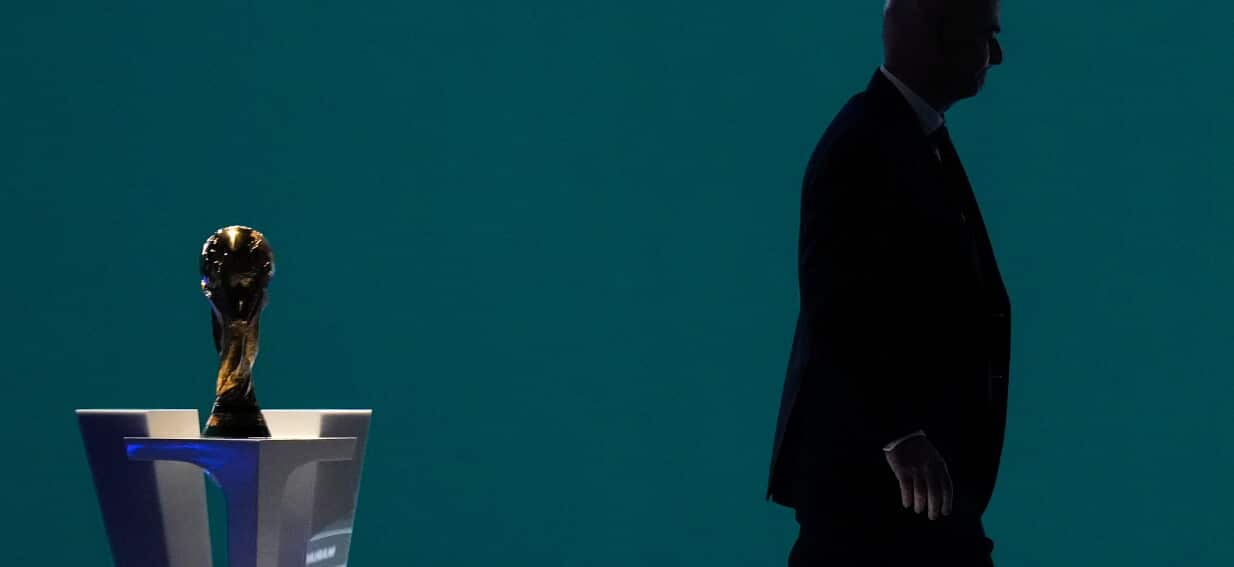
Gianni Infantino thought he had total control over global football. He was wrong. A failed gamble to sell private equity stakes in the World Cup commercial operations blew up in his face, turning loyal supporters into open rebels. National associations across Europe and the Americas are pushing back, and the March 2027 election in Rabat suddenly looks like a real contest.
For years, nobody dared run against him. Over two hundred member associations used to line up behind his leadership. That illusion shattered the moment money and private investors mixed with the crown jewel of international sports. Now, powerbrokers are quietly testing the waters to see if the FIFA president can actually be beaten.
The Anatomy of a Sudden Revolt
Politics in football move fast when money gets involved. Infantino tried pushing a commercial restructuring plan that bypassed normal consultation tracks. Big mistake.
UEFA launched a fierce opposition campaign, threatening widespread boycotts of tournaments if the proposal stayed on the table. Then the cracks spread further. National federations like Sweden, Wales, and Serbia publicly withdrew their backing. High-level departures followed inside FIFA itself, with chief operating officer Kevin Lamour resigning and openly criticizing the administration for serving personal agendas rather than the collective game.
When insiders start jumping ship, the throne gets shaky. Nominations close on November 18, giving potential successors a tight window to build cross-continental coalitions.
Victor Montagliani and the North American Play
The name coming up most often in backstage conversations is Victor Montagliani. As the head of CONCACAF, the Canadian administrator holds a strategic geographic and political hand.
Montagliani watched CONCACAF reject Infantino's commercial plans without sparking the nuclear-level warfare seen in Europe. That makes him uniquely positioned. If a European candidate runs directly, Infantino's loyalists will paint it as a hostile takeover by wealthy Western nations trying to reassert old colonial habits over global football. Montagliani avoids that trap. He bridges the gap between the Americas, Europe, and developing markets.
Yet, he has a weak spot. He spent years inside the inner circle as a senior FIFA insider. Challengers trying to run on an anti-establishment ticket will ask why his opposition only materialized when a commercial dispute flared up.
Aleksander Ceferin and the European Muscle
UEFA president Aleksander Ceferin has spent the last few years trading blows with FIFA. Skipping the World Cup final was a deliberate statement. Bookmakers and analysts frequently point to Ceferin as a natural favorite because he commands fifty-five European votes and holds massive institutional power.
Running a global election from a strictly European platform rarely works on its own. Africa, Asia, and Oceania hold the real voting weight. If Ceferin runs, it might backfire by uniting non-European confederations against a perceived European power grab. His best move might be playing kingmaker instead of candidate, pooling European influence behind a more palatable compromise figure like Montagliani.
Sheikh Salman and the Asian Alternative
You can never count out Sheikh Salman bin Ibrahim Al Khalifa. The Asian Football Confederation president already went toe-to-toe with Infantino in the bruising 2016 election, losing by a razor-thin margin in the final round.
He commands deep, quiet networks across Asia and commands respect within traditional power structures. While the AFC recently criticized FIFA's poor consultation methods over private equity, Sheikh Salman represents traditional stability. If member states want a steady hand who knows how to work the room without upending the entire governance model, he remains a heavy-hitting option.
The Reformers and Outside Disruptors
If the electorate decides to burn the house down and start fresh, outsider voices like Norwegian football president Lise Klaveness enter the conversation. Klaveness has built a reputation for calling out institutional corruption, human rights abuses, and governance failures directly to FIFA delegates.
Her hurdle isn't talent or moral clarity. It is raw electoral math. National associations vote based on development grants, tournament slots, and political patronage. Activism doesn't always translate into ballot boxes. Meanwhile, figures like Paris Saint-Germain president Nasser Al-Khelaifi pull massive strings across club football, broadcasting rights, and executive committees, though a direct run for the presidency remains an open question.
Everything hinges on whether the current crisis deepens before November. Infantino still controls a vast apparatus of global patronage, but for the first time in a decade, his opponents smell blood in the water. Watch the backroom deals in the coming weeks, because the succession battle for world football has officially begun.