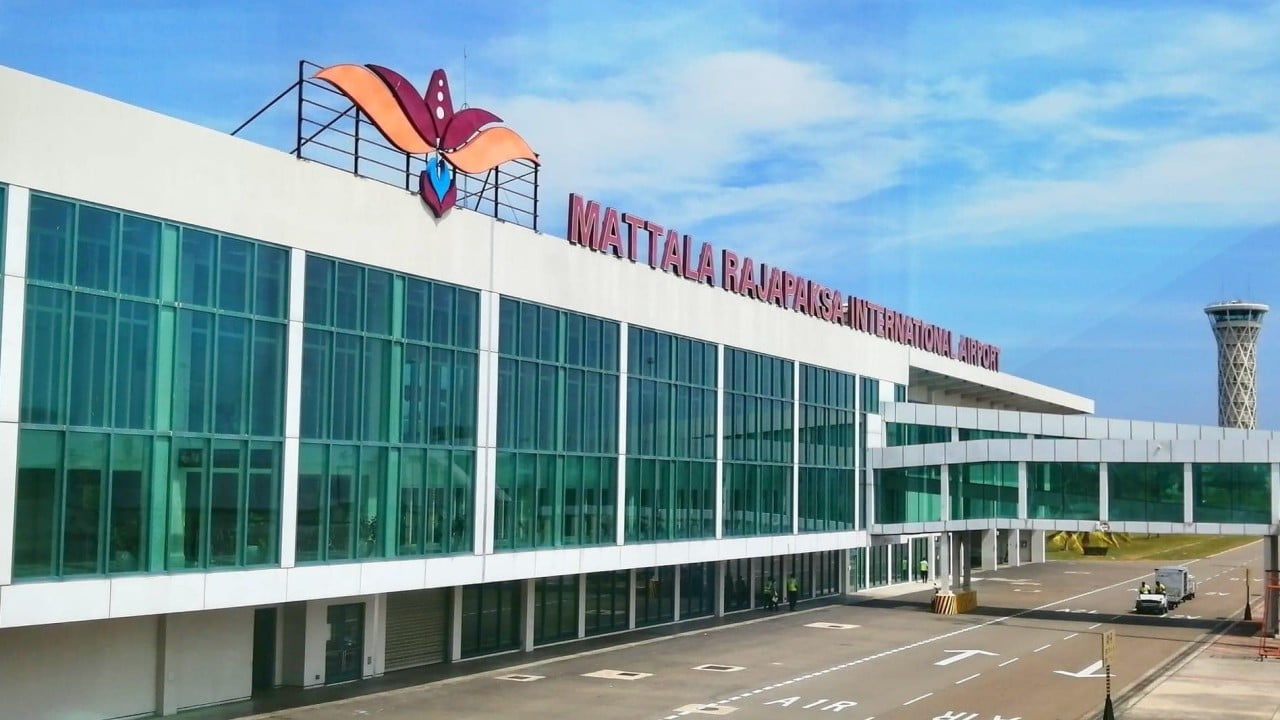
The silence at Mattala Rajapaksa International Airport is not the peaceful quiet of a library. It is heavy. It is the kind of silence that rings in your ears, a pressurized stillness that feels like it might crack the glass walls of the terminal. Deep in the scrublands of southern Sri Lanka, a janitor pushes a broom across a polished floor that hasn't seen a footprint in hours. Outside, the tropical sun beats down on a runway long enough to land an Airbus A380, yet the only things landing today are the peacocks and the occasional wandering elephant from the nearby sanctuary.
They call it the world’s emptiest airport. It is a title that carries the weight of a billion-dollar punchline. Also making waves in related news: Aviation Sovereignty and Sanction Erosion The Mechanics of the US-Venezuela Air Corridor.
To understand why Sri Lanka is currently begging global investors to take this massive piece of infrastructure off its hands, you have to look past the balance sheets. You have to look at the hunger of a nation that tried to build its way into a future it couldn't yet afford. This wasn't just an airport; it was a monument to ego and a bet against the gravity of economics. Now, the debt is due, and the jungle is waiting to reclaim the concrete.
The Concrete Mirage
Consider the traveler who actually lands here. Let’s call him Rohan. He is a hypothetical businessman, perhaps one of the few who took a budget flight from Dubai during the brief period when airlines were coerced into using Mattala as a secondary hub. Rohan steps off the plane and expects the frantic energy of Colombo’s Bandaranaike International. He expects the smell of kerosene, the shouting of taxi drivers, and the humid press of a thousand bodies. More details into this topic are covered by The Wall Street Journal.
Instead, he finds a cathedral of glass and steel where his own footsteps echo like gunshots.
The air conditioning hums, cooling vast, empty halls for passengers who do not exist. The baggage carousels rotate with a rhythmic, mechanical groan, carrying nothing. For Rohan, the experience is surreal, almost post-apocalyptic. For the Sri Lankan taxpayer, it is a slow-motion disaster. The facility was designed to handle a million passengers a year. In its most "successful" periods, it struggled to see more than a few dozen people a day. At one point, the government resorted to using the high-tech cargo terminals to store surplus rice.
The rice didn’t need a runway. It didn’t need a control tower. It just needed a roof.
The Math of a White Elephant
The numbers behind this silence are staggering. Built with nearly $200 million in loans from the Export-Import Bank of China, Mattala was the centerpiece of a grand plan to turn the southern district of Hambantota into a global shipping and aviation nexus. The logic seemed sound on a map: the region sits near some of the world's busiest sea lanes.
But maps don't account for human behavior or market demand.
Airlines are creatures of habit and efficiency. They fly where the people are. Colombo, the capital, is 250 kilometers away—a grueling five-hour drive before the new highways were fully realized. Most tourists heading to the ancient ruins or the tea country found Mattala to be a detour to nowhere. The "Build It and They Will Come" philosophy works in movies, but in the cutthroat world of international aviation, it is a recipe for bankruptcy.
The interest on those loans didn't stop just because the planes did. As the country slid toward its historic sovereign default in 2022, the airport shifted from a prideful landmark to a symbol of the "debt-trap" narrative that has defined Sri Lankan geopolitics for a decade. The state was spending more to keep the lights on in an empty terminal than it was earning from the entirety of its operations there.
The Desperate Auction
Now, the government is ringing the dinner bell, but the table remains empty.
The current proposal is an "Expression of Interest" for the management and maintenance of the airport. It is a polite way of asking if anyone, anywhere, can find a way to make this place breathe. They are looking for a partner to take over the overhead, to bring in flight schools, to lure in private jets, or to perhaps turn the site into a maintenance and repair hub.
The stakes are invisible but absolute. If a deal isn't struck, the airport remains a hemorrhaging wound on the national budget. But selling or leasing a "ghost" airport is a Herculean task. An investor looks at Mattala and doesn't see a gleaming terminal; they see the cost of electricity. They see the distance from a major city. They see the difficulty of convincing a pilot to land in a place where there is no ground crew to meet them and no passengers to pick up.
There is a quiet desperation in the corridors of power in Colombo. The authorities have tried to bundle the airport with other assets. They have tried to court Indian firms, Chinese conglomerates, and Russian charter operators. Each time, the negotiations stall. The reality is that Mattala is a specialized tool for a job that doesn't exist yet. It is a high-performance engine sitting in a chassis with no wheels.
A Sky Without Wings
Why should we care about a failed airport in the middle of a jungle? Because Mattala is a cautionary tale for the modern world. It represents the danger of top-down development that ignores the pulse of the local economy. It shows what happens when politics dictates infrastructure.
Think back to the janitor with the broom. He represents thousands of people whose livelihoods were tied to the promise of a "second city." Around the airport, hotels were built. Guesthouses opened. Young men bought vans to work as tour guides. They all bet their futures on the roar of jet engines. Today, those hotels are often as empty as the terminal. The vans sit under tarps, tires slowly deflating.
The human cost of a white elephant isn't measured in the millions of dollars lost; it’s measured in the stagnation of a community that was told prosperity was landing on Runway 05.
The birds are the only ones thriving. Flocks of migratory species have found the quiet airfield to be a sanctuary. Bird strikes became such a frequent hazard during the early days of operation that the airport had to hire "bird chasers" to clear the paths for the few planes that did arrive. Nature is patient. It recognizes when a structure is no longer serving a purpose.
The Weight of the Future
Sri Lanka is at a crossroads. The country is slowly clawing its way back from the brink of total economic collapse. Every rupee counts. Every state-owned enterprise that loses money is a weight around the neck of a child born in Galle or Kandy today. Removing the burden of Mattala is not just a business transaction; it is an act of survival.
The investor call is more than a search for a manager. It is a plea for a miracle. The government needs someone with the vision to see past the empty halls and the overgrown grass—someone who can find a reason for the world to fly to a place it has spent a decade avoiding.
Until that happens, the airport remains a monument to a dream that was too big for the reality it inhabited. The lights will stay on, illuminating rows of empty seats and check-in counters where no one ever waits. The radar will continue to spin, scanning a sky that remains stubbornly, hauntingly clear.
Somewhere in the distance, an elephant trumpets, the sound carrying easily across the tarmac. The jungle is encroaching. The concrete is hot. And the world’s emptiest airport waits for a guest who may never arrive.