The water in the Hecate Strait isn't just cold. It’s a heavy, oppressive grey that feels as though it wants to crush the breath out of your lungs. Below the surface, where the light begins to fail and the green fades into a bruised purple, there is a silence so profound it feels physical. For decades, we looked at these depths and saw a void. We assumed the history of the world was written in stone and bone, and that anything fragile had long since been ground into dust by the shifting tectonic plates of the Pacific.
We were wrong.
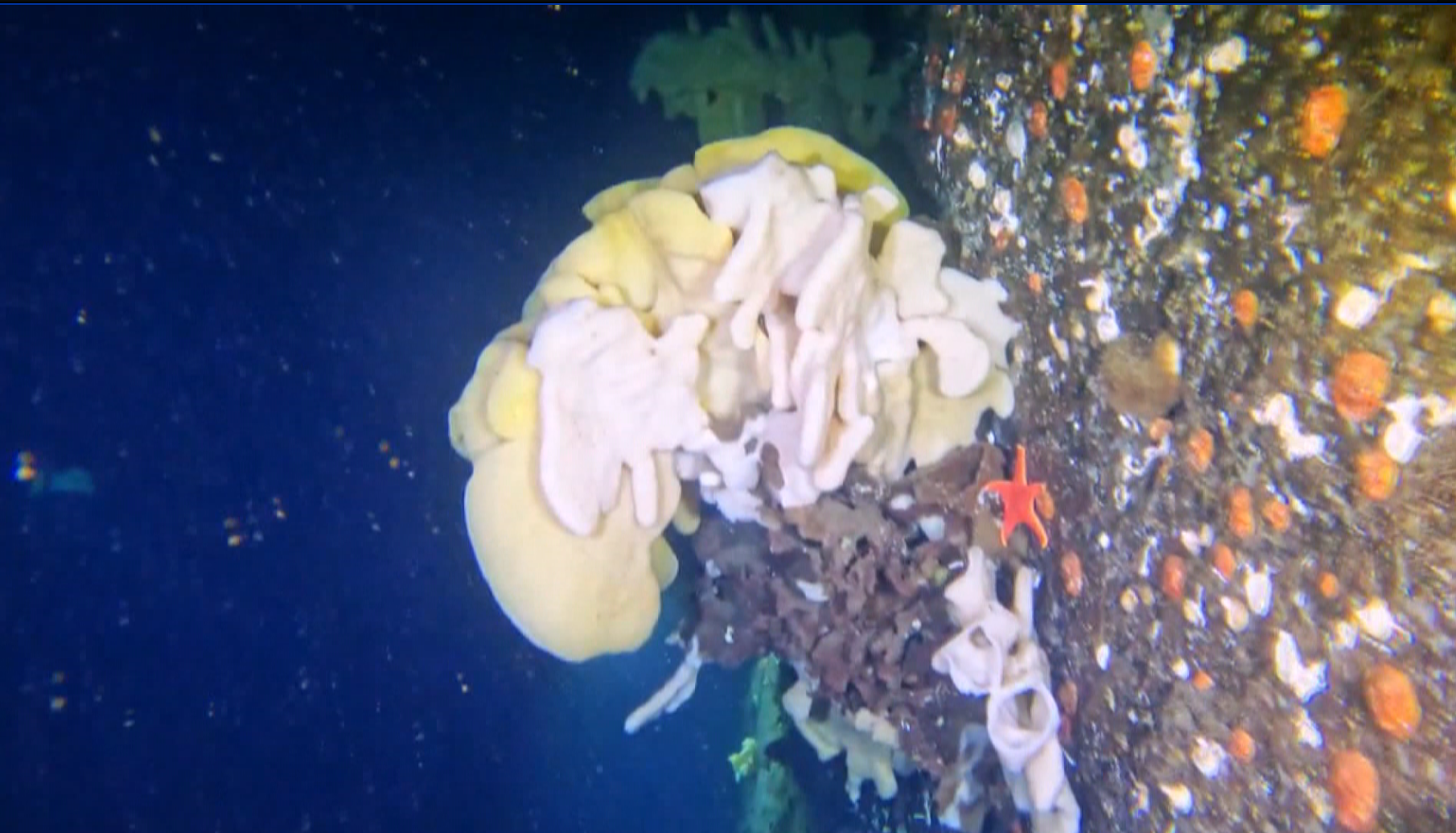
A team of researchers, dropping a remotely operated vehicle (ROV) into the hidden crevices of British Columbia’s coast, recently stared into a monitor and saw something that shouldn't exist. It wasn't a wreck or a new species of shark. It was a cloud sponge—a creature made of living glass, delicate as a breath, and supposedly lost to the shadows of prehistoric time.
To understand why this matters, you have to understand the fragility of the thing itself. This isn't a sponge you’d find in a kitchen or a bathroom. This is a hexactinellid. Its skeleton is constructed from silica, essentially the same material used to make your smartphone screen or a wine glass. In the deep, dark pressure of the B.C. fjords, these organisms weave themselves into intricate, cathedral-like structures. They don't just sit on the seafloor; they build it.
The Architect of the Abyss
Imagine a builder who works only with crystal.
For 9,000 years, these sponges have been quietly assembling reefs that rival the Great Barrier Reef in complexity, if not in color. They are the silent filters of the ocean. A single sponge, no larger than a footstool, can process thousands of liters of water every day, stripping out bacteria and pumping out life-sustaining oxygen. They are the lungs of the deep.
But for the longest time, the scientific community believed the specific "ancient" lineage of these cloud sponges had vanished during the mass extinctions that wiped out the dinosaurs. We had the fossils. We had the rocky imprints of their delicate lattices, preserved in stone from the Jurassic period. We talked about them in the past tense. They were ghosts, interesting only to geologists and those who find comfort in the study of what used to be.
Then, the camera light hit the reef.
The ROV, a tethered robot bristling with sensors and high-definition lenses, pushed through a cloud of silt. The operators back on the surface ship held their breath. There, shimmering in the artificial glow, were the expansive, billowing folds of the cloud sponge. It didn't look like a fossil. It looked like a city.
The human element of this discovery isn't found in the data logs or the GPS coordinates. It’s found in the trembling hands of the scientists who realized they were looking at a "living fossil" that had bypassed the expiration date of its entire lineage. It is the profound, ego-bruising realization that the Earth is much better at keeping secrets than we are at uncovering them.
The Invisible Stakes of a Silent World
Why should you care about a glass filter in a dark fjord you will likely never visit?
Consider the mechanics of the ocean’s health. The B.C. coastline is a rugged, jagged labyrinth of inlets. These fjords are high-stakes environments. They are the nurseries for rockfish, the highways for salmon, and the hunting grounds for orca. But all of that charisma—the leaping fish and the breaching whales—relies on a foundation that is almost entirely invisible to us.
The cloud sponge reefs provide the structural complexity that young fish need to hide from predators. Without the sponges, the seafloor is a flat, featureless desert. With them, it is an underwater metropolis. If the sponges die, the neighborhood collapses. The salmon don't have a place to rest. The rockfish have nowhere to grow.
The problem is that glass is brittle.
The very thing that makes these sponges beautiful—their intricate, silica skeletons—makes them terrifyingly vulnerable. A single heavy trawl net dragged across the bottom doesn't just damage the reef; it shatters it. It turns nine millennia of slow, patient growth into a graveyard of sharp shards in a matter of seconds.
We are currently in a race against our own industrial footprint. The discovery of these "extinct" sponges occurred in an area that has been subject to heavy fishing and potential subsea cable laying. We have been driving over a museum for a century without knowing it was there.
A Journey Through the Silt
The discovery wasn't a fluke. It was the result of a shift in how we use technology to see the world. In the past, we mapped the ocean floor with sound, bouncing pings off the bottom to get a rough idea of the topography. It was like trying to understand a forest by throwing a ball against the trees and measuring how fast it bounced back. You might know there’s a lump there, but you don't know if it’s a mountain or a maple.
Now, we have the eyes.
Modern ROVs allow us to hover inches away from structures that would be destroyed by a human diver's bubbles or the clumsy touch of a grab-arm. We are finally developing a sense of "deep-sea empathy." When you see the translucent walls of a sponge through a 4K lens, pulsating slightly with the movement of the current, it stops being a "resource" or a "biological specimen." It becomes a resident.
But the technology that reveals the beauty also reveals the scars. Researchers have found "sediment plumes"—clouds of dirt kicked up by human activity—that settle on the sponges. Because these creatures are filters, they can easily choke. Imagine trying to breathe in a room filled with fine flour. The sponge's pores clog, its energy drops, and eventually, the glass city begins to crumble.
The Weight of Our Ignorance
There is a specific kind of humility that comes with finding something you thought was dead. It forces us to admit that our maps of the world are mostly blank spaces filled with our own assumptions. We assumed the deep ocean was a wasteland because we couldn't see anything in the dark. We assumed the ancient sponges were gone because we hadn't stumbled over them yet.
This discovery challenges the narrative of the "conquered" earth. It suggests that right beneath the hulls of our ferries and fishing boats, there are ecosystems operating on a timeline that dwarfs human civilization. A sponge that is five feet tall might have started growing when the first pyramids were being built in Egypt. It has sat there, silent and silver, through the rise and fall of empires, through industrial revolutions, and through the dawn of the digital age.
It is a living testament to patience.
But patience has its limits. The temperature of the Pacific is shifting. The acidity of the water is rising. Silica structures—glass—are sensitive to the chemistry of the water around them. If the water becomes too acidic, the very bones of the sponge can begin to weaken. We are changing the environment faster than a 9,000-year-old species can adapt.
The researchers who found these sponges aren't just celebrating a "cool find." They are sounding an alarm. They are asking for protection zones that are more than just lines on a map. They are asking for a fundamental shift in how we view the "invisible" parts of our geography.
Shattering the Glass Ceiling of Conservation
Conservation is usually focused on the beautiful and the obvious. We save the pandas because they are cute. We save the tigers because they are majestic. It is much harder to convince the public to save a "glass filter" that lives 500 feet below the waves.
Yet, this is where the real work of the planet happens.
The "extinct" cloud sponge is a reminder that the world is still capable of surprising us. It offers a rare moment of hope in a cycle of news that is usually dominated by loss. We didn't lose this species. We just lost track of it. Now that we've found it again, we are faced with a choice.
Do we continue to treat the ocean floor as a basement where we store our trash and drag our nets? Or do we recognize it as a gallery of ancient, living art that we have been given a second chance to protect?
The researchers are back on the surface now. The ROV is tucked away in its cradle, its sensors cooling, its hard drives full of footage that will be analyzed for years to come. But the sponges are still down there. In the dark. In the cold. They are weaving their glass houses, gallon by gallon, century by century.
They are waiting to see if we are finally smart enough to leave them alone.
The next time you look out over the water of a bay or a strait, don't just see the surface. Don't just see the reflection of the clouds or the whitecaps of the wind. Try to look through it. Try to imagine the cities of glass rising from the silt, silent and ancient, breathing the ocean into being.
We thought they were gone. We were wrong. And in that mistake lies the possibility that there is still so much more to save than we ever dared to imagine.
The ghosts have returned, and they are made of glass.