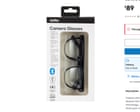
You slide them onto your face. They feel weightless, almost fragile, resting lightly against the bridge of your nose. To a bystander in a crowded aisle—say, down the familiar fluorescent corridors of a Kmart store—they look like ordinary smart eyewear. A sleek frame. Darkened lenses. A subtle accessory worn by someone trying to catch a podcast or check a digital route home.
Then the camera activates.
In cybersecurity, we talk about threat vectors as abstract equations. We draw diagrams with neat little arrows pointing from servers to routers, treating breaches as mathematical accidents. But the threat vector of our current era has a physical address. It sits right there on someone's face, recording the uninitiated without their consent, feeding optical data into remote servers thousands of miles away.
Consider what happens next: A casual shopper reaches for a shelf. They adjust their jacket. They argue quietly with a toddler over a shopping cart. Every micro-expression, every hesitation, every second of their public existence is captured through a lens designed to look like nothing at all. And behind that lens stands a China-based company whose software architecture has just triggered the heavy, grinding gears of a major privacy watchdog probe.
We call them pervert glasses in the harsh shorthand of tabloid headlines. The phrase is crude, sensational, and entirely inadequate for the systemic nightmare they represent.
The Illusion of Invisibility
For decades, we harbored a comforting fiction about public space. We assumed that walking down a suburban street or browsing through a retail outlet offered a baseline of casual anonymity. Sure, closed-circuit television cameras hung from the ceilings, their red indicator lights blinking a silent warning. You knew they were there. You could look up, spot the dome, and alter your path if you chose to.
Consumer surveillance technology broke that social contract.
When recording devices shrink to the scale of everyday fashion, the warning lights disappear. The social friction that once kept invasive behavior in check evaporates. If someone pulls out a bulky smartphone to record strangers on a subway platform, heads turn. People stare. Social pressure acts as a crude, effective firewall. But when a camera is embedded flush into the temple of a pair of designer-imitation frames, that friction vanishes entirely.
The company under investigation by privacy regulators built its entire product around this friction-free exposure. Marketed innocuously, the glasses promised seamless integration between physical reality and digital capture. What they actually delivered was a frictionless pipeline for harvesting the likeness, movements, and private moments of unsuspecting individuals who never signed a release form, never agreed to a terms-of-service agreement, and never knew they were being filmed.
It is a profound violation of personal sovereignty disguised as a gadget upgrade.
Code That Crosses Oceans
To understand why privacy watchdogs are moving with such uncharacteristic urgency, we have to look past the hardware and examine the data pipeline.
A photograph taken in a Melbourne storefront does not stay in Melbourne. It travels. In milliseconds, packets of compressed light bounce across subterranean fiber-optic cables, ascend through satellite uplinks, and land on servers located within foreign jurisdictions. Once that data crosses international borders, it enters a regulatory gray zone where local laws lose their teeth.
The company at the center of this storm operates out of China—a nation where state intelligence laws grant authorities sweeping access to corporate data repositories. When a consumer device streams video feeds or stores facial recognition logs on overseas cloud infrastructure, the user isn't just recording their surroundings; they are unwittingly exporting the biometric markers of everyone they encounter.
Imagine walking your dog past a café. A person sits at an outdoor table wearing these frames. As you pass, the integrated software captures your face, maps your bone structure, correlates your location with a timestamp, and transmits that packet to a server farm half a world away. You didn't buy the product. You didn't download the companion app. Yet your identity has been ingested into a foreign database, ripe for algorithmic sorting, training, or commercial exploitation.
This is not science fiction. This is the baseline operating procedure of unregulated consumer hardware.
The Anatomy of a Probe
When a privacy watchdog launches a formal investigation, the process is painfully slow. Lawyers draft notices. Regulators issue subpoenas. Engineers reverse-engineer firmware to discover where data packets are secretly routing when the user thinks the device is powered down.
While the watchdogs pore over lines of hexadecimal code, the market moves on. Thousands of pairs of these glasses are already out in the wild. They are sitting in glove compartments, hanging from shirt collars, and being worn into locker rooms, schools, and quiet neighborhood parks.
This is the central tragedy of modern tech regulation: it is always retroactive. The law gallops along behind the express train of venture capital, gasping for breath, trying to slap warning labels on a catastrophe that has already occurred.
Let us be entirely honest about why these products find a market in the first place. They tap into a dark, persistent current of human behavior—the desire to observe without being observed, to archive other people's lives without their consent, to possess a secret window into spaces that ought to remain sacred. The technology didn't invent this impulse; it merely lowered the barrier to entry. It took a vile urge and turned it into an app feature.
Reclaiming the Street
We are standing at a precipice. If we normalize the idea that anyone within arm's reach can covertly record our private conversations, our children, and our vulnerable moments for remote algorithmic analysis, public life ceases to exist. We retreat behind closed doors. We eye our neighbors with suspicion. We build psychological armor because our physical bodies can no longer move through the world unmeasured.
The probe into the Kmart-linked app manufacturer is a necessary step, but it is only a skirmish in a much larger war. True defense requires a radical shift in how we think about bodily integrity in the digital age.
Your face is not public property simply because you stepped outside your front door. Your likeness is an extension of your personhood. When foreign manufacturers treat human beings as raw data to be mined by hidden lenses, they are engaging in a form of digital extraction that makes traditional surveillance look quaint.
The investigation will grind forward. Press releases will be issued. Fines may be levied. But the real test won't happen in a regulatory hearing room. It will happen the next time you are standing in a quiet aisle, looking down at a shelf, and you notice someone staring at you just a fraction too long—not with their eyes, but with the glass resting quietly on their face.
And you are left to wonder what invisible record of you is currently traveling across the sea.