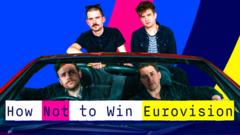
The air inside a Glasgow tenement flat in mid-winter has a specific, biting character. It smells of damp wool, cheap instant coffee, and the faint, metallic tang of a space heater struggling against a draft. In this cramped, gray reality, the neon-soaked stage of the Eurovision Song Contest feels less like a television show and more like a celestial event. For most, it is a kitschy annual distraction. For brothers Donny and Sandy, it is the only exit ramp left on a road that has mostly been paved with potholes.
They aren't real, of course. Not in the sense of blood and bone. But in the world of the mockumentary—the specific, dry-witted cinematic tradition of the United Kingdom—they are more authentic than the polished pop stars they hope to emulate. This is the story of a film that understands a fundamental human truth: the smaller the chance of success, the more desperate the belief becomes.
The Audacity of the Underdog
Imagine a man in a sequined tracksuit standing against a backdrop of rain-streaked sandstone. He is practicing a dance move that requires a grace he simply does not possess. His brother, clutching a handheld camera with a cracked lens, shouts encouragement that sounds suspiciously like a prayer.
This is the heartbeat of the Scottish mockumentary. It focuses on the "Gallowgate Two," a fictional duo convinced that their brand of "high-concept synth-pop" is exactly what the European Broadcasting Union has been waiting for. The humor doesn't come from the music being bad—though it is gloriously, unapologetically mediocre—but from the sincerity of their conviction.
There is a specific kind of bravery in being delusional. We live in an era of curated perfection, where every aspiring artist has a ring light and a social media strategy. Donny and Sandy have neither. They have a Casio keyboard from 1994 and a dream that is entirely decoupled from their talent. When they speak to the camera, they don't look like comedians. They look like believers.
Why the Fake Documentary Feels So Real
The mockumentary format works here because it mimics the way we actually process failure. A standard drama would make this a tragedy. A sitcom would make it a farce. But the fly-on-the-wall style forces us to sit in the awkward silences. It makes us watch the long beats after a joke fails or a high note cracks.
Consider the "invisible stakes." On the surface, the stakes are a spot in a singing competition. In reality, the stakes are the brothers' sense of self. If they aren't the next big thing from Scotland, then they are just two unemployed men in a cold flat. The sequins aren't just costumes. They are armor.
The film leans heavily into the contrast between the mundane and the magnificent. One scene features the duo discussing their "pyrotechnic requirements" while eating beans on toast. The absurdity is the point. It highlights the vast chasm between the lives we lead and the lives we project.
The Eurovision Fever Dream
To understand the film, you have to understand the beast that is Eurovision. It is a world where political tensions are settled through interpretive dance and power ballads. It is a place where a heavy metal band from Finland can win one year, and a grandmother baking bread from Russia can almost win the next.
For a Scottish duo, the dream is complicated by a layer of national identity. Scotland has a complicated relationship with the contest, often seeing it through the lens of the United Kingdom’s frequently dismal performance. By positioning these two brothers as the "true" voice of a nation, the filmmakers tap into a vein of quiet, fierce pride. They aren't just singing for themselves; they are singing for every pub singer who ever thought they could do better than the nil-points entry on the telly.
It is a specific type of satire that punches up, not down. The joke isn't on the brothers for wanting more; the joke is on a world that makes it so difficult for people like them to ever get a foot in the door.
The Mechanics of the Cringe
There is a moment in the film where the brothers perform at a local community center. The audience consists of three elderly women and a bored janitor. Donny gives a speech about "breaking the fourth wall of pop," and then proceeds to trip over a microphone cord.
It’s painful. It’s hard to watch.
But why do we keep watching?
Because we recognize the vulnerability. Everyone has had a moment where they thought they were being profound, only to realize they had spinach in their teeth. By grounding the "Eurovision dream" in this level of gritty, embarrassing detail, the film transcends the mockumentary genre. It becomes a character study.
The pacing of the narrative mimics the brothers' trajectory. It builds with the manic energy of a manic episode—all big ideas and frantic rehearsals—before crashing into the cold light of a Monday morning. The cinematography is intentionally grainy, favoring the sickly yellow of streetlights over the polished glow of a studio. It feels like a home movie you weren't supposed to find.
The Power of the "Nearly Man"
The "nearly man" is a staple of British storytelling. He is the guy who was almost a pro footballer, the singer who almost got signed, the inventor whose idea was stolen. Donny and Sandy are the ultimate nearly men.
They represent the millions of us who harbor secret, improbable ambitions. We might not want to win Eurovision, but we want the equivalent. We want to be seen. We want the world to stop and acknowledge that we have something unique to offer, even if that "something" is a poorly choreographed dance routine and a song about galactic peace.
The film's genius lies in its refusal to give them a Hollywood ending. There is no magical talent scout in the audience. There is no viral moment that saves the day. There is only the pursuit.
The pursuit is where the humanity lives. It’s in the way Sandy adjusts his brother’s collar before they go on stage, a gesture of tenderness that contradicts their bickering. It’s in the way they walk home in the rain, sharing a single umbrella, already planning their "comeback" before the first show is even over.
The Resonance of the Small Scale
We are often told to dream big, but we are rarely shown the cost of dreaming big in a small world. This mockumentary doesn't shy away from the cost. It shows the strained relationships, the empty bank accounts, and the quiet judgment of neighbors.
Yet, it remains hopeful.
It suggests that there is a certain glory in the attempt. If you spend your life trying to get to the biggest stage in the world, you might end up in a community center in Glasgow, but at least you spent your time looking at the stars instead of the cracked pavement.
The film acts as a mirror. It asks the viewer: what is your Eurovision? What is the thing you are willing to look foolish for?
There is a scene near the end where the music fades out, and we are left with just the sound of the wind whistling through the tenements. Donny looks at the camera, his face smeared with sweat and cheap glitter. He doesn't say anything. He doesn't have to. The exhaustion and the stubborn, irrational spark in his eyes say it all.
He isn't a joke. He’s us.
He is every person who ever stood in front of a mirror with a hairbrush and saw a stadium full of lights. He is the grit in the gears of a cynical world. He is the reminder that as long as there is a stage, someone will be brave enough—or mad enough—to try and stand on it.
The lights of the Eurovision stage are thousands of miles away from the Gallowgate. But in the minds of two brothers, those lights are close enough to touch, if only they can get the harmony right just one more time.


