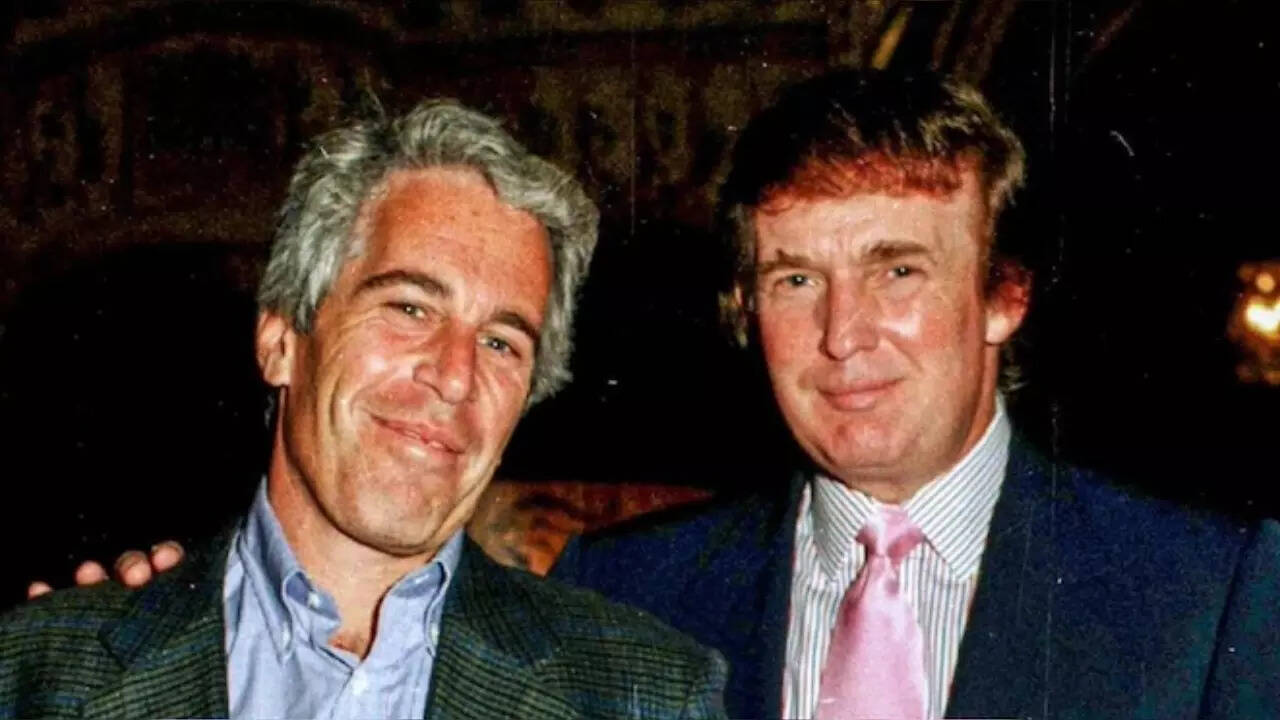
The heavy, gilded doors of Mar-a-Lago do more than keep the humidity of Palm Beach at bay. They act as a filter for history. Inside those walls, where the ceilings are gold-leafed and the air smells of expensive sea salt and old money, the past has a way of being curated. It is a place where narratives are polished until they shine as brightly as the silverware. But even the most meticulous polishing cannot always remove a stain.
For years, a specific story was told about the relationship between the club’s owner, Donald Trump, and the financier Jeffrey Epstein. The story was simple. It was clean. It suggested a swift, moral excision. The narrative claimed that after Epstein’s behavior became too much to ignore, he was shown the door. He was banned. He was persona non grata. It was a tale of a line drawn in the Florida sand.
Then came the unredacted emails.
They arrived not with a bang, but with the sterile click of a digital file opening. Specifically, an email from 2007. This wasn't a public relations statement or a carefully coached deposition. It was a private communication from Epstein himself, written during the very window of time when the public was told he had been cast out into the wilderness.
Epstein wrote that he had "never been asked to leave" the club.
The Weight of a Quiet Email
Consider the mechanics of a high-society snub. Usually, it is a spectacle. There is a scene at the valet stand, a hushed conversation with the manager, or a formal letter delivered by a courier. It is a social execution meant to be felt. Yet, here was the man at the center of the century’s most sordid web of influence, casually noting to his inner circle that the gates remained open.
This isn't just about a guest list. It’s about the architecture of truth.
When a powerful figure makes a claim—especially one involving a character like Epstein—it serves as a shield. It tells the world, "I saw the darkness and I rejected it." It builds a foundation of reflected morality. But when an email surfaced from the archives of a legal battle, that foundation shifted. The 2007 message suggests that the "ban" was less of a wall and more of a curtain—translucent and easily pushed aside.
The email wasn't sent to a stranger. It was part of an exchange that highlighted Epstein's continued sense of belonging in the upper echelons of Palm Beach society. At the time he wrote those words, the legal walls were already closing in on him. The police were watching. The survivors were starting to speak. And yet, in his own mind, and apparently in his physical reality, the welcome mat at Mar-a-Lago hadn't been pulled back.
The Disconnect in the Dining Room
Think about the tension of that dining room. On one side, you have the official version of events: a decisive break. On the other, you have a man who felt so comfortable in his status that he felt the need to correct the record to his associates. He wasn't being kicked out; he was simply moving through the world as he always had, with the arrogance of a man who believed himself untouchable.
Why does a small detail in an old email matter nearly two decades later?
Because accountability has a very long half-life. We live in an era where the "truth" is often whatever can be repeated the loudest and most frequently. By claiming he banned Epstein, Trump signaled a clean break from a radioactive association. It was a strategic move. It looked like leadership. It looked like a man protecting the sanctity of his club and his family.
But the unredacted text offers a different perspective. It suggests that the "break" might have been a convenient fiction, a story told to satisfy the optics of the moment while the reality remained much more fluid. It paints a picture of a world where the powerful protect one another through silence rather than through confrontation.
The Invisible Stakes of Memory
We often treat these revelations as political fodder, tools to be used by one side or the other. But the human element is far more chilling. For the women who were harmed in Epstein’s orbit, these details are not political. They are visceral. Every time a door is shown to have been left unlocked for their abuser, it reinforces the idea that the world was built to accommodate him, not to protect them.
Imagine being one of those survivors, watching the news and hearing a powerful man claim he threw the monster out of his house. It offers a shred of validation. Then, years later, you see the email. You see the monster himself scoffing at the idea that he was ever unwelcome. The validation evaporates. In its place is the cold realization that the "ban" might have been a performance for an audience that wasn't even in the room.
The email from 2007 doesn't just contradict a timeline. It challenges the integrity of the narrator. If the ban didn't happen when and how it was described, what else about that era was edited for the sake of the story?
The Polished Surface and the Cracks Beneath
There is a specific kind of silence that exists in places like Palm Beach. It’s a polite, expensive silence. It covers up the sounds of uncomfortable truths. For years, the story of the Mar-a-Lago ban was a cornerstone of that silence. It was the "proof" that the club was a place of standards.
The unredacted email acts like a crack in a Ming vase. At first, it looks like a hair-thin line. You might not even notice it if the light doesn't hit it just right. But once you see it, you realize the structural integrity of the whole piece is compromised. You can’t unsee the gap between the public boast and the private reality.
The financier’s own words—"never asked to leave"—serve as a haunting refrain. They echo through the halls of the club, bouncing off the gold-leafed moldings and the imported stone. They suggest that the circles of power are much smaller and much more forgiving than we are led to believe. They remind us that for the elite, a "ban" is often just a suggestion, a temporary inconvenience to be managed with a wink and a nod.
In the end, the story isn't just about a property in Florida or an email from a dead man. It is about the way we allow the powerful to write their own histories. It is about the difference between a moral stand and a marketing campaign. We are left to wonder how many other "bans" were actually open invitations, and how many other "clean breaks" were actually tangled knots.
The gates of Mar-a-Lago still stand, imposing and beautiful against the Florida sky. They remain a symbol of success and exclusivity. But for those who have read the emails, the gold seems a little dimmer, the history a little more crowded with the ghosts of the men who were never asked to go.
The most dangerous lies aren't the ones told to deceive others; they are the ones told to convince ourselves that we are better than the company we keep.



