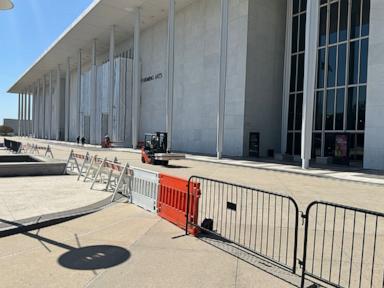
The erection of perimeter fencing around the John F. Kennedy Center for the Performing Arts in Washington, D.C., is not an isolated facilities management decision. It is the physical manifestation of a classic principal-agent conflict where statutory branding restrictions, judicial injunctions, and $257 million in congressionally appropriated capital have locked into a zero-sum operational freeze. When a governance board ties physical infrastructure maintenance to a contested naming-rights campaign, the facility itself becomes an operational hostage.
To understand how an active national cultural institution transitions overnight into a fenced-off perimeter with suspended public access, one must strip away the partisan rhetoric and examine the underlying mechanics of statutory authority, capital deployment, and institutional risk management.
The Structural Anatomy of the Impasse
Standard reporting frames the Kennedy Center closure as a chronological sequence of political tit-for-tat: a court blocks a name change, a board votes to close, and security erects barriers. In operational reality, this is a three-variable governance deadlock. Each variable acts as a hard constraint on the others, preventing standard institutional equilibrium.
- Statutory Naming Authority: The John F. Kennedy Center for the Performing Arts operates under specific federal statutory mandates established by Congress. U.S. District Judge Christopher Cooper ruled that the board cannot alter the building's statutory designation—specifically blocking proposals to inscribe "Restored and Renovated By President Donald J. Trump" on the facade, add endowment inscriptions for the Trump Kennedy Center Fund, or rename the surrounding plaza—without explicit congressional authorization.
- Conditional Capital Deployment: Congress allocated $257 million specifically to cover physical safety repairs and infrastructure renovations. Under normal institutional governance, approved capital expenditures proceed immediately upon appropriation to mitigate liability and preserve asset value. Here, executive leadership explicitly conditioned the release and execution of those $257 million repairs on the judicial approval of the naming inscriptions.
- The Operational Closure Lever: Following the judicial injunction against the renaming proposals, the Trump-aligned board voted to close the main building, citing safety requirements and financial distress. Within 24 hours, perimeter fencing went up and security personnel turned away both the public and legal representatives.
This sequence exposes a fundamental breakdown in corporate governance. In a functional nonprofit or public-private trust, the board’s fiduciary duty is the preservation of the core mission and physical asset. When branding objectives supersede asset maintenance, the board converts a capital improvement budget into political leverage.
The Cost Function of Conditional Capital
In institutional finance, delaying funded maintenance creates an accelerating cost function. The $257 million appropriation exists because the physical plant requires structural and safety remediation. By freezing the deployment of already-allocated funds until a separate legal battle over facade inscriptions is resolved, leadership introduces three compounding financial penalties into the institution's balance sheet.
1. Revenue Destruction via Access Termination
Erecting perimeter fencing and halting public access immediately zeroes out earned revenue streams. Performing arts centers rely on a delicate cash-flow cycle driven by ticket sales, subscriber renewals, concessions, and ancillary event rentals. Prior to the closure vote, internal warnings already pointed toward severe financial strain and declining ticket sales. Shutting the doors without an active construction schedule maximizes fixed overhead losses—security, baseline utilities, debt service, and administrative payroll—while eliminating every dollar of variable box-office income.
2. Asset Degradation and Liability Accumulation
Deferring funded safety repairs while citing those exact safety hazards as justification for closure creates an acute legal vulnerability. If management asserts in court filings and public statements that the venue is "unsafe" and "decrepit", yet simultaneously refuses to spend the $257 million sitting in its capital account to fix those hazards, the institution assumes self-inflicted operational paralysis. Physical deterioration in a large riverfront structure accelerates when HVAC systems, roof membranes, and structural joints are left unmaintained during a stalemate.
3. Construction Inflation and Vendor Demobilization
Large-scale public infrastructure renovations require complex contracting pipelines, specialized union labor scheduling, and long-lead material procurement. Halting or delaying project mobilization after funds are appropriated erodes the purchasing power of the $257 million allocation. Every month of litigation-induced delay subjects the capital budget to materials inflation and remobilization fees, shrinking the actual scope of safety repairs the $257 million will ultimately buy.
Legal Friction and the Discovery Trap
The decision to erect physical fencing immediately after a judicial defeat triggered an aggressive legal counter-maneuver that places the board's internal governance under federal scrutiny.
Rep. Joyce Beatty, an ex-officio board member, petitioned the court for an emergency hearing, alleging an unlawful closure. Her legal team argued that sudden perimeter restrictions and the denial of building access to legal staff signal an attempt to alter physical access points or initiate demolition work that would render the court's injunction moot. Advocacy groups and legal observers pointed to prior executive actions—such as the demolition of the White House East Wing to construct a ballroom—as precedent for rapid physical alteration outpacing judicial review.
From a litigation strategy standpoint, closing the building immediately after losing a naming-rights ruling creates a severe evidentiary problem for the board:
- Pretext Scrutiny: In administrative and corporate law, when a governing body takes an extreme operational action (closing a national venue) hours after an adverse court ruling (blocking a name change), courts examine whether the stated rationale (safety repairs) is a pretext for retaliation or evasion.
- Mandatory Discovery Exposure: Judge Cooper indicated that before approving permanent closure or major structural alterations, the institution must disclose its internal deliberations and renovation plans. Boards typically guard internal communications, financial projections, and donor-driven naming agreements fiercely. By forcing an emergency judicial review, the closure vote accelerates court-ordered discovery into how the board weighed branding against fiduciary solvency.
- The Demolition Restraint: Any attempt to alter the structural footprint without judicial sign-off risks immediate restraining orders and contempt proceedings, neutralizing the speed advantage that physical fencing is normally meant to secure.
Brand Equity vs. Fiduciary Solvency
The core strategic argument advanced by the Kennedy Center's leadership is that adding Donald Trump's name to the facade—alongside a proposed $100 million "Trump Kennedy Center Fund" inscription—is necessary to prevent "fiscal collapse". This argument rests on a specific hypothesis about cultural philanthropy: that political alignment with the sitting president unlocks a new tier of major-gift fundraising capable of offsetting declining traditional ticket and donor revenue.
Evaluating this hypothesis requires separating short-term capital infusion from long-term institutional brand equity.
- The Donor Concentration Risk: Tying an institution's survival to a single political brand trades broad-based, multi-generational philanthropic support for concentrated, partisan capital. While a dedicated fund might theoretically attract pledges toward a $100 million threshold, politically polarizing a performing arts venue alienates core subscriber bases, touring artists, and corporate sponsors who require brand neutrality. Evidence of this friction already surfaced in performer cancellations and related contract disputes.
- The Statutory Mismatch: Unlike a private corporate arena where naming rights are an alienable asset sold to the highest bidder, a congressionally chartered memorial operates under a statutory trust. Attempting to monetize or politically rebrand a statutory memorial without legislative amendment invites endless litigation, during which neither the traditional donor base nor the new political donor base will deploy capital at scale.
- Operational Contradiction: You cannot execute a donor-driven turnaround strategy while the physical asset is wrapped in chain-link fencing and closed to patrons. High-net-worth cultural philanthropy depends on prestige, visibility, and active programming. A shuttered venue destroys the very experiential product donors pay to be associated with.
Distinguishing Verified Facts from Strategic Projections
When analyzing fast-moving institutional crises, practitioners must separate established operational facts from unverified claims and downstream probabilities.
Verified Operational Facts:
- U.S. District Judge Christopher Cooper blocked the Kennedy Center board from adding Donald Trump's name to the building facade, adding an endowment inscription, or renaming the plaza without congressional approval.
- Hours after the ruling, the board voted to close the main facility.
- Perimeter fencing was installed around the main building the following day, and security staff barred public and legal-staff entry.
- Congress has allocated $257 million for safety repairs at the center.
- Executive leadership stated that the $257 million repairs would proceed only if the board is allowed to add Trump's name to the building.
Unverified Claims and Open Variables:
- Physical Decay Severity: While leadership cited safety hazards and released video purporting to show interior decay, those visual claims have not been independently verified by structural engineers under court supervision.
- Demolition Intent: Fears expressed by activists and opposing board members that the closure is a precursor to partial demolition remain an educated hypothesis based on prior executive construction projects rather than an officially filed architectural plan.
- Fundraising Realization: Whether a Trump-branded endowment fund would actually secure $100 million in liquid cash—rather than non-binding pledges—remains entirely speculative.
The Strategic Resolution Path
The current posture—holding $257 million in approved safety funds hostage while locking out the public behind perimeter fencing—is structurally unsustainable. Every day the building remains closed without active, court-approved construction increases fixed cash burn, strengthens the plaintiffs' pretext arguments in federal court, and degrades the physical asset.
To exit this governance trap without catastrophic financial or legal loss, institutional leadership must decouple capital execution from statutory branding immediately:
- Unfreeze the $257 Million Capital Allocation: Separate the engineering and safety remediation contracts from the naming-rights litigation. Submit a transparent, third-party engineering scope of work to Judge Cooper demonstrating that funds are being deployed strictly for statutory life-safety compliance.
- Transition from Perimeter Lockout to Phased Construction: Replace blanket facility closure with localized construction zoning. Keeping performance halls and public revenue centers operational during phased infrastructure upgrades preserves box-office cash flow and neutralizes emergency injunctions alleging unlawful lockout.
- Shift Naming Ambitions to Legislative Channels: Recognize that federal courts will not override explicit statutory naming mandates through administrative board votes. If leadership intends to pursue permanent facade inscriptions, the effort must move exclusively to congressional appropriations riders rather than operational brinkmanship at the facility gates.
If the board refuses to decouple the $257 million renovation budget from the facade dispute, the court will inevitably compel internal discovery, freeze structural alterations, and leave the institution trapped in a self-imposed revenue blackout while its appropriated capital sits idle.