The federal government is testing a dangerous legal blueprint in Minnesota, and it should make anyone who has ever attended a rally incredibly nervous.
In June 2026, the Department of Justice unsealed a massive 94-page indictment against 15 Twin Cities activists. The feds are calling them a violent cell of an "Antifa Terrorist Network." The activists say they are just neighbors looking out for neighbors. They are formally known as the Minnesota 15, and the government wants to put them away for years.
But when you strip away the dramatic press release language, you find something chilling. The core of the government's case does not rely on a single catastrophic act of violence. It relies on group chats, social media posts, and shared spreadsheets. The Justice Department is using broad conspiracy laws to turn routine, protected protest tactics into major federal crimes.
If this strategy works in Minneapolis, it will become the default tool to silence dissent across the country.
The Siege of Operation Metro Surge
You cannot understand these conspiracy charges without understanding what happened on the ground in Minneapolis earlier this year. In January 2026, the Trump administration launched Operation Metro Surge. It was the largest federal immigration deployment in United States history, flooding the Twin Cities with nearly 4,000 agents.
The tactics were brutal. ICE agents pulled people from their cars, kicked down doors without warrants, and deployed heavy amounts of tear gas in residential neighborhoods. The tension boiled over quickly. Clashes between federal agents and residents became a daily routine on the streets and outside the Bishop Henry Whipple Federal Building, the local ICE headquarters.
During the height of the surge, federal agents shot and killed two local residents, Renee Good and Alex Pretti. Another resident was severely wounded. No federal agents have been charged in connection with those deaths.
In response to this overwhelming federal presence, a network of local organizers, union workers, teachers, and nurses did what Minnesotans do: they organized. They formed Direct Action Minnesota, a decentralized rapid-response network. They built neighborhood-level watch groups to track ICE vehicles, alert families in danger of deportation, and bring food and basic supplies to people who were hiding in fear.
To the community, this was basic survival and solidarity. To the Justice Department, it was a criminal enterprise.
Turning Logistical Organizing Into a Federal Crime
The 94-page indictment targets 15 individuals associated with Direct Action Minnesota and smaller subgroups like the Black Cat Workers Collective. The primary charge is conspiracy to impede or injure a federal officer. They also face counts of interstate stalking, interstate threats, and destruction of government property.
Look closely at what the government is using as evidence. Prosecutors are pointing directly to the tools of modern organizing. They are using encrypted Signal group chats, public social media alerts, and the coordination of rapid-response phone trees to argue that a criminal conspiracy existed.
The government claims that by tracking ICE vehicles and publishing their locations, these activists were "identifying and harassing" federal agents to prevent them from doing their jobs.
Think about that for a second. If you see a speed trap on the highway and flash your headlights to warn other drivers, or if you post a tweet warning your neighbors about a police checkpoint, you are doing exactly what these activists did. But because these organizers did it in a coordinated way to oppose a controversial immigration policy, the government is treating the coordination itself as a syndicate-level crime.
U.S. Attorney Daniel Rosen explicitly stated that the defendants are charged not for their political opinions, but for their actions. He highlighted blockades at the Whipple building on January 23 and March 1, where protesters allegedly used overturned RVs, blocks of ice, and makeshift obstacles to delay ICE vehicles.
Defense attorneys do not deny that blockades happened. They argue that peaceful, disruptive blockades are a time-honored tradition of American civil disobedience, from the civil rights movement to anti-war protests.
The government's own statements reveal the real goal of this prosecution. During the press conference announcing the indictments, acting Attorney General Todd Blanche bragged that the arrests demonstrate a commitment to stopping "organized political violence." Yet, when repeatedly pressed by reporters, prosecutors could not name a single specific physical injury suffered by a federal officer at the hands of these 15 defendants.
Conspiracy law allows the government to bypass that inconvenient lack of injury. Under federal conspiracy statutes, prosecutors do not need to prove that you actually hurt someone. They only need to prove that you agreed with others to commit an illegal act, and that you took one "overt step" toward making it happen. In this case, that overt step could be as simple as sending a text message saying, "ICE van spotted on 4th Avenue."
The Nationwide Blueprint for Political Repression
This is not an isolated incident in Minnesota. It is part of a deliberate, coordinated federal strategy to use the judiciary to terrorize the activist community into silence. We are seeing this pattern play out in cities across the United States.
In Spokane, Washington, federal prosecutors brought the exact same conspiracy charges against a group of local protesters. Their crime? They formed a human wall to block an ICE transport bus. A jury convicted them, and they now face up to six years in federal prison.
In Prairieland, Texas, the crackdown reached an even more terrifying extreme. Prosecutors labeled a group of local activists a "north Texas antifa cell." A judge handed down sentences ranging from 30 to 100 years. One activist received a multi-decade sentence for simply moving a box of political zines.
The goal in Texas, Spokane, and Minneapolis is identical: create a massive chilling effect. The government knows it cannot arrest every single person who shows up at a march. But if they can take 15 prominent organizers and threaten them with decades in a federal penitentiary, they can scare thousands of regular citizens into staying home.
Sometimes, this aggressive overreach backfires on the government. Take the case of Michael Rabbitt in Chicago. He was traveling in Portugal with his wife for their 30th wedding anniversary when he received a phone call from an FBI agent. He learned he had been indicted by a federal grand jury on conspiracy charges for allegedly surrounding an ICE vehicle.
Rabbitt had to scramble to find an attorney, cut his trip short, fly back to the United States, and face the total disruption of his life and livelihood. He spent months under the terrifying shadow of a potential seven-year prison sentence.
In May 2026, a federal judge threw out the entire Chicago case. Why? Because federal prosecutors engaged in severe misconduct, including speaking with a grand juror outside the official jury room.
The Chicago case proves that these indictments are often built on shaky, desperate legal foundations. But even when a case gets dismissed, the government still partially wins. They succeeded in draining Michael Rabbitt's bank account, exhausting his energy, and signaling to every other activist in Chicago that the state can upend your entire life at a moment's notice. Legal warfare is an effective tool of intimidation, regardless of the eventual verdict.
The Activists Refuse to Back Down
If the Justice Department expected the Minneapolis activist community to scatter in fear after the June indictments, they severely miscalculated.
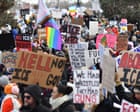
On July 1, 2026, hundreds of supporters packed the area outside the Diana E. Murphy United States Courthouse in downtown Minneapolis. They stood in solidarity as 14 of the 15 defendants walked inside for their formal arraignment. Every single one of them entered a plea of not guilty.
The defendants are ordinary people. They are your coworkers, your neighbors, and your friends. One of them, Emmett Doyle, spent the days following his not-guilty plea performing Irish protest ballads at a local dive bar. Another defendant, Treasure Thoreson, spoke directly to the crowd outside the courthouse before walking inside.
"This case we're here for today is all about intimidation and repression," Thoreson told the crowd. "The federal government is terrified of our ability to organize." She made it clear that she refuses to let federal prosecutors scare her into abandoning her community.
Monique Cullars-Doty, another prominent local activist who was indicted in a separate federal protest case earlier this year, spoke at the rally with a clear message for the city. She reminded everyone that while some organizers are temporarily tied up in complex legal battles, the responsibility to protect vulnerable neighbors now falls on the rest of the community.
The state wants isolation. The organizers are responding with deep, loud solidarity.
How to Protect Your Community and Your Rights
The prosecution of the Minnesota 15 reveals a massive shift in how federal law enforcement operates. If you plan on engaging in any form of political activism, you have to change how you operate. You cannot rely on outdated assumptions about what is safe or protected.
First, treat digital security as a foundational requirement, not an optional hobby. The government is actively combing through group chats to build conspiracy cases. Use encrypted communication apps like Signal, set your messages to auto-delete after a short period, and never use group chats to discuss logistics that could be construed as illegal. Keep your conversations focused strictly on the public information necessary for the immediate task.
Second, separate your public political speech from operational planning. The feds are explicitly using public social media accounts to link individuals together and establish a narrative of a shared "terrorist network." Be incredibly mindful of what you post, what you share, and who you tag online.
Third, build robust local legal defense funds before you need them. The government's goal is to bankrupt dissenters through endless legal fees and pretrial motions. Communities need to establish permanent, reliable infrastructure to fund bail and hire competent criminal defense attorneys who understand federal conspiracy laws.
The Minnesota 15 are facing the full weight of the federal apparatus because they dared to throw a wrench into a massive deportation machine. The government wants you to look at them and feel afraid. The only effective response is to look at them, learn from their legal battle, and double down on organizing your own neighborhood.
Federal prosecutors charge 15 with impeding agents during Minnesota immigration surge
This press conference footage reveals exactly how federal prosecutors are attempting to frame community organizing as a coordinated criminal conspiracy.