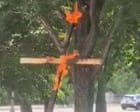
You don't expect to see a six-foot wooden cross engulfed in bright orange flames in the middle of a Tuesday afternoon. Especially not in downtown Chicago. Yet, around 2:30 p.m. on June 9, 2026, that's exactly what drivers and pedestrians witnessed right in the core of Grant Park.
The image was jarring. A blazing symbol of Jim Crow-era terror leaning casually against a park tree while traffic hummed along near Lake Michigan. If you enjoyed this piece, you should look at: this related article.
The Chicago Fire Department put the fire out quickly. Nobody was hurt. There wasn't any major property damage. But the psychological impact sent immediate shockwaves through a city where over a quarter of the population is Black.
Local police are hunting for a specific suspect, and the FBI has stepped in to help. But if we are being completely honest, we need to stop acting like this stuff comes out of nowhere. This isn't a historical ghost. It's a direct reflection of our current climate. For another look on this story, check out the recent coverage from Associated Press.
The Hunt for the Grant Park Arsonist
Chicago police didn't waste time putting out a community alert. They released images of a young man caught on camera fleeing the immediate area. He looks to be in his 20s, has dark hair, and was carrying a black backpack while wearing dark pants and white sneakers.
The Rev. Michael Pfleger, the longtime senior pastor at Saint Sabina on the South Side, put up a $10,000 reward for information leading to an arrest. He didn't mince words when talking to local news outlets. This wasn't a spur-of-the-moment prank. You have to build a six-foot wooden cross somewhere. You have to haul it into downtown Chicago, walk it into a highly visible public space, and douse it in accelerant.
It takes effort. It takes planning.
Mayor Brandon Johnson, who just got back from meeting the Pope in Vatican City, released a statement saying he was deeply disturbed. He promised that Chicago would remain safe and inclusive. That's the standard mayoral playbook. But local activists and residents are demanding more than just boilerplate statements about unity.
The Calculated Geography of Hate
You can't talk about this incident without talking about exactly where it happened. Grant Park isn't just a random patch of green grass. It's Chicago's front yard. It draws 20 million visitors every year who come to see the Buckingham Fountain or head up toward Millennium Park.
More importantly, Grant Park is where former President Barack Obama stood in 2008 to give his victory speech as the first Black president of the United States.
Choosing this specific spot in 2026 feels like a deliberate, ugly response to that history. It gets even sharper when you look at the calendar. Next week, global leaders and dignitaries are heading to Chicago's South Side to dedicate the Obama Center. The sprawling presidential library complex is scheduled to open to the public on Juneteenth, the national holiday celebrating the end of slavery.
The timing isn't a coincidence. It's a pushback.
Why the Terror Symbol Fails to Terrify
For older generations of Black Americans, a burning cross meant a targeted threat of immediate physical violence or death. The Ku Klux Klan used it to mark lawns, churches, and schools.
In a landmark 2003 ruling written by Justice Sandra Day O'Connor, the U.S. Supreme Court explicitly stated that the First Amendment allows states to ban cross burnings because the act is a uniquely virulent form of intimidation. The law recognizes that the symbol itself carries the weight of historic lynchings and organized terror.
Yet, the reaction on the ground in Chicago shows a shift in how this hatred is received. Gina Miranda Samuels, a faculty director at the University of Chicago's Center for the Study of Race, Politics and Culture, pointed out something crucial. While the sight brings a heavy wave of sadness, it doesn't necessarily trigger the visceral terror it did fifty years ago.
A burning cross in a massive public park doesn't make Black Chicagoans pack up and flee the city. It infuriates people. It disgusts them. But it doesn't break them.
Connecting the Dots in the Political Climate
Local community leaders aren't treating this as an isolated incident by a single troubled kid. They see a direct line between public displays of white supremacy and the current national landscape.
Frank Chapman, the executive director of the National Alliance Against Racist and Political Repression, explicitly blamed the broader political environment. He noted that the sweeping presidential pardons and dismissed cases for individuals who stormed the U.S. Capitol on January 6, 2021, sent a clear message to extremist groups. When people with a white supremacist mentality see others get a pass, they feel like they have a license to operate out in the open again.
We've seen a steady rise in bold, public hate displays across the North Shore and the wider Chicago area over the last couple of years. The Council on American-Islamic Relations (CAIR-Chicago) pointed out that these groups feel emboldened because political leaders frequently let divisive rhetoric fester without real consequences.
What Happens Right Now
If you have any information about the guy in the black backpack seen running from Grant Park on Tuesday afternoon, don't sit on it. Call the Chicago Police Department’s arson unit or submit an anonymous tip through the CPD online portal. You can also contact Saint Sabina regarding the active $10,000 reward fund.
Keep your eyes open during the upcoming Juneteenth celebrations and the Obama Center dedication events. The city is ramping up security around these high-profile locations, but community awareness matters more than police presence.
Don't let the shock of the image paralyze you. Talk to your neighbors, support local civil rights organizations, and show up for the community events happening across the South and West Sides this month. The best response to an old symbol of intimidation is a loud, stubborn refusal to be intimidated.