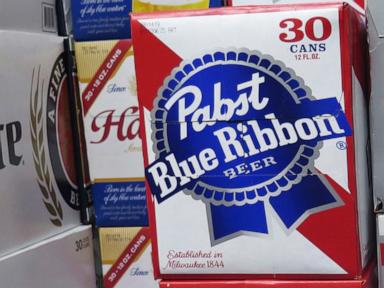
Some mysteries involve jewels locked in subterranean vaults or clandestine art swiped from dimly lit galleries under the cover of a thunderstorm. Others involve twenty thousand cases of cheap, iconic American lager vanishing into the humid ether of the Midwest, leaving behind only bewildered executives, empty pallets, and a corporate bounty large enough to buy a very respectable used sedan.
Let us trace the scent of stale hops and bureaucratic panic.
It starts with a ledger. A spreadsheet glowing in the harsh fluorescent hum of an office park in San Antonio, Texas, or perhaps a quiet corner of Los Angeles where Pabst Brewing Company orchestrates its blue-ribboned empire. Someone notices a discrepancy. A gap in the inventory. A ghost shipment. Twenty thousand cases of Pabst Blue Ribbon—millions of individual ounces of amber liquid, housed in aluminum cans adorned with that familiar red, white, and blue ribbon—simply ceased to exist on paper.
Or rather, they existed on paper just long enough to leave the loading dock, and then vanished into the vast American logistical labyrinth.
Imagine the truck driver. Let us call him Earl, though his name might just as well be a string of alphanumeric digits on a bill of lading. Earl climbs into the cab of a semi-truck on a Tuesday morning. The air smells of diesel exhaust and black coffee. Behind him sits a heavy, swaying wall of corrugated cardboard boxes. Millions of bubbles are trapped in those cans, vibrating against the aluminum walls, blissfully unaware that they are about to become protagonists in a strange corporate scavenger hunt. Earl shifts into gear, pulls out onto the interstate, and drives toward a destination that turns out to be a mirage.
The truck arrives. Or maybe it never does. That is the crux of the ghost shipment.
Logistics is the invisible circulatory system of modern civilization. We take it for granted that when we press a button on a glowing rectangle, a package appears on our porch three days later. We assume that when a brewery dispatches twenty thousand cases of beer, those cases land precisely where they are supposed to land: in the sticky-floored storage room of a distributor, behind the counter of a neighborhood dive bar, or stacked neatly in the refrigerated aisle of a suburban grocery store.
When that system fails on a massive scale, nobody panics immediately. Systems are built for error. Clerks re-file forms. Managers shrug and blame a miscommunication with a third-party freight broker. But weeks bleed into months, and the accounting books refuse to balance. Twenty thousand cases of beer do not simply evaporate. They weigh hundreds of thousands of pounds. They occupy cubic footage. You cannot hide a semi-truck full of cheap lager in a coat closet.
Yet, somewhere in the continental United States, those cans are sitting.
Pabst decided they had seen enough of the ledger discrepancy. They did what any modern institution does when faced with an absurd corporate puzzle: they went public, dangling a twenty-thousand-dollar reward like a fat worm over a dark lake, hoping something big would bite.
Twenty thousand dollars. It is a curious figure. Not enough to retire on a private island, but more than enough to motivate a rogue warehouse worker with a loose tongue or a freelance internet sleuth who spends their Tuesday nights cross-referencing satellite imagery of truck stops in Indiana.
The internet, naturally, treats a missing beer heist like a cross between a holy crusade and a sitcom plot. Social media feeds light up with amateur detectives imagining vast syndicates of geriatric hipsters hoarding millions of ounces of nostalgia in underground bunkers. People love the underdog mythology of Pabst. It is the beer of poets who cannot afford bourbon, of art school dropouts sketching in smoky corners, of blue-collar workers who want something cold and unpretentious at the end of a ten-hour shift.
To lose PBR is to lose a small piece of greasy-spoon Americana. It feels personal.
Consider the sheer physical footprint of the missing cargo. Twenty thousand cases means roughly 480,000 cans. If you stacked them end to end, they would stretch for miles, a glittering silver highway cutting across the asphalt. If you drank them at a rate of one per day, it would take you more than thirteen hundred years to finish the job. This is not a stray six-pack left behind in the trunk of a borrowed sedan. This is an entire ecosystem of liquid socialization that walked away on four wheels and never checked back in.
Where does cargo go when it goes rogue?
The answers usually lie in the murky, unglamorous underbelly of secondary markets and freight insurance fraud. Cargo theft is a quietly thriving enterprise. Criminal rings target everything from designer sneakers to frozen chicken wings, but beer occupies a special category. It is perishable, high-demand, easily liquidated, and untraceable once the cans are cracked open and swallowed. A stolen flat-screen television has a serial number. A stolen can of lager tastes the same whether it was purchased legally or fenced out of the back of a refrigerated trailer parked behind an abandoned strip mall in Ohio.
Perhaps the beer was diverted. A corrupt broker takes the dispatch, intercepts the driver, alters the paperwork, and redirects the trailer to a rogue distributor who asks no questions because the price is suspiciously sweet. The pallets are unloaded into a generic warehouse. New labels are slapped on, or the original ones are simply cleared out through cash-only outlets where regulators rarely tread.
Or perhaps it is more mundane. A clerical error compounded by a bankrupt trucking firm, leaving a trailer rotting in a dusty impound lot while local weeds grow up through the tires and the beer inside slowly bakes under a merciless July sun, turning flat and bitter.
Whatever happened, the twenty-thousand-dollar bounty transformed a boring corporate write-off into a living, breathing thriller. It invited the public into the normally closed-door world of supply chain forensics.
We live in a culture obsessed with closure. We hate loose ends. When a story begins with a missing shipment of beer and a hefty cash reward, our brains demand a third act. We want the warehouse door kicked open by local authorities. We want the smug realization of a detective who traced a paper trail of forged signatures across three state lines. We want to see the pallets dragged back into the light, even if the beer inside is by now a bit warm and shaken up.
The reality, of course, will likely be far quieter. A tip called in by a disgruntled former employee. A quiet settlement negotiated in the corner of a corporate law office in Chicago. No dramatic car chases, no cinematic shootouts behind the loading docks—just the slow, grinding machinery of corporate accountability catching up to a very large administrative headache.
Yet, for a brief moment, the imagination wanders.
Out there, somewhere in the vast, rumbling expanse of the American highway system, a ghost truck is still rolling. Or perhaps it is parked, silent and dark, waiting for someone to turn the right corner, read the right manifest, and find the mountain of blue ribbons hiding in plain sight.