The National Centre of Meteorology (NCM) just issued another advisory about rain, dust, and wind. Predictably, the collective heart rate of the Emirates has spiked. People are checking their window seals, cancelling dinner plans, and bracing for what the headlines treat as an impending meteorological apocalypse.
It is time to stop treating a standard low-pressure system like a black swan event. If you liked this article, you might want to read: this related article.
The "lazy consensus" pushed by regional news outlets is that any shift in the atmospheric pressure over the Arabian Sea is a crisis in the making. They thrive on the "alert" culture. They want you glued to the radar, terrified that your SUV might get a few spots of mud on it. But if you actually look at the mechanics of Middle Eastern weather patterns, you’ll realize that the real story isn't the rain. It’s our total inability to treat a desert climate like a desert.
The Desert Isn't Fragile
News outlets love to talk about "unstable weather conditions." This is a linguistic trick. In a region where 45°C is the baseline for four months of the year, a localized thunderstorm isn't "instability"—it’s a vital, necessary reset. The NCM isn't warning you because the sky is falling; they are warning you because the infrastructure hasn't caught up to the reality of the climate. For another perspective on this story, see the latest coverage from Reuters.
We treat rain as an anomaly. It isn't. Historically, the Shamal winds and the convective clouds that roll off the Hajar mountains are as much a part of the UAE's DNA as the sand itself. The alarmism is a byproduct of a city built for a postcard, not for the elements.
Your Fear of Dust is a Management Failure
The advisory mentions "dust and blowing sand reducing visibility." The reaction? People stay indoors and complain about their balconies getting dirty.
I have watched logistics firms and construction giants lose millions in productivity every time a dust warning pops up because they haven't built "weather-agnostic" workflows. They treat a sandstorm as an Act of God that justifies a total shutdown. A sandstorm in the Rub' al Khali is not a surprise. It is a Tuesday.
If you are a business owner or a resident letting a 40-knot wind derail your week, you aren't a victim of the weather. You are a victim of poor planning. The "contrarian" truth here is that we don't need fewer alerts; we need thicker skin and better drainage.
The Cloud Seeding Elephant in the Room
Whenever these advisories go out, the chatter immediately turns to cloud seeding (salt flaring). The public loves to blame—or credit—the NCM's Beechcraft King Air planes for every drop.
Let's get the science straight. Cloud seeding does not "create" rain out of thin air. It enhances what is already there. If there isn't a moisture-heavy cloud mass moving in from the Gulf of Oman or the Red Sea, no amount of salt pellets will make it pour.
The media plays into this "man vs. nature" narrative because it gets clicks. It makes for a great story: Scientists Command the Clouds! In reality, the seeding program is a marginal gain strategy. It targets a 15% to 30% increase in precipitation from existing clouds. When we see a massive "weather alert" for next week, that is a large-scale synoptic system. It’s physics. It’s the movement of the Intertropical Convergence Zone. It isn't a button someone pushed in an office in Abu Dhabi.
Why We Overreact to "Moderate" Rain
The competitor article will tell you to "drive with caution." I will tell you why you actually crash.
It isn't the water. It’s the oil.
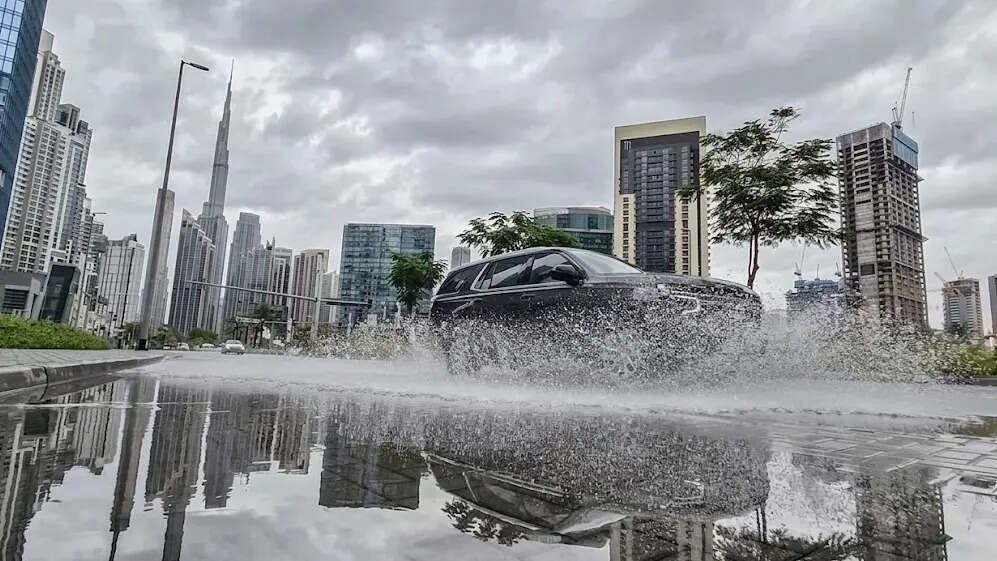
After six months of dry heat, the asphalt on the E11 and E311 becomes a petri dish of leaked engine oil, tire rubber, and fine silt. When the first ten minutes of rain hit that surface, it creates a lubricant more effective than anything you’d find in a laboratory.
$$\mu_{wet} < \mu_{dry}$$
The friction coefficient drops off a cliff. People crash because they drive on wet roads with the same aggressive tailgating habits they use on bone-dry pavement. They blame the "unprecedented" weather. No. You crashed because you ignored basic Newtonian physics. The weather was just the catalyst that exposed your lack of technical driving skill.
The "Stay Home" Fallacy
Every time the NCM issues a yellow or orange alert, the immediate impulse is to hunker down. This has created a "fragile" economy that shudders at the sight of a gray sky.
Imagine a scenario where we actually leaned into the rain. In London or Seattle, life doesn't stop for a drizzle. In Dubai, a puddle on the shoulder of the road causes a five-mile tailback because everyone slows down to film it for their Instagram stories.
The disruption isn't caused by the wind or the rain. The disruption is caused by the spectacle. We have turned the weather into a digital content event rather than a natural occurrence.
Stop Checking the Forecast and Start Checking Your Gutters
If you want actionable advice that isn't "carry an umbrella," here it is:
- Verify your drainage capacity. Most villas in this country were built during dry spells by contractors who didn't prioritize runoff. If your roof collects water, a "moderate" rain alert is a structural threat.
- Upgrade your tires. Stop buying the cheapest rubber available just because it’s hot. You need compounds that can handle the thermal expansion of the road and the hydroplaning risks of a flash flood.
- Ignore the hyperbole. When the advisory says "strong winds," it means you should move your light patio furniture inside. It doesn't mean the world is ending.
The UAE is a global hub of innovation and resilience. We have built skyscrapers in the sand and islands in the sea. It is embarrassing that we still let a forecast for "partly cloudy with a chance of rain" send the entire population into a tailspin of frantic WhatsApp forwarding.
The weather isn't the problem. Our collective obsession with the "alert" is. Next week, it will rain. The wind will blow. Dust will settle on your car. You will survive.
The clouds are coming. Get over it.