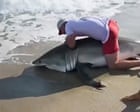
A viral video of an angler releasing a great white shark off the coast of Nantucket recently captured the internet's attention. The footage shows a startled fisherman clipping the line to free a massive apex predator in shallow waters just feet from the beach. While social media treats these encounters as shocking, anomalies of nature, the reality is far more calculated. Great white sharks are returning to the New England coastline in numbers not seen in generations. This is the direct result of a massive ecological rebound that is moving closer to crowded public beaches every summer.
The incident on Nantucket highlights a growing intersection between marine conservation success and human recreation. For decades, seeing a white shark near a Massachusetts beach was a rare event. Today, it is an seasonal certainty. To understand why these encounters are escalating, we have to look at the strict federal protections enacted decades ago and a booming prey population that acts as an irresistible dinner bell.
The Gray Seal Rebound Driving the Predators Inshore
The story of the great white shark's return actually begins with a completely different animal.
In 1972, the United States passed the Marine Mammal Protection Act. Before this legislation, gray seals were hunted nearly to extinction in New England, viewed by fishermen as pests that stole catch and ruined nets. The protections worked extraordinarily well. Over the last fifty years, the gray seal population exploded, establishing massive colonies on Monomoy Island, Muskeget Island, and the beaches of Nantucket and Cape Cod.
Sharks go where the food is. Gray seals are the preferred high-fat prey for mature great white sharks. As seal colonies expanded from isolated sandbars to mainland beaches, the sharks followed them right into the surf zone.
This creates a geographic bottleneck. Seals spend their time resting on the sand and swimming in the shallow, trough-like channels running parallel to the shore. Great whites hunt by cruising these exact same shallow trenches, sometimes in water less than ten feet deep. When an angler casts a line from a Nantucket beach, they are not fishing in an empty ocean. They are dropping bait directly into a highly active, nearshore hunting ground.
The Reality of Beach Angling in a Modern Shark Sanctuary
Many beachgoers assume great white sharks remain miles out in the open ocean. The data collected by marine biologists tells a completely different story.
Acoustic tracking tags attached to hundreds of Atlantic great whites show these predators routinely patrol within hundreds of yards of popular swimming areas. When surf casters target striped bass or bluefish from the beach, the scent of bait and the vibrations of a struggling fish act as a beacon.
The mechanics of a beach hookup with a white shark are dangerous for both the angler and the animal.
- Gear Failure: Standard surf fishing tackle is not designed to hold a one-ton apex predator. Lines snap instantly, leaving heavy steel hooks and trailing steel leaders lodged in the shark's mouth.
- Proximity Hazards: Landing a shark of that size requires dragging it into the breaking surf. In shallow water, a thrashing shark can cause severe injury to anyone standing nearby, even if the animal is not actively trying to bite.
- Physiological Stress: Sharks fight with everything they have. The intense exertion causes lactic acid to build up in their muscles, a condition that can be fatal to the fish even if it is successfully released.
The angler in the viral video did the right thing by cutting the line quickly rather than trying to drag the animal onto the dry sand for a photo. Attempting to land a white shark is illegal under both state and federal laws, which mandate immediate release without removing the animal from the water.
Conservation Triumphs Create Public Safety Dilemmas
The return of the great white shark is an undeniable victory for marine biologists. Ecosystems require apex predators to keep prey populations healthy and prevent overgrazing on lower levels of the food web. Yet, this biological success story creates a complicated public safety puzzle for coastal towns that rely heavily on summer tourism.
Nantucket and Cape Cod now boast some of the highest concentrations of white sharks in the world during the summer months. Local municipalities have been forced to adapt quickly.
Shark Safety Infrastructure Escalation:
2010: Basic warning signs posted at beach entrances.
2018: Spotter planes deployed; introduction of the Sharktivity tracking app.
2026: Satellite-linked acoustic receivers providing real-time beach alerts.
Towns have invested heavily in emergency response kits, placing bleeding-control supplies at remote beach access points. Lifeguards are trained to scan the water not just for struggling swimmers, but for the distinct shape of a predatory fin moving through the swells.
The gray area lies in public perception. For a century, humans viewed the ocean near the beach as a backyard swimming pool. Coexisting with a recovered wild ecosystem requires a fundamental shift in behavior. Swimmers must avoid entering the water at dawn and dusk, stay away from seal herds, and understand that wading past waist-deep water means entering a wild predatory environment.
The Changing Economics of the New England Coastline
The influx of sharks has shifted the local maritime economy in unexpected ways. While charter boat captains face challenges with sharks stealing hooked fish before they can be boated, a new eco-tourism sector has emerged.
Sightseeing boats now take tourists out specifically to catch a glimpse of a great white fin slicing through the water. Merchandise featuring shark logos fills boardwalk gift shops. An animal that was once feared and targeted for eradication has become a major economic driver for the region.
This economic benefit comes with a strict caveat. A single high-profile negative encounter can empty a beach community for weeks, hurting hotels, restaurants, and local shops. Managing the risk is a delicate balancing act that requires constant communication between scientists, local officials, and the public.
Redefining the Rules of the Surf
As the population of both seals and sharks stabilizes at historically natural levels, the rules of coastal recreation must change permanently. Surf fishing from popular swimming beaches during peak summer months is becoming an increasingly volatile activity. Anglers must expect that large predators are sharing the water, moving silently through the breakers just beyond the foam.
The viral footage from Nantucket was not a bizarre, one-off fluke. It was a clear look at the new normal for the New England coastline. Humans are no longer stepping into a sterile environment when they enter the Atlantic surf; they are stepping into a fully functioning, wild ecosystem that has successfully healed itself.