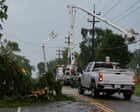
Severe convective storms across the United States Midwest recently severed power infrastructure for approximately 540,000 residential and commercial properties. Standard news coverage frames such events as meteorological anomalies, treating widespread blackouts as unpredictable acts of nature. This perspective fails to account for the deterministic mechanics of electrical grid architecture under localized extreme weather vectors. Power delivery networks operate on strict load-balancing equilibria. When high-velocity straight-line winds and localized microbursts exceed the structural safety margins of overhead distribution assets, cascading failures occur not by chance, but by physical necessity.
Understanding why half a million customers lose power requires deconstructing the vulnerabilities inherent in mature transmission and distribution systems. Grid failure during storm events is a product of three primary variables: mechanical asset exposure, radial network topology, and vegetation management thresholds. If you liked this article, you might want to look at: this related article.
The Mechanics of Structural Asset Failure
Overhead distribution lines represent the primary point of failure during severe weather events. Unlike high-voltage transmission lines, which are engineered with rigorous safety factors and wide rights-of-way, local distribution poles and conductors weave through dense environments characterized by high wind resistance and spatial constraints.
When wind velocities surpass forty miles per hour, dynamic pressure on utility poles increases exponentially rather than linearly. Wooden utility poles, which constitute a significant percentage of legacy mid-tier distribution infrastructure, degrade over time due to environmental weathering, insect infestation, and internal rot. The bending moment exerted by wind-loaded conductors strung between poles creates shear stress at the groundline. For another angle on this story, check out the recent coverage from USA Today.
Wind Velocity Increases -> Exponential Dynamic Pressure -> Bending Moment Exceeds Groundline Shear Threshold -> Pole Fracture
Conductor clashing represents a secondary mechanical failure mode. When wind induces high-frequency oscillations in unshielded parallel lines, phase conductors make physical contact. This triggers immediate short circuits, activating automatic circuit protection devices. While these protective relays prevent catastrophic equipment meltdowns and transformer fires, they intentionally de-energize circuits, turning a localized mechanical strike into a widespread regional outage.
The Topology Problem: Radial versus Meshed Networks
The scale of a blackout is largely determined by network architecture. Most distribution systems in the Midwest utilize a radial topology. In a radial design, electricity flows outward from a single substation through a branching tree of feeders to end-users.
The structural flaw of the radial model is its complete lack of redundancy. Every customer on a given lateral feeder depends on a single path of continuity. If a single tree limb brings down a primary conductor near the substation, every property downstream loses power regardless of whether their local service drop is undamaged.
Transmission systems, by contrast, utilize meshed networks where power can reroute automatically around damaged nodes. Distribution networks lack this self-healing capability at the neighborhood level. Restoration requires manual field crews to physically isolate damaged segments, reclose upstream switches, and backfeed power where sectionalizing equipment permits.
Radial Topology:
Substation ===> Primary Feeder ===> Transformer ===> Customer A
                                 ===> Transformer ===> Customer B (Single point of failure cuts entire branch)

Meshed Topology:
Substation ===> Node 1 <---> Node 2 ===> Customer (Alternative pathways exist for current rerouting)
This structural dependency creates massive restoration bottlenecks. Utilities cannot dispatch crews simultaneously to every fault site. Instead, they must follow a strict triage protocol:
- Repair transmission lines and substations to restore bulk power to millions.
- Clear primary feeders that serve critical infrastructure such as hospitals and water treatment plants.
- Fix secondary taps and individual service drops feeding residential clusters.
Vegetation Encroachment and the Cost Function of Maintenance
The single largest external contributor to distribution grid failure is tree contact. Trees interact with power lines through two distinct mechanisms: structural impacts during high winds and electrical contact causing ground faults.
Utility companies operate under a continuous optimization problem regarding vegetation management. The cost function of pruning involves balancing the capital expenditure of aggressive clearance against the probabilistic risk of storm-induced outages.
$$Total Cost = Capital_{Pruning} + Probability(Storm) \times Impact(Outage)$$
Many utilities historically underfunded routine clearance cycles to maintain short-term operating margins. When severe storms hit, unmanaged trees adjacent to rights-of-way act as mechanical levers. Wind forces canopy sections into conductors, or uproots entire root balls that pull down utility poles.
Subsurface soil saturation exacerbates this vulnerability. Extended heavy rainfall immediately preceding high winds softens the soil matrix surrounding tree roots. Anchorage strength drops precipitously, allowing winds to uproot trees that would otherwise withstand equivalent velocities in dry soil conditions.
Quantifying the Economic Ripple Effects
A 540,000-customer outage generates immediate economic friction that propagates beyond the utility balance sheet.
Industrial and commercial operations experience direct output cessation. Continuous-process manufacturing facilities suffer catastrophic material loss when power cuts mid-cycle. Cold-chain logistics providers face inventory spoilage within hours unless backup generation is deployed instantly.
Retail businesses lose transactional volume, though this loss is frequently shifted rather than destroyed. The primary unrecoverable economic cost resides in labor productivity loss and emergency response expenditures. Municipalities must deploy police departments to manage unlit intersections, while emergency medical services experience surges in call volume related to backup generator carbon monoxide poisoning and heat stress during summer outages.
Strategic Resource Allocation for Grid Hardening
Mitigating future catastrophic distribution failures requires a shift from reactive repair models to preemptive architectural hardening. Utilities operating in storm-prone corridors must evaluate three capital allocation strategies based on return on investment and structural impact.
Undergrounding distribution lines eliminates wind and tree exposure entirely. However, the capital expenditure per mile for undergrounding is frequently five to ten times higher than overhead construction, and repair times for underground faults, when they do occur, are significantly longer and more labor-intensive. Consequently, complete undergrounding is economically unviable across sprawling suburban and rural service territories.
Targeted sectionalization represents a higher-ROI intervention. By installing smart automated reclosers and remote-controlled switches along radial feeders, utilities can automatically isolate faulted segments and reroute power to healthy sections via alternative distribution ties, shrinking the radius of affected customers from tens of thousands to a few hundred.
Simultaneously, predictive vegetation management driven by LiDAR mapping and machine learning models allows asset managers to identify high-risk trees based on species growth rates, health indexes, and proximity to high-capacity lines. Prioritizing clearance budgets based on algorithmic risk assessment rather than fixed calendar cycles reduces storm-induced fault frequencies without inflating overall operational expenditures.
The recurrence of widespread blackouts in the Midwest demonstrates that legacy distribution models are mismatched with intensifying weather patterns. Addressing this vulnerability requires treating grid resilience not as an insurance problem, but as a core engineering challenge defined by asset redundancy, topological flexibility, and rigorous mechanical tolerances.