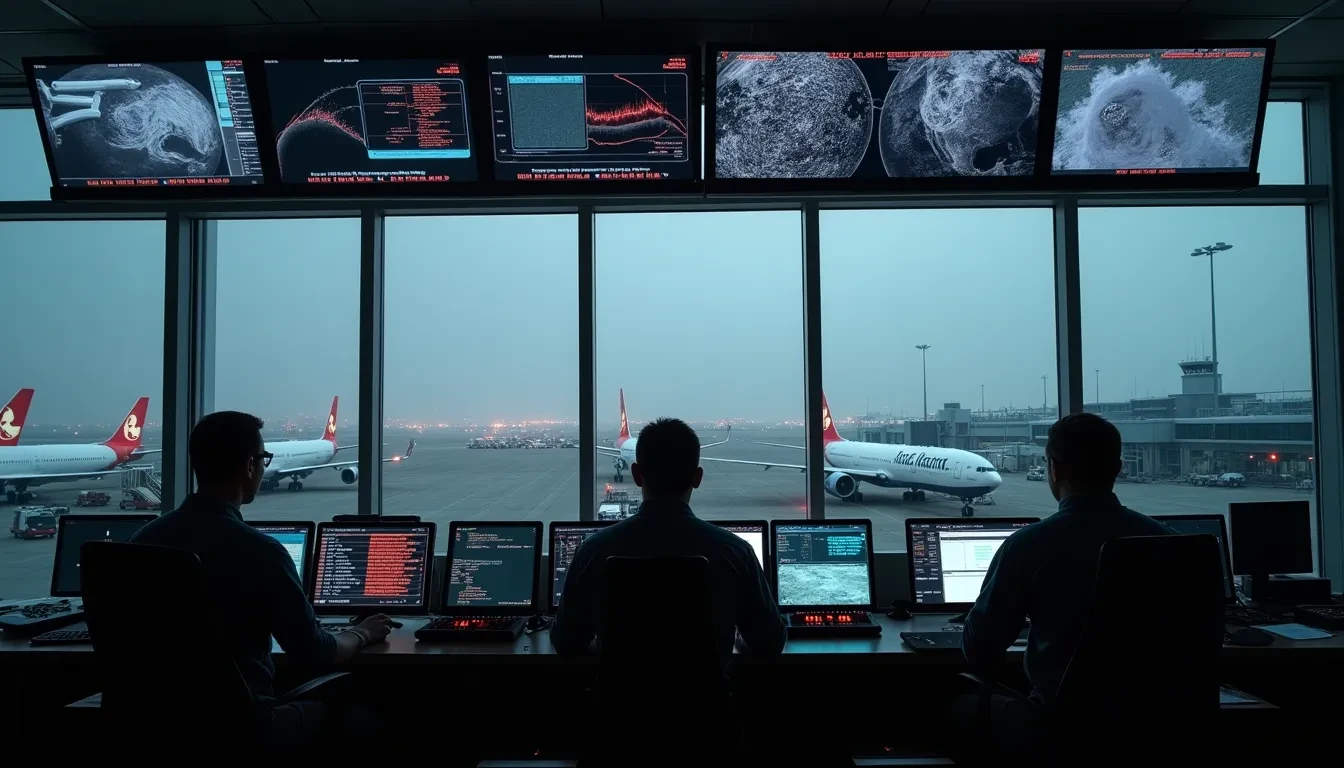
An Air Canada Airbus A321-200, carrying 163 passengers, sat motionless on the Newark Liberty International Airport tarmac as a ground service vehicle slammed into its fuselage. The impact, which occurred during the critical pre-flight window for Flight AC761 to Toronto, left a visible gash in the aircraft’s skin and grounded the flight indefinitely. While no injuries were reported among the passengers or crew, the collision represents a staggering failure of basic airport coordination. This was not a freak weather event or a complex mechanical breakdown. It was a failure of the "human-machine interface" in one of the most tightly regulated environments on earth.
When a multi-million-dollar jet is sidelined by a slow-moving utility truck, the industry tends to point fingers at the driver. But the reality is far more systemic. Newark, like many congested hubs in the Northeast corridor, is currently a pressure cooker of labor shortages, aging infrastructure, and a relentless push for faster "turns"—the time it takes to empty, clean, and reload a plane.
The Physics of a Tarmac Collision
Modern commercial aircraft are marvels of engineering, designed to withstand extreme turbulence and high-altitude pressure differentials. However, their aluminum or composite skins are surprisingly vulnerable to blunt force trauma at ground level. A service vehicle doesn’t need to be traveling at high speed to cause structural damage that requires weeks of repair.
The impact at Newark struck near the cargo hold area. In the aviation world, even a minor dent must be treated as a potential structural compromise. Mechanics have to perform non-destructive testing, often using ultrasound, to ensure the internal "ribs" of the plane haven't been bent. If the pressurized seal of the cabin is at risk, the plane cannot fly. Air Canada was forced to deplane everyone, a logistical nightmare that ripples through the entire North American flight schedule.
The Invisible Crisis of Ground Handling
While pilots and air traffic controllers undergo years of rigorous training and mental health screenings, the "below-wing" workforce—the people driving the tugs, catering trucks, and fuel hydrants—often operates under vastly different conditions. This is the soft underbelly of the travel industry.
Since the 2020 industry contraction, airlines and their third-party contractors have struggled to maintain a veteran workforce. High turnover rates mean that on any given day, a significant percentage of the vehicles moving around a $100 million aircraft are operated by individuals with less than six months of experience. They are working in high-noise, high-stress environments where a three-minute delay can result in a formal reprimand.
- Communication Gaps: In many cases, ground vehicle drivers are not on the same radio frequency as the cockpit or the ramp tower. They rely on visual cues that are easily missed in the glare of Newark’s industrial lighting.
- The "Turn" Pressure: Airlines lose money every minute a plane sits at a gate. This creates an unspoken incentive to cut corners, moving vehicles closer to the aircraft before it has come to a complete stop or before the "chocks" are set.
- Physical Fatigue: It is common for ground crews at major hubs to work double shifts. A driver operating a 10-ton vehicle with blurred vision and slowed reflexes is a recipe for the exact type of metal-on-metal contact we saw with AC761.
Newark as a Case Study in Congestion
Newark Liberty (EWR) consistently ranks as one of the most difficult airports to navigate, both in the air and on the ground. Its layout is a relic of an era when planes were smaller and flight frequencies were lower. Today, the ramp areas are tight, leaving very little margin for error when a pilot is taxiing or a driver is maneuvering a belt loader.
The Federal Aviation Administration (FAA) has been tracking "runway incursions" and "ramp incidents" with increasing scrutiny. While most public attention goes to near-misses between two planes on a runway, the frequency of ground vehicle strikes is rising. These incidents are often categorized as "non-consequential" because they don't result in fire or loss of life, but the economic cost is massive. For Air Canada, the cost isn't just the repair bill; it’s the hotel vouchers for 163 people, the lost revenue from a grounded jet, and the long-term impact on their safety rating.
The Myth of the Automated Airport
There is a common misconception that technology has solved these proximity issues. We have cars that can parallel park themselves and sensors that beep when you get too close to a curb, yet the vast majority of airport ground equipment is decades old. Most baggage tugs and catering trucks lack basic proximity sensors or automatic braking systems that could prevent a collision with an aircraft.
Implementing these safety features across a fleet of thousands of vehicles is an expense that many ground handling companies—operating on razor-thin margins—refuse to bear unless mandated by federal law. The FAA has been slow to move on ground vehicle standards, focusing instead on cockpit technology. This leaves a gap where a $15,000 used truck can take down a flagship jet because of a simple blind spot.
The Passenger’s Stake in the Scuffle
For the person sitting in 12A, a ground collision is an infuriating mystery. You feel a slight jolt, or perhaps you see a truck pull away too quickly from your window. Then comes the captain’s voice, often vague, announcing a "minor mechanical issue."
This lack of transparency is a deliberate choice by airlines to avoid panic, but it obscures a vital truth about modern travel. Your safety is just as dependent on the person loading the suitcases as it is on the person flying the plane. When the industry treats ground operations as a low-skill, high-turnover sector, incidents like the Newark collision become inevitable rather than accidental.
Breaking the Cycle of Tarmac Errors
Fixing this requires a shift in how we value the airport ramp. We need more than just an investigation into one driver at Newark.
- Mandatory Proximity Sensors: All vehicles operating within 50 feet of an aircraft should be equipped with active braking systems that trigger when an obstacle is detected.
- Standardized Training Records: A national database for ground handlers would ensure that workers who are fired for safety violations at one airport can’t simply move to another terminal and start over.
- Real-Time Telemetry: Just as flight data recorders track every move of a plane, ground vehicles should have "black boxes" that monitor speed and proximity violations.
The Air Canada incident is a warning shot. We are operating a high-tech aviation network on the back of a low-tech, overworked ground support system. Until the investment in ramp safety matches the investment in engine efficiency, the next collision is already being timed by a stopwatch at a gate near you.
Check the tail number of your next flight on a tracking app; if that aircraft has a history of "unscheduled maintenance" following a gate arrival, you are looking at the scars of an industry that is moving too fast for its own good.