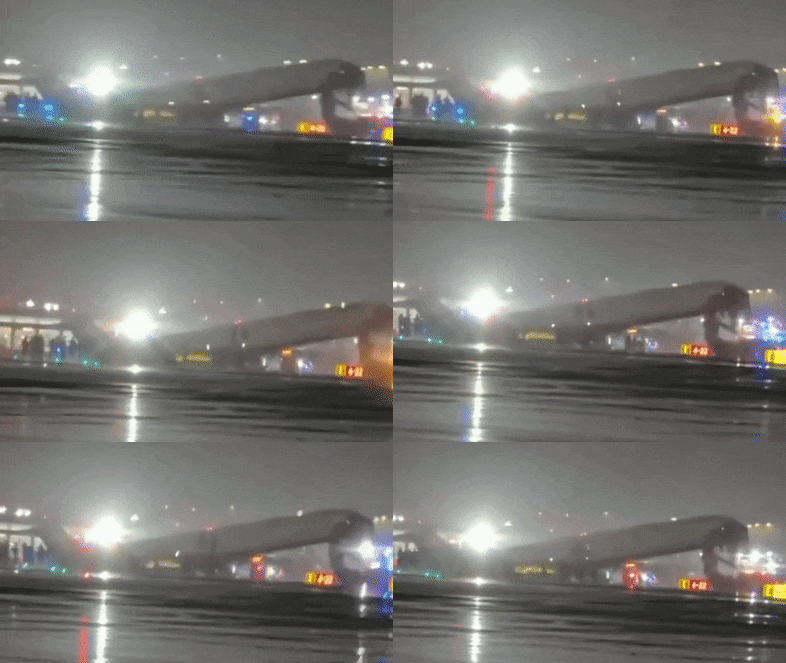
Ground collisions aren't just a headache for airlines. They’re a logistical nightmare for you. When an Air Canada plane hits a ground vehicle at New York’s LaGuardia Airport, the ripple effect spreads across the entire East Coast corridor. It isn't just about a dented wing or a cracked windshield on a tug. It's about the hours you spend sitting on the tarmac because a single ground handling error triggered a safety grounding.
LaGuardia is notorious for its cramped quarters. It’s essentially a postage stamp with two runways and thousands of moving parts. When an Airbus A321 or a Boeing 737 tangles with a baggage loader or a fuel truck, the Federal Aviation Administration (FAA) doesn't just "buff it out." They shut down the immediate area. They pull the flight crew for interviews. They inspect every inch of the airframe.
You’re likely reading this because you’ve seen the reports of the latest Air Canada mishap. Or maybe you’re stuck in Terminal B right now. Here is the reality of why these incidents happen and how they actually impact your travel.
The LaGuardia Tightrope Walk
Most people don't realize how little room for error exists at LGA. It’s one of the most congested airports in the United States. Pilots often describe taxiing there as trying to park a semi-truck in a grocery store aisle. The "report" of an Air Canada plane hitting a ground vehicle usually points to a breakdown in communication between the cockpit and the ground crew.
Ground handlers are under immense pressure. Turnaround times are shrinking. Airlines want planes back in the air in 45 minutes or less. In that window, crews must offload bags, refuel, cater the cabin, and board 150 people. One distracted driver or one misunderstood hand signal from a wing walker results in metal-on-metal contact.
I’ve seen how these investigations play out. The National Transportation Safety Board (NTSB) often finds that "low-speed ground incidents" are rising even as mid-air safety improves. It’s the "hangar rash" of the commercial world. It sounds minor, but for a pressurized metal tube traveling at 500 miles per hour, there is no such thing as a minor dent.
What Happens to Your Flight After a Wing Strike
If you're on a plane that clips a vehicle, your day is done. The aircraft is immediately out of service. Even if the damage looks like a scratch to the naked eye, the structural integrity of the wing or fuselage is now a legal question mark. Air Canada, like any major carrier, has to follow strict maintenance protocols.
- Immediate Deplaning: You aren't going anywhere on that tail number.
- Re-accommodation Chaos: At a crowded hub like LaGuardia, finding a spare plane is nearly impossible.
- The Inspection Loop: Mechanics have to x-ray the impacted area for internal stress fractures.
Safety isn't negotiable. You might feel frustrated that your flight to Toronto or Montreal was canceled over a "fender bender," but the alternative is far worse. Aviation history is littered with examples of "minor" ground damage leading to catastrophic failures at high altitudes. If that skin is breached, the cabin pressure could fail. No pilot is taking that risk.
Why Ground Handling is the Weak Link in Aviation
We spend billions on automated flight decks and advanced radar. Yet, we still rely on a guy in a neon vest and a tug to get the plane to the runway safely. This is the irony of modern flight. The most dangerous part of your journey often happens at three miles per hour.
Staffing shortages haven't helped. Since 2022, the industry has struggled with high turnover in ground operations. New hires are learning on the fly in high-stress environments like LaGuardia. When you combine inexperienced crews with the physical constraints of New York’s infrastructure, these reports become inevitable.
Air Canada has a solid safety record, but they’re at the mercy of the ground contractors at every airport they serve. It doesn't matter how great the pilots are if the tug driver isn't paying attention.
The Economic Cost of a Tarmac Tangle
A single ground collision can cost an airline upwards of $1 million. That isn't just the repair bill. It's the cost of hotel vouchers for 180 stranded passengers. It's the lost revenue from the aircraft being out of rotation for two weeks. It's the fines from the airport authority.
Ultimately, these costs find their way into your ticket price. When insurance premiums for ground handlers go up, the "airport improvement fees" and "carrier-imposed surcharges" follow. We all pay for that clipped wing.
How to Protect Yourself from Ground Delay Chaos
You can't control whether a fuel truck hits your plane. You can control how you react to it. If you hear a thud or see ground crews scurrying around the wing, don't wait for the announcement.
Open your airline’s app immediately. Start looking for the next available flight. By the time the pilot comes over the intercom to explain the "minor incident," three hundred other people will be trying to book the same ten seats on the next departure.
Check your credit card benefits. Many premium cards offer trip delay insurance that kicks in the moment a mechanical or equipment issue grounds your flight. This covers your meals and that expensive New York hotel stay while the airline's "recovery team" tries to find a bus or a new plane.
Keep your carry-on light. In these scenarios, you often have to move quickly between gates or terminals. If your plane is stuck on the tarmac after a strike, you might be there for a while. Ground incidents often require "sterile" scenes where no one can leave until the initial report is filed. Carry a portable charger and a bottle of water. You're going to need them.
The report of an Air Canada plane hitting a vehicle at LaGuardia is a reminder that the "safe" part of your trip isn't over until the wheels are up. Pay attention to the ground. If something looks too close to the wing, it probably is.