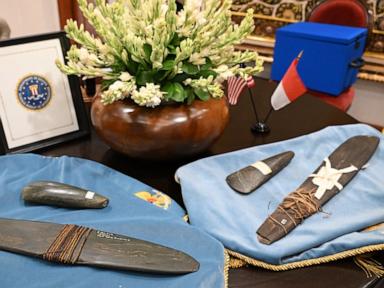
When law enforcement heads meet heads of state, the conversation usually revolves around counterterrorism, cybercrime, or transnational syndicates. But on July 22, 2026, a high-level meeting in Jakarta took a surprisingly tangible turn. FBI Director Kash Patel handed over a collection of smuggled Papuan cultural artifacts directly to Indonesian President Prabowo Subianto at his residence in Kertanegara.
The handed-over items included polished stone ax heads and ceremonial objects tied to the Dani, Asmat, and Lake Sentani communities. To an outsider, stone axes might look like simple historical tools. In reality, they are sacred heirlooms. For highland tribes like the Dani, these axes represent social status, served as essential currency in traditional marriage exchanges, and preserved tribal lineages across generations. Seeing them illicitly trafficked across international borders and funneled into private Western collections wasn't just a property crime—it was a direct hit to Indonesia's cultural identity.
This repatriation wasn't an isolated gesture of diplomatic goodwill. It highlights a massive, ongoing shift in how law enforcement agencies across the globe handle black-market antiquities and cultural sovereignty.
How Stolen Antiquities End Up in American Living Rooms
The black market for stolen art and cultural property is a multi-billion-dollar enterprise. How do ancestral artifacts from remote regions in Papua end up on the opposite side of the globe?
It usually follows a predictable, dark pathway:
- Local looting: Organized networks target vulnerable archaeological sites or rural indigenous villages where law enforcement presence is thin.
- Forged paperwork: Smugglers create fake provenance documentation—essentially paper trails claiming the items were legally acquired decades ago or exported before strict international conservation laws took effect.
- Laundering through illicit dealers: Infamous traffickers, such as the late Bangkok-based dealer Douglas Latchford, acted as middle agents. Latchford famously laundered looted Southeast Asian antiquities into high-profile private collections, auction houses, and prestigious museums for decades before his 2019 indictment by federal prosecutors.
- Private acquisition: Wealthy collectors buy the items, sometimes oblivious to their illegal origins, other times turning a blind eye until law enforcement comes knocking.
In this case, intensive provenance research conducted jointly by the FBI and Indonesia's Ministry of Culture proved beyond doubt that these Papuan artifacts were illegally trafficked out of the country.
A Broader Crackdown on Southeast Asian Art Trafficking
This specific handover comes on the heels of several major legal victories against international smuggling rings. Just weeks earlier, U.S. Attorney Jay Clayton and Homeland Security Investigations announced the return of two 8th-century bronze Buddhist sculptures of Avalokiteshvara to Indonesia. Those rare statues had been stolen directly from Indonesian archaeological sites, funneled through Latchford’s network, and sold to an American collector before being identified and surrendered.
Indonesia's Culture Minister, Fadli Zon, noted that recovering these items is fundamentally about restoring "cultural sovereignty." For decades, nations in the Global South watched their heritage stripped away—first through colonial exploitation, and later through sophisticated criminal smuggling networks.
Now, governments are aggressively pushing back. Indonesia has ramped up pressure not just on private collectors, but also on former colonial powers like the Netherlands to return tens of thousands of looted items.
What Happens to the Returned Papuan Artifacts Next
Unlike items that vanish into government archives, these repatriated stone axes and ceremonial pieces are headed straight to the public eye. According to the Ministry of Culture, the artifacts will be exhibited at Indonesia’s National Museum in Jakarta.
Putting these objects on public display serves two crucial purposes:
- Educating the public: It gives Indonesians direct access to ancient Papuan heritage that was almost lost forever.
- Deterring future looting: High-profile repatriations signal to private buyers worldwide that buying unvetted antiquities carries massive financial and legal risks.
If you are a collector, art enthusiast, or museum professional, the message from law enforcement is clear: the era of "no questions asked" art collecting is dead.
How to Verify the Integrity of Historical Collectibles
If you ever purchase ancient art or ethnic artifacts, protect yourself and history by taking these concrete steps:
- Demand verifiable provenance: Never buy an item without documented ownership history stretching back before major international treaties like the 1970 UNESCO Convention.
- Check red-flag registers: Search the Art Loss Register or the Interpol Stolen Works of Art Database before committing to a high-value purchase.
- Report suspicious sales: If an seller cannot prove how an item left its country of origin, contact specialized law enforcement units like the FBI's Art Crime Team immediately.
The return of Papua's treasures to Jakarta isn't just a political photo-op—it's proof that stolen history can, and will, find its way back home.